
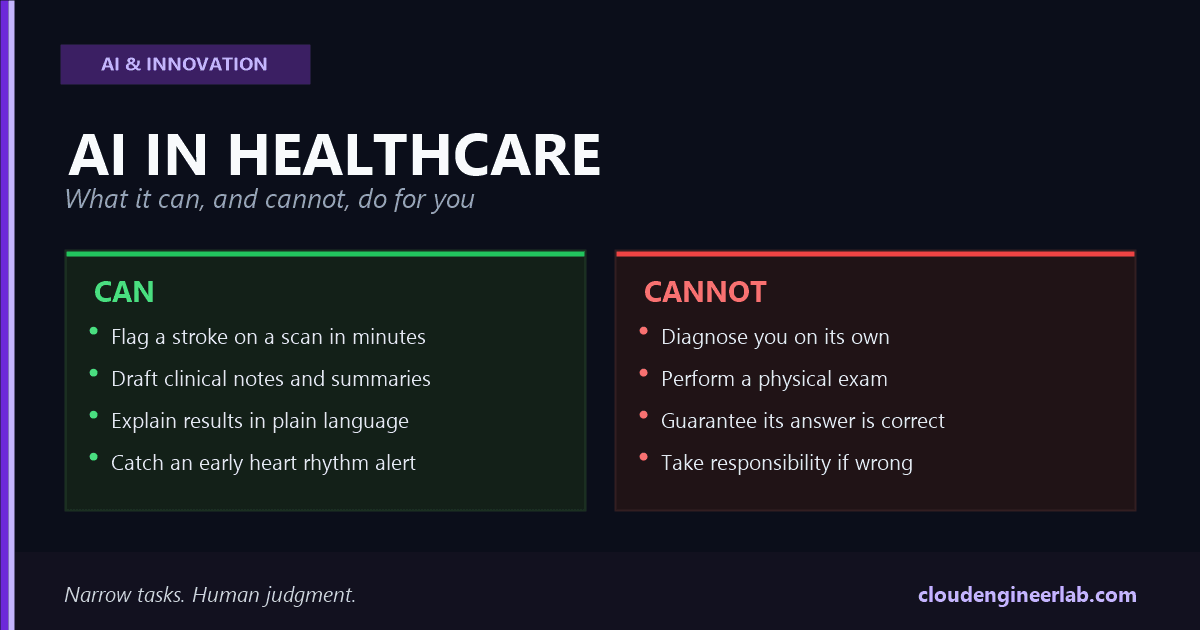
AI in Healthcare: What It Can (and Cannot) Do for You
AI can flag a stroke on a scan in seconds and still get a diagnosis wrong with total confidence. Here's exactly where it helps, and where it can't be trusted alone.
In 2018, an AI system called IDx-DR became the first FDA-authorized autonomous diagnostic tool allowed to tell a patient they likely have diabetic retinopathy, without a doctor reviewing the image first. It scans a retinal photograph and gives a result in under a minute, work that used to require a specialist appointment.
Around the same time, IBM's Watson for Oncology, once marketed as a system that would help doctors choose cancer treatments, was quietly wound down from many of its hospital partnerships after reports that it sometimes recommended treatments that were unsafe or not aligned with real clinical guidelines, built largely on synthetic training cases rather than enough real patient data.
Both of those are real AI healthcare stories. One became a genuine clinical tool still in use today. The other became a cautionary tale taught in medical AI courses. The difference between them is exactly what this guide is about.
The one sentence to remember
AI in healthcare works best at narrow, well-defined tasks with a human reviewing the output, and works worst the moment it's trusted to replace judgment instead of support it.
This is a practical, honest look at where AI genuinely helps in healthcare today, real cases on both sides, the specific things it cannot and should not do, and how to use it wisely as a patient, caregiver, or clinician.
Where AI Genuinely Helps Today
1. Imaging and Diagnostic Support
This is where AI has produced the most genuinely validated results, because medical images are exactly the kind of narrow, pattern-based data these systems are good at.
| Real example | What it does |
|---|---|
| Viz.ai and similar stroke-detection tools | FDA-cleared software that scans CT images for signs of large-vessel occlusion stroke and alerts a specialist within minutes, cutting the time to treatment |
| IDx-DR (now LumineticsCore) | Autonomously screens retinal photographs for diabetic retinopathy, the first AI system authorized to give a screening result without a doctor's real-time review |
| Skin lesion analysis tools | AI models trained on large image datasets that flag suspicious moles or lesions for a dermatologist's closer review |
| Mammography AI support | Used as a "second reader" alongside a radiologist, flagging areas that might warrant closer attention |
Notice the pattern in every one of these
Every genuinely successful example above does one specific, narrow task and hands the result to a human specialist. None of them make a final diagnosis or treatment decision alone.
2. Administrative Work and Documentation
Clinicians spend a significant share of every working day on notes, coding, and paperwork rather than patients. This is one of the least glamorous and most impactful uses of AI in healthcare.
| Task | How AI helps |
|---|---|
| Visit documentation | Ambient AI listens to a patient visit and drafts clinical notes, which the clinician reviews and signs off on |
| Medical coding | AI suggests billing codes based on the visit notes, reducing manual lookup time |
| After-visit summaries | AI drafts a plain-language summary of what was discussed, for the patient to take home |
| Prior authorization paperwork | AI drafts the repetitive insurance forms clinicians spend hours on, based on the patient's chart |
3. Patient Communication
For patients, this is often the most directly useful application: turning dense medical language into something understandable.
Explaining lab results in plain language
A patient can ask an AI assistant what a specific value on a lab report means, and get a clear explanation of what it measures and what a normal range looks like, without waiting for a callback.
Preparing questions before an appointment
Dictating symptoms and concerns beforehand and asking AI to help organize them into a clear list makes short appointment windows far more useful.
Understanding a treatment plan or discharge instructions
Asking AI to re-explain a discharge summary in simpler terms helps catch anything unclear before leaving the building, not after.
Explaining is not the same as diagnosing
There is a real, important line between "help me understand what my doctor told me" and "tell me what's wrong with me." AI is genuinely useful for the first. The second is where things go wrong, covered in detail below.
4. Remote Monitoring and Early Warning
| Real example | What it does |
|---|---|
| Apple Watch and similar wearables | FDA-cleared irregular heart rhythm notifications that have prompted real, early AFib diagnoses in wearers who had no symptoms |
| Continuous glucose monitors with AI trend alerts | Flag dangerous blood sugar trends before they become an emergency, for people managing diabetes |
| Hospital deterioration prediction tools | Monitor vital sign trends in admitted patients and flag early signs of decline to nursing staff |
5. Research and Drug Discovery
AI has measurably shortened parts of the drug discovery pipeline, particularly identifying candidate molecules and predicting protein structures, work that used to take years of lab time to narrow down.
What AI Cannot Do, and Where It Has Gone Wrong
This section matters more than the last one
Every capability above comes with a boundary. Understanding where AI healthcare tools have actually failed is not pessimism, it's the information that keeps the tools above safe to use.
Real Cases Where AI in Healthcare Fell Short
| Case | What happened |
|---|---|
| IBM Watson for Oncology | Reported to have recommended cancer treatments that were unsafe or inconsistent with real clinical guidelines in some cases, in part because it was trained heavily on hypothetical cases rather than enough real patient outcomes; many hospital partnerships were later scaled back or ended |
| Racial bias in a widely used risk-prediction algorithm | A landmark 2019 study published in Science found that a healthcare risk-prediction algorithm used on millions of patients in the US systematically underestimated how sick Black patients were, because it used healthcare cost as a proxy for health need, and less money was historically spent on Black patients' care for reasons unrelated to how sick they actually were |
| Epic's sepsis prediction model | An external validation study published in JAMA Internal Medicine found the widely deployed model performed substantially worse at identifying real sepsis cases in practice than the vendor's internal claims suggested |
| AI symptom-checker chatbots facing scrutiny | Several consumer symptom-checker apps, including high-profile ones marketed directly to patients, have faced criticism and clinical scrutiny over giving confident but incorrect triage advice for serious symptoms |
The common thread in every one of these
Each failure happened when an AI system's output was trusted with less human scrutiny than the stakes required, either because it replaced a specialist's judgment entirely, or because the training data quietly encoded a bias nobody checked for before deployment.
The Specific Things AI Cannot Do
| AI cannot... | Because... |
|---|---|
| Legally or ethically diagnose you on its own | Diagnosis carries legal accountability that sits with a licensed clinician, not a software model, in virtually every healthcare system |
| Perform a physical examination | It cannot feel a swollen lymph node, hear a subtle heart murmur in person, or notice something during a hands-on exam that never made it into a chart |
| Guarantee its answer is correct | Like any large language model, a general-purpose AI chatbot can hallucinate, generating a fluent, confident, completely wrong medical explanation with no visible difference from a correct one. See AI Hallucinations Explained for how this specific risk works |
| Understand your full life context automatically | A doctor who has known you for years factors in your history, your other conditions, and things you've mentioned in passing that never made it into structured data |
| Remove bias it inherited from its training data | If the historical data an AI model learned from reflects unequal care, the model will often reproduce that inequality unless someone deliberately audits and corrects for it |
| Take responsibility when something goes wrong | There is no accountability structure today where an AI model, rather than a clinician or health system, is held responsible for a harmful outcome |
| Replace the human relationship of care | Bedside manner, trust built over time, and a clinician's read of a patient's emotional state are not tasks a model performs, they're part of what makes care effective in the first place |
How to Use AI in Healthcare Wisely
As a Patient or Caregiver
Use AI to prepare, not to replace, a real appointment
Organize your symptoms, questions, and history with AI before you see a clinician, so the appointment itself is used for judgment, not information-gathering.
Treat any AI health explanation as a starting point to verify
If an AI assistant explains a symptom, a medication interaction, or a diagnosis possibility, bring it to your actual doctor or pharmacist before acting on it.
Tell your doctor when you've used AI
Mentioning that you looked something up with AI, and what it said, gives your clinician useful context and a chance to correct anything inaccurate before it shapes a decision.
Prefer tools your health system actually built or endorses
A hospital's own patient portal AI features, built on your actual medical record and reviewed by that health system, are held to a different standard than a general-purpose chatbot with no access to your history.
Treat urgent symptoms as urgent, regardless of what AI says
If something feels seriously wrong, call emergency services or go to urgent care. Do not let a calm-sounding AI response talk you out of seeking real, immediate help.
As a Clinician or Health System
Require human review for anything that reaches a patient
Every clinical AI tool worth deploying should have a defined point where a licensed professional reviews the output before it changes a patient's care.
Audit for bias before and after deployment
Check whether a model performs equally well across different patient demographics, not just in aggregate, before trusting it in production, and keep checking after.
Verify real regulatory clearance, not marketing claims
Confirm actual FDA clearance (or the equivalent in your country) and read the specific claims it covers. A tool cleared for one narrow use is not automatically safe for a broader one.
Be transparent with patients about where AI was involved
Patients have a right to know when a note, a summary, or a triage recommendation involved AI, and what human review that output received.
A Simple Way to Think About It
| If the task is... | AI's role should be... |
|---|---|
| Reading a scan for a known, narrow pattern | A first-pass flag for a specialist, never the final word |
| Writing up a visit or a summary | A drafting assistant a clinician reviews and signs |
| Explaining a result or instruction in plain language | A genuinely useful, low-risk translator |
| Deciding a diagnosis or treatment | Not appropriate for AI to do alone, under any current standard |
| Monitoring a trend over time (heart rhythm, glucose, vitals) | A useful early-warning layer, backed by a real clinical response plan |
| Answering "is this an emergency" | Never trust AI alone. Call for real help if there's any doubt |
The Bottom Line
AI in healthcare has already produced real, measurable good: strokes caught faster, retinopathy screened without a specialist appointment, hours of documentation returned to clinicians, drug candidates identified faster than traditional methods could manage. None of that is hype.
But every one of those successes shares the same shape: a narrow task, a clear boundary, and a human still accountable for what happens next. The failures, the biased risk scores, the unsafe treatment suggestions, the overconfident chatbot triage, share a different shape: a system trusted with more judgment than it, or its training data, could actually support.
Start with the one habit that matters most
Before you act on any AI-generated health information, ask one question: has a licensed clinician actually reviewed this, or am I about to be the first human to check it? If it's the second, that's the moment to slow down.
AI can help you understand your health faster than ever before. It still can't be the one accountable for it. That part stays human, and for now, that's exactly how it should be.

Written by
Chetan Yamger
Cloud Engineer · AI Automation Architect · Modern Workplace Consultant
Cloud Engineer, AI Automation Architect, and Modern Workplace Consultant based in Amsterdam, Netherlands. Specializing in scalable, secure enterprise solutions with Microsoft Azure, Intune, PowerShell, and AI-driven automation using ChatGPT, Gemini, and modern LLM technologies.
Stay in the loop.
New articles, straight to you.
Deep-dive technical articles on Intune, PowerShell, and AI — no noise, no spam.
Discussion
Share your thoughts — your email stays private
Leave a comment