
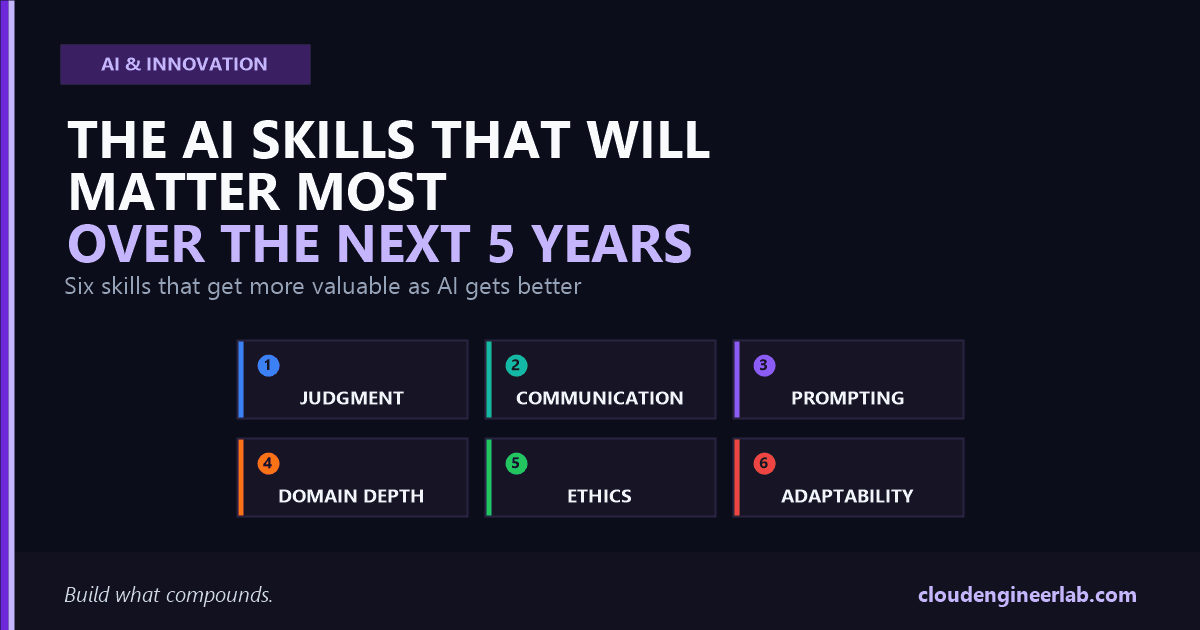
The AI Skills That Will Matter Most Over the Next 5 Years
Six specific AI skills worth building now, with real examples of what strong AI-assisted work looks like next to weak AI-assisted work.
Five years ago, almost nobody had used a chatbot for work. Today, most professionals use one weekly, and a growing share use one daily. Five years from now, the people who look back on this moment as the point they got serious about a specific set of skills will be running teams, leading projects, and earning what they're worth. The people who spent this window only watching will be explaining, again, why they're still doing the same job at the same level.
That's not a scare tactic. It's just what happens whenever a new capability spreads through an industry: an early gap opens between the people who build real skill with it and the people who treat it as a curiosity. That gap is open right now, and it's still small enough to close.
The one sentence to remember
The skills worth building are the ones that get more valuable as AI gets more capable, not less.
Here are six of them, what they actually look like in practice, and a real writing example that shows the difference between someone who has these skills and someone who doesn't.
Why These Six, Specifically
Plenty of skills will matter over the next five years. These six were chosen because they share one property: every one of them becomes more valuable as the underlying AI models get better, not less. A skill that only matters because today's AI is clumsy will quietly disappear as the tools improve. These six won't.
1. Judgment: Knowing When AI Is Wrong
This is the single most valuable skill on this list, and it's the hardest to fake. AI answers with the same fluent confidence whether it's right or completely wrong, which means the responsibility for catching the difference sits entirely with you.
The people who build this skill develop something close to an instinct. They notice when an answer is suspiciously specific with no source behind it. They know which topics in their field are thin enough in training data that AI tends to guess. They ask one follow-up question before accepting an answer, instead of zero.
How to build it, starting today
Every time you get an AI answer that matters, ask yourself one question before acting on it: could I point to where this actually came from? If the honest answer is no, spend two minutes verifying before you use it. Do that consistently for a month and the instinct starts forming on its own.
Why it compounds: as AI gets woven into more decisions, the cost of an unverified wrong answer only grows. A person who catches errors reliably becomes the one others trust to sign off on AI-assisted work, which is a genuinely valuable position to hold on any team.
2. Communication: Turning a Draft Into Something Worth Reading
AI is extremely good at producing a first draft. It is much weaker at producing something that sounds like a real person made a deliberate choice about every sentence. The skill that matters here isn't writing from scratch anymore; it's editing with a sharp enough ear to close that gap.
Here's what that actually looks like, side by side.
A raw, unedited AI draft of a client update email:
I hope this email finds you well. I wanted to provide you with an update regarding the current status of the project. We have made significant progress on several fronts, and the team continues to work diligently to ensure that all deliverables are met in a timely manner. Please do not hesitate to reach out if you have any questions or concerns.
The same update, edited by someone who knows what they're doing:
Quick update: the dashboard redesign is done and live in staging, and the API migration is about two days behind where we planned, mostly because the third-party auth library needed a workaround. Nothing that affects your launch date. I'll flag it if that changes.
Notice what changed. The second version says something specific. It names the actual work, the actual delay, and the actual reason, in about a third of the words. It doesn't hedge with filler like "I hope this email finds you well" or "please do not hesitate." It respects the reader's time.
The edit that matters most
Read your AI draft out loud. Every sentence that sounds like it could belong in absolutely any email about absolutely any project is a sentence to cut or make specific. Specificity is what makes writing sound like it came from a person who was actually there.
Why it compounds: the more AI-written text floods every inbox, the more a genuinely clear, specific, human message stands out. This skill gets more valuable as generic AI writing becomes the norm, not less.
3. Prompting and Context Design
"Prompt engineering" sounds like a technical discipline, and in its most advanced forms it is. But the version that matters for most people is much simpler: the ability to give AI enough of the right context that you get a useful answer on the first attempt instead of the fifth.
| Weak prompt | Stronger prompt |
|---|---|
| "Write a project update" | "Here are my rough notes from this week [pasted below]. Turn them into a client update email, direct tone, under 100 words, and don't add anything I didn't mention." |
| "Explain this error" | "Here's the exact error message and the code that produced it [pasted below]. Explain what's causing it and suggest one fix, referencing only what's shown here." |
| "Summarize this document" | "Summarize this document in five bullet points for someone who has 30 seconds, focused only on what requires a decision from them." |
The pattern in every strong prompt is the same: it hands over real material instead of asking the model to guess, and it specifies exactly what "good" looks like for this particular task.
The habit that separates strong prompters from everyone else
Before you type a prompt, ask yourself what a smart colleague would need to know to do this task well. Then put that into the prompt. Most weak prompts fail because they skip context a human would have asked for automatically.
Why it compounds: as more of your daily work routes through an AI interface, the gap between someone who gets a usable answer immediately and someone who fights the tool for ten minutes turns into a real difference in output over a year.
4. Domain Depth: The Expertise AI Accelerates, Not Replaces
AI can write a passable script, draft a passable contract clause, or sketch a passable marketing plan. What it can't do is know, from real experience, which of those three passable options will actually work in your specific situation, with your specific constraints, for your specific audience.
That knowledge, built from years in a field, is what turns an AI draft from "plausible" into "correct." A nurse who understands patient triage catches an AI diagnosis suggestion that doesn't fit the actual case. An accountant who understands the client's business catches a plausible-sounding tax deduction that doesn't actually apply. Neither of them needed to become an AI expert to do this. They needed to stay excellent at their actual job and add AI as a way to move faster within it.
The trap to avoid
Don't let AI fluency substitute for real expertise. Someone who can write a great prompt about a topic they don't understand will still produce work that a genuine expert can pick apart in minutes. Depth is what AI cannot manufacture for you.
Why it compounds: the value of deep domain knowledge paired with AI fluency goes up precisely because AI makes shallow, generic output cheap and abundant. Genuine expertise becomes the differentiator, not a nice extra.
5. Ethical and Responsible Use
This one rarely makes these lists, and it's becoming one of the most commercially valuable skills on it. Every organization using AI at scale eventually runs into the same questions: what should we disclose to customers, what should never be automated without a human check, and who's accountable when the AI gets something wrong.
People who can answer those questions clearly, calmly, and specifically for their own field are in genuine demand right now, and that demand is growing faster than the supply of people who can do it well.
Learn your industry's actual rules, not just general ethics
Healthcare, finance, legal, and education all have specific regulatory questions around AI use. Generic "be ethical" advice doesn't help; knowing the actual disclosure and compliance requirements in your field does.
Practice explaining AI involvement plainly
Being able to tell a client, patient, or reader exactly how AI was used in a piece of work, in one clear sentence, is a skill in itself and builds trust that vague answers destroy.
Get comfortable saying no to an automation
Knowing which decisions genuinely need a human, and being willing to say so even when automating them would be faster, is what makes you the person leadership trusts with the harder calls.
Why it compounds: as AI regulation catches up with AI adoption, the organizations that already have someone who understands this well will move faster and get burned less often than the ones scrambling to figure it out after a problem.
6. Adaptability: Staying Useful While the Tools Keep Changing
The specific AI tool you're best at today will very likely be replaced, renamed, or rebuilt within the next two years. That's not a reason to avoid learning tools; it's a reason to build the habit of learning new ones quickly, rather than mastering one and stopping.
The people who handle this well share a pattern: they treat every new AI release as a ten-minute experiment, not a six-month commitment. They ask what's genuinely new about it, try it on one real task, and decide from that single test whether it's worth deeper attention.
A four-question test for any new AI tool or feature
Does it do something I actually need done? Can I test that in under fifteen minutes? Did it noticeably save time or improve quality on that real test? If yes to all three, invest more time. If not, move on without guilt.
Why it compounds: the gap between people who adapt quickly and people who cling to familiar tools widens every time the underlying technology takes a real step forward, which is happening more often, not less.
What This Looks Like Over Five Years
Picture two people starting from the same job, the same salary, and the same base skill level today.
One of them treats AI as something to glance at occasionally: a novelty for writing an awkward email or settling a trivia question. The other spends this year building the six skills above, deliberately, one real task at a time.
In year one, the difference is barely visible. Both are still doing recognizably the same job. By year three, one of them is the person a team turns to for the hard calls, the person whose drafts need almost no rewriting, the person who's already fluent in whatever new tool just launched. The other is still asking, politely, why they weren't considered for the promotion that went to someone with less tenure.
Five years is a long time to build something. It is also a short time to fall behind in.
How to Start This Week
Pick one real task, not a hypothetical one
Choose something you're already doing this week: a report, an email, a piece of research. Use AI on it deliberately, then apply the edit-and-verify habits above before it goes anywhere.
Write down one thing AI got wrong or missed
Every task where you catch an error is a small deposit into your judgment skill. Keep a short running note. In a month, you'll have a clear, personal picture of exactly where AI needs your oversight most.
Rewrite one AI-generated paragraph until it sounds like you
Take any AI draft and spend five extra minutes making it specific, direct, and unmistakably yours. That single habit, repeated, is what separates AI-assisted work that reads well from AI-assisted work that reads generic.
Teach someone else what you learned
Explaining a prompt that worked, or a mistake you caught, to a colleague forces you to understand it well enough to put into words. It also makes you the person people associate with using AI well.
The Bottom Line
None of these six skills require a computer science degree, a certification, or months of dedicated study. They require using AI on real work, paying close attention to where it helps and where it fails, and building the habit of closing that gap yourself, one task at a time.
Start with the one habit that matters most
Pick one piece of AI-assisted work you're doing this week and ask two questions before you consider it finished: is this actually true, and does it actually sound like me? Everything else on this list grows out of taking those two questions seriously.
Five years from now, the gap between the people who did this and the people who didn't will be obvious to everyone, including the people who let it happen. You still have time to decide which side of that gap you're on. Start today, on something small, and let it compound.

Written by
Chetan Yamger
Cloud Engineer · AI Automation Architect · Modern Workplace Consultant
Cloud Engineer, AI Automation Architect, and Modern Workplace Consultant based in Amsterdam, Netherlands. Specializing in scalable, secure enterprise solutions with Microsoft Azure, Intune, PowerShell, and AI-driven automation using ChatGPT, Gemini, and modern LLM technologies.
Stay in the loop.
New articles, straight to you.
Deep-dive technical articles on Intune, PowerShell, and AI — no noise, no spam.
Discussion
Share your thoughts — your email stays private
Leave a comment