
How to Use AI Without Losing Your Own Thinking Skills
GPS quietly weakened our sense of direction. Now AI is positioned to do the same to our thinking, unless you know the difference between Autopilot Mode and Copilot Mode.
In 2020, neuroscientists at McGill University found something unsettling about GPS. People who habitually relied on turn-by-turn navigation showed measurably reduced activity in the hippocampus, the part of the brain responsible for spatial memory and, notably, a region that also shrinks in early-stage dementia. London cab drivers, by contrast, who spend years memorising the city's 25,000 streets without satnav, develop a larger hippocampus than average.
The tool didn't make anyone worse at driving. It made them worse at finding their own way, a subtly different skill, and one that quietly atrophied because it was never being asked to work.
That's the exact risk sitting inside how most people use AI today. Not that it gets things wrong. That it's so good at getting things right that we stop exercising the muscle it's replacing.
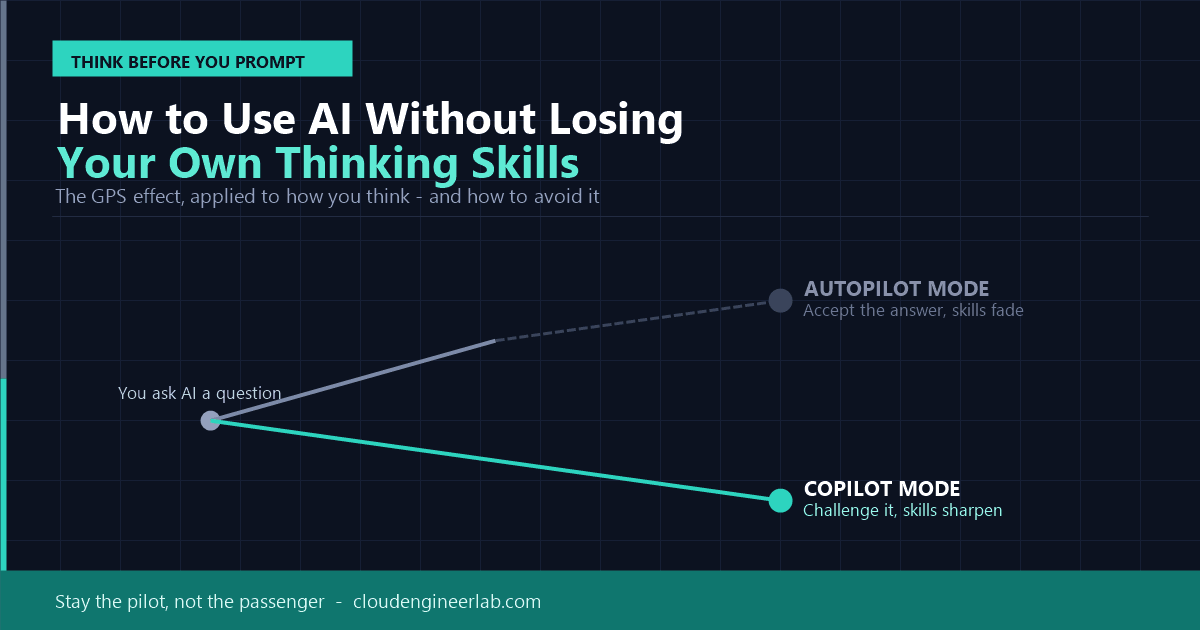
Autopilot Mode vs. Copilot Mode
There's a useful distinction hiding in the aviation metaphor everyone already uses without thinking about it. An autopilot flies the plane. The pilot can look away, and the aircraft holds its course regardless. A copilot does something different: they support the person who is still flying, catching what they miss, offering a second opinion, but never actually taking the controls.
Most people using AI today are running Autopilot Mode without realising it. They ask a question, receive an answer, and act on it, the same shape of interaction whether the stakes are "what's a synonym for 'utilize'" or "should I sign this contract." The thinking happened somewhere, but it wasn't in their head.
Task: Decide whether to switch your team from Trello to Asana.
Prompt: "Should we switch from Trello to Asana?"
What happens: AI produces a balanced-sounding answer with pros and cons. You skim it, agree with the conclusion, and announce the decision to your team an hour later.
What you retain: The AI's conclusion. Not the reasoning. If someone asks you to defend the choice next week, you're explaining someone else's judgment as if it were yours.
Same task. Same tool. Completely different outcome for the thinking involved.
Three More Places This Plays Out
Writing
| Autopilot Mode | Copilot Mode | |
|---|---|---|
| Prompt | "Write a project update for my manager." | "Here are my rough notes: [notes]. Draft a project update, but flag anywhere my notes are vague or contradictory." |
| Result | A polished update you didn't really write | A polished update, plus you noticed your own notes contradicted themselves on the deadline |
| What you kept | Nothing, the thinking was outsourced entirely | The habit of noticing gaps in your own reasoning before they become someone else's problem |
Learning a New Concept
| Autopilot Mode | Copilot Mode | |
|---|---|---|
| Prompt | "Explain how compound interest works." | "Explain how compound interest works, then give me a problem to solve myself before showing me the answer." |
| Result | You read an explanation and feel like you understand it | You attempt the problem, get it wrong once, and the correction sticks because you made the mistake yourself |
| What you kept | A feeling of understanding that fades within days | An actual, testable skill |
Debugging Code
| Autopilot Mode | Copilot Mode | |
|---|---|---|
| Prompt | "Fix this error." | "Here's the error and my code. Before you fix it, tell me what you think is causing it, I want to check my own theory first." |
| Result | Working code, no idea why it was broken | Working code, and you now recognise this bug pattern for next time |
| What you kept | Nothing transferable to the next bug | A pattern-matching skill that gets sharper with each real diagnosis |
The pattern across all four examples
Copilot Mode isn't slower or more complicated. It's the same prompt with one addition: you commit to a position, a guess, or an attempt before AI responds, so there's something of yours in the exchange for the answer to sharpen, correct, or confirm.
Signs You've Slipped Into Autopilot
A quick honesty check
None of these are catastrophic on their own. The pattern matters more than any single instance.
- You can't recall why a recent decision was made, only that AI recommended it
- You've stopped attempting a problem before asking AI to solve it
- You accept the first answer you get instead of pushing back or asking "are you sure?"
- You'd struggle to explain, out loud, something you "learned" from AI last week
- Your own first drafts have gotten worse, not better, since you started using AI regularly
If two or more of these feel familiar, it's not a crisis, it's just useful information.
How to Stay in Copilot Mode
Think first, even briefly
Before you open the chat, spend 60 seconds forming your own rough answer, guess, or opinion. It doesn't need to be right. It just needs to exist, so the AI's response has something of yours to react to.
Ask it to challenge you, not just answer you
Add one line to your prompt: "Push back on my reasoning" or "tell me what I'm missing" instead of just "tell me the answer." This single habit does more than any other change on this list.
Use the Explain-It-Back Test
After AI explains something to you, close the chat and explain it out loud, in your own words, without looking. If you can't, you didn't learn it, you borrowed it temporarily. Go back and actually work through it.
Reserve AI for the mechanical 80%, not the judgment-heavy 20%
Let it draft, format, summarise, and handle boilerplate. Keep the actual decision, the actual diagnosis, the actual argument as something you construct, even if AI checks your work afterward.
Notice when you're rubber-stamping
If you're about to act on an AI response you only skimmed, stop and actually read it critically first. The two extra minutes are where the thinking either happens or doesn't.
What This Isn't Saying
This isn't an argument for using AI less. It's an argument for using it differently, the same way GPS isn't the enemy of navigation; blind, unquestioning dependence on it is. A London cabbie can absolutely use a map for an unfamiliar route without losing "The Knowledge" they spent years building. The skill degrades only when the tool replaces the exercise entirely, every single time, without exception.
The goal in one sentence
Use AI to go further and faster, not to go somewhere without knowing how you got there.
The Bottom Line
The hippocampus doesn't shrink because someone uses GPS once. It shrinks because someone stops navigating, consistently, over years, the skill fades from disuse, not from a single convenient shortcut. The same mechanism is now available for judgment, writing, problem-solving, and learning, and it will play out exactly the same way for anyone who lets AI do 100% of the thinking, 100% of the time.
You don't need to distrust the tool. You need to stay in the loop: form a view before you ask, question the answer you get, and explain it back in your own words before you call it understood. That's the entire difference between Autopilot Mode and Copilot Mode, and it costs about sixty seconds per use.
Next time you open an AI tool, try it once: answer the question yourself first, badly if you have to, before you ask. See what changes.

Written by
Chetan Yamger
Cloud Engineer · AI Automation Architect · Modern Workplace Consultant
Cloud Engineer, AI Automation Architect, and Modern Workplace Consultant based in Amsterdam, Netherlands. Specializing in scalable, secure enterprise solutions with Microsoft Azure, Intune, PowerShell, and AI-driven automation using ChatGPT, Gemini, and modern LLM technologies.
Stay in the loop.
New articles, straight to you.
Deep-dive technical articles on Intune, PowerShell, and AI — no noise, no spam.
Discussion
Share your thoughts — your email stays private
Leave a comment