
How AI Can Help You Learn Any Skill Faster
Learning has always been slow for one specific reason: feedback takes too long. AI collapses that delay to seconds. Here's the exact loop, applied to five completely different skills.
Learning a new skill has always been slow for one specific, unglamorous reason: feedback takes too long. You practice a guitar chord wrong for two weeks before a teacher corrects it. You write broken code and wait until code review to learn why. You mispronounce a word in a new language for months because nobody was there to correct you in the moment.
AI doesn't make you smarter. It doesn't replace practice. What it does is collapse the feedback loop from days to seconds, and that one change is why people are learning skills faster with AI than almost any other method in history.
This post breaks down the exact loop, then applies it to five genuinely different skills so you can see it's not a coding-specific trick.
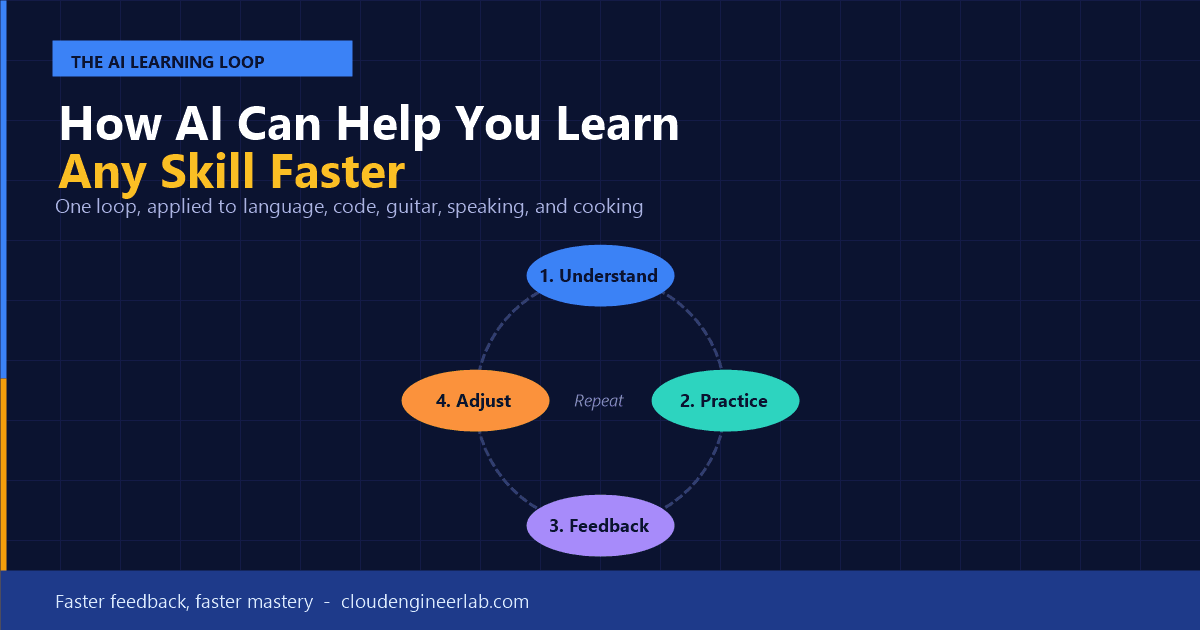
The AI Learning Loop
Every skill, physical, technical, or creative, is learned through the same four-stage cycle. AI speeds up every single stage.
The loop is the whole point
Traditional self-study usually breaks down at Stage 3: you don't have anyone available to tell you, right now, what you got wrong. That's the exact stage AI is best at. It's always available, and it never gets tired of correcting the same mistake twice.
The rest of this post is that loop applied to five different skills, with real examples for each.
Skill 1: Learning a New Language
Understand: Instead of a generic textbook explanation, ask for the concept in context. "Explain the difference between ser and estar in Spanish, using examples about describing a person's mood versus their permanent personality."
Practice: "Give me 5 sentences in English. I'll translate them into Spanish using ser or estar correctly."
Feedback: Submit your attempts and ask: "Check my translations. For any mistakes, explain exactly why it's wrong, not just what the correct answer is."
Adjust: "I keep confusing these two with descriptions of weather. Give me 5 more practice sentences focused specifically on that."
Why this beats a textbook
A textbook gives you the rule once and 20 generic exercises. AI notices your specific recurring mistake, weather expressions, in this example, and generates practice targeted at exactly that gap. That's the personalisation a $40/hour tutor provides, available at 11 PM for free.
Skill 2: Learning to Code
Understand: "Explain what a Python list comprehension is, assuming I already understand basic for loops."
Practice: Write your own attempt at a real problem, not a copied example. "Here's my attempt at converting this for loop into a list comprehension: [paste your code]."
Feedback: "Is this correct? If not, explain what's wrong with my logic, not just the fixed code."
Adjust: "Give me three more for loops of increasing difficulty to convert, so I can practice this pattern."
This is the exact loop covered in more depth in 10 ChatGPT Prompts Every IT Admin Should Bookmark. The review-and-explain prompt pattern works identically whether you're a working IT admin or someone learning to code from zero.
Skill 3: Learning to Play Guitar
This is where people are most skeptical: AI can't hear you play. True, but it can still close most of the loop.
Understand: "Explain the difference between a C major and C major 7 chord, and why the 7 changes the sound."
Practice: Record yourself playing a chord change and describe what happened. "I'm trying to switch from G to C in time with a metronome at 80 BPM, but I keep muting the high E string. What's likely causing that?"
Feedback: AI can't hear the recording, but it can diagnose the mechanical cause from your description: finger placement, hand angle, timing, based on the exact symptom you describe.
Adjust: "Give me a 5-minute daily drill focused just on that transition, building up from 60 BPM."
Where AI genuinely can't replace a human
For anything requiring physical technique AI can't observe, actual finger positioning, posture, tone, it's a research and troubleshooting partner, not a replacement for a teacher or a mirror. Use it to understand why something might be going wrong, then verify against a video of your own playing.
Skill 4: Learning Public Speaking
Understand: "What makes an opening line for a presentation memorable? Give me three different techniques with examples."
Practice: Write and paste your actual opening line for a real talk you're preparing.
Feedback: "Here's my opening line: [paste it]. Is it strong? What specifically makes it work or not work, compared to the techniques you just explained?"
Adjust: "Rewrite it two different ways using two of those techniques, so I can compare them."
How to close the loop for real: Practice the delivery out loud, record yourself, and ask AI to help you turn the transcript into a tighter version: "Here's a transcript of me practising this section out loud. Where did I ramble? Where could I cut words without losing the point?"
Skill 5: Learning to Cook a New Cuisine
Understand: "Explain the base flavour components of Thai cooking. What does a dish need to taste authentically Thai?"
Practice: Attempt a real recipe with what you have. "I'm making a green curry but don't have fish sauce or palm sugar. What can I substitute, and how will it change the result?"
Feedback: After cooking, describe the result. "My curry came out too sweet and not spicy enough. What did I likely get wrong in the balance?"
Adjust: "Give me the same recipe again with adjusted ratios based on that feedback."
The Pattern Across All Five
| Skill | Understand | Practice | Feedback | Adjust |
|---|---|---|---|---|
| Language | Concept in context | Real sentences | Specific error explanation | Targeted drills on your gap |
| Coding | Concept building on what you know | Your actual code attempt | Logic-level correction | Harder variations of the same pattern |
| Guitar | Why a technique works | Describe the specific attempt | Likely mechanical cause | Focused daily drill |
| Public speaking | A named technique | Your real opening line | Specific strengths/weaknesses | Rewritten alternatives to compare |
| Cooking | Underlying flavour theory | Real recipe attempt | Diagnose what went wrong | Adjusted version to retry |
Every column is the same four-stage loop. The skill changes; the loop doesn't.
Why This Is Genuinely Faster Than Traditional Self-Study
| Traditional self-study | AI-accelerated learning | |
|---|---|---|
| Feedback speed | Hours to weeks (a class, a mentor, trial and error) | Seconds |
| Personalisation | Generic exercises for everyone | Practice targeted at your specific mistake |
| Availability | Scheduled sessions only | 24/7, whenever you have 10 minutes |
| Cost | Tutors, courses, classes | Often free or a few dollars a month |
| Explaining "why," not just "what" | Depends entirely on the teacher | Consistently available on request |
None of this replaces the value of a real teacher, a study group, or actual practice hours. What it replaces is the waiting: the days you'd otherwise spend practising a mistake before anyone told you it was one.
Common Mistakes That Slow This Down
Skipping the practice step
The most common failure mode: reading AI's explanation, feeling like you understand it, and moving on without actually attempting the skill yourself. Understanding a concept and being able to do it are different things; the loop only works if you complete all four stages, every time.
- Accepting the first explanation without testing it. If an explanation doesn't fully click, ask for it a different way, a new analogy, a simpler breakdown, a worked example, before moving on.
- Not giving AI your actual attempt. "Is my code good?" without pasting the code, or "how's my Spanish?" without a real sentence, gives AI nothing concrete to correct. Always practice on something real, then bring that real attempt back for feedback.
- Trusting AI feedback as infallible. For factual domains especially, cross-check anything that surprises you. See AI Hallucinations Explained for why confident-sounding AI feedback isn't automatically correct feedback.
Build Your Learning Loop This Week
Step 1: Pick one skill and one specific sub-topic
Not "learn Spanish," "get comfortable with ser vs estar." Not "learn guitar," "clean up my G to C chord transition." Specificity is what makes the loop work.
Step 2: Ask for an explanation pitched at your actual level
Tell the AI what you already know, so it doesn't waste your time re-explaining the basics or skip ahead of what you understand.
Step 3: Attempt something real, immediately
Don't read three more explanations first. Attempt the skill, write the sentence, the code, the chord change, the paragraph, right after the explanation, while it's fresh.
Step 4: Bring your real attempt back for specific feedback
Paste or describe exactly what you did. Ask what was wrong and why, not just for the corrected version.
Step 5: Do it again, immediately, with the fix applied
Close the loop the same session. The gap between feedback and your next attempt is where most self-learners lose momentum; don't let it stretch to tomorrow.
Tools That Fit This Loop Well
| Tool | Best for | Why |
|---|---|---|
| ChatGPT / Claude | Any skill: general explanation and feedback | Flexible, handles code, language, writing, and reasoning-based feedback well |
| Duolingo Max | Language learning specifically | Built-in AI explanations for wrong answers, roleplay conversation practice |
| Khanmigo (Khan Academy) | Academic subjects, guided by Socratic questioning | Designed specifically not to just give answers, pushes you to reason |
| GitHub Copilot / Cursor | Coding, learned through real projects | Feedback happens inline, in your actual code, as you write it |
| Google Gemini | Anything needing current, real-world reference material | Connected to live web data for up-to-date facts |
The Bottom Line
AI doesn't make learning effortless. It makes the effort you put in count for more, by giving you feedback in seconds instead of days. The loop is the same whether you're learning Spanish, Python, guitar, public speaking, or a new cuisine: understand, attempt something real, get specific feedback, adjust, and go again.
Pick one skill you've been meaning to learn. Run the loop once, today, on one small piece of it. That single rep is worth more than another hour of reading about how to learn.
Written by
Chetan Yamger
Cloud Engineer · AI Automation Architect · Modern Workplace Consultant
Cloud Engineer, AI Automation Architect, and Modern Workplace Consultant based in Amsterdam, Netherlands. Specializing in scalable, secure enterprise solutions with Microsoft Azure, Intune, PowerShell, and AI-driven automation using ChatGPT, Gemini, and modern LLM technologies.
Stay in the loop.
New articles, straight to you.
Deep-dive technical articles on Intune, PowerShell, and AI — no noise, no spam.
Discussion
Share your thoughts — your email stays private
Leave a comment