
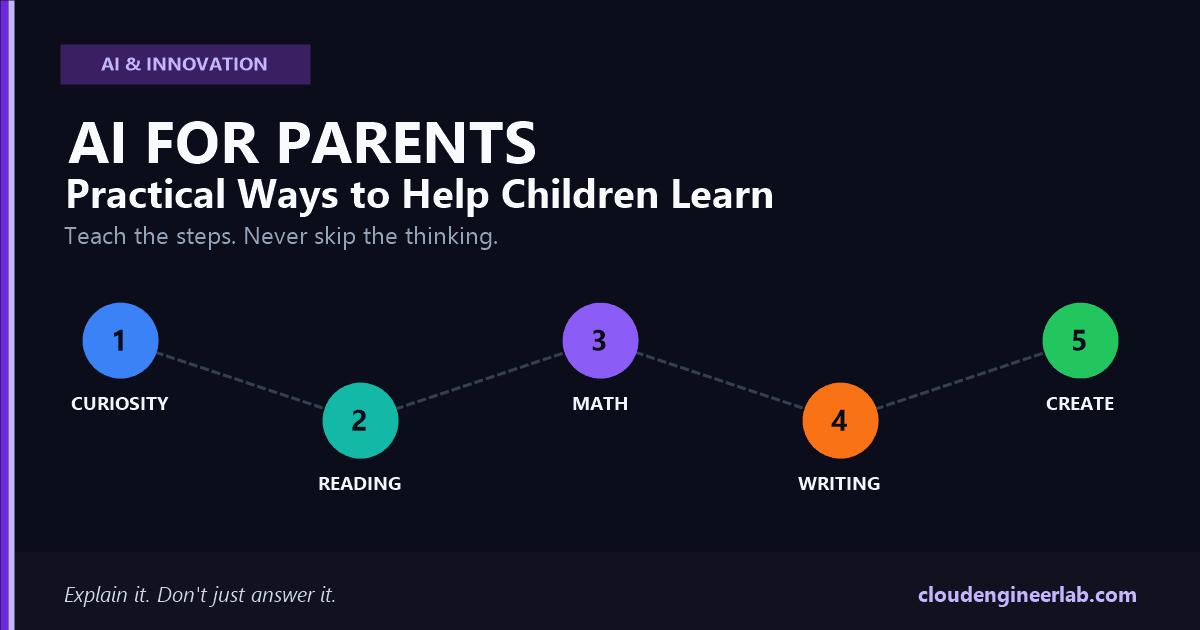
AI for Parents: Practical Ways to Help Children Learn
AI can turn a homework meltdown into a five-minute win, or quietly do the thinking for your child instead of them. Here's how to get the first outcome, not the second.
It's 7:40 PM. A ten-year-old is stuck on a long division problem, in tears, and neither parent in the house has done long division in twenty years. The old options were limited: struggle through it together with a shaky memory of the method, call another parent, or give up for the night and deal with the teacher in the morning.
Now there's a fourth option: ask an AI assistant to explain the exact method being taught, step by step, at a ten-year-old's level, in under a minute. The homework gets done. Nobody cries. And critically, the child watched the steps happen and could follow along, rather than just being handed an answer.
That distinction, between AI that teaches the steps and AI that just hands over the answer, is the entire difference between this being one of the best tools a parent has and one of the more damaging ones.
The one sentence to remember
The right question isn't "did AI help with the homework." It's "did my child understand more after using it than before."
This is a practical guide: real ways AI genuinely helps children learn, age-appropriate guardrails, the line between helping and doing it for them, and how to set this up as a family without it becoming a screen-time or academic-honesty problem.
Where AI Genuinely Helps Kids Learn
1. Curiosity: Answering the Questions Nobody Has Time For
Children ask an enormous number of genuine questions a day, and a tired parent can only field so many "but why" follow-ups before running out of patience or actual knowledge. AI has infinite patience for this, which is a real, underrated use case.
| Real example | What it looks like |
|---|---|
| "Why is the sky blue?" followed by three more "but why" questions | AI keeps answering at an age-appropriate level without getting tired of the chain of questions |
| A child curious about dinosaurs, space, or how something works | AI can hold a genuine back-and-forth conversation at a child's reading and vocabulary level |
| A question a parent genuinely doesn't know the answer to | AI gives both parent and child a starting explanation to explore further together |
Turn the answer into the next question
The best use of AI here isn't getting a fast answer, it's modeling curiosity. After AI answers, ask your child "what do you want to know next?" That habit, repeated, teaches a child how to keep learning long after the screen is off.
2. Reading: Explaining Words and Checking Understanding
Explaining an unfamiliar word in context
A child reading a book can ask what a word means, and AI can explain it using the actual sentence from the book, which sticks far better than a generic dictionary definition.
Checking comprehension after a chapter
Ask AI to generate three or four simple questions about a chapter your child just read, to check understanding without it feeling like a test.
Finding the next book
Describe what your child enjoyed in their last book and ask for similar recommendations at the right reading level, which often works better than generic bestseller lists.
3. Math: Teaching the Method, Not Just the Answer
This is the single highest-stakes category, because it's the easiest place for AI to accidentally do the thinking instead of teaching it.
A weak way to use AI for math homework:
Parent types the problem and asks: "What's the answer to 847 divided by 23?"
A strong way to use AI for the same problem:
"My child is learning long division using the method shown in this example: [describe or paste the school's method]. Walk through 847 divided by 23 step by step, the way a teacher would on a whiteboard, and stop after each step to let my child try the next one."
The first gets a number. The second teaches the process, which is the actual point of the homework.
If it only gives the final answer, it didn't help
An AI response that's just a number is worse than useless for learning, it's a shortcut that skips the entire point of the exercise. Always ask for the steps, not the result.
4. Writing: Brainstorming and Feedback, Never Ghostwriting
This is where academic honesty lines get crossed
Having AI write a child's essay, story, or report is not help, it's doing the assignment for them, and most schools now treat this the same as any other form of cheating. The line matters, and it's worth being explicit about it at home before a teacher has to be the one to explain it.
| What's genuinely helpful | What crosses the line |
|---|---|
| "Give me three ideas I could write about for this prompt" | "Write the essay for this prompt" |
| "Here's my paragraph, what's one thing I could make clearer?" | "Rewrite my paragraph to sound better" |
| "What are some strong opening lines for a story about a lost dog?" | "Write the opening chapter of a story about a lost dog" |
| "Check if my sentence has any spelling mistakes" | "Fix my whole essay" |
A simple family rule that works
AI can talk with your child about their writing. It should never write instead of your child. Say this rule out loud, once, and revisit it when a deadline makes the temptation stronger.
5. Creating: Turning Ideas Into Real Things
This is where AI genuinely shines for younger kids, low-stakes, high-engagement creative projects where there's no test attached and no honesty line to cross.
| Activity | How AI helps |
|---|---|
| Making up a bedtime story together | Ask AI to continue a story your child starts, taking turns adding the next part |
| A school project on an animal or country | AI helps organize research into simple sections a child can turn into a poster or presentation, in their own words |
| Learning a new language | Apps like Duolingo now use AI-powered practice conversations that adjust to a learner's level in real time |
| Music or art ideas | AI can suggest a simple song structure or drawing prompt to get a stuck creative project moving again |
The Line Between Helping and Doing It For Them
The test that actually matters
Before letting AI answer something for your child, ask: if I removed the AI response right now, could my child explain what just happened in their own words? If not, they didn't learn it, they just watched it happen.
| Green light | Yellow light | Red light |
|---|---|---|
| Explaining a concept step by step | Checking a finished answer for mistakes | Generating the finished answer or essay |
| Answering curiosity questions | Suggesting story ideas | Writing the story itself |
| Practicing conversation in a new language | Summarizing a chapter to check understanding | Summarizing a book instead of reading it |
Age-Appropriate Guidance
| Age group | What's appropriate | What to watch for |
|---|---|---|
| Under 8 | Supervised use only, voice-based Q&A, co-reading and story games with a parent present | Screen time limits, content filtering, no independent chat accounts |
| 8 to 12 | Homework method explanations, reading comprehension checks, supervised creative projects | Teaching them to double-check facts, keeping essay-writing fully their own work |
| 13 and up | More independent use for research and study help, with agreed family rules | School AI policies, academic honesty expectations, critical evaluation of AI answers rather than blind trust |
Check your child's school AI policy
Many schools now have explicit rules about what AI use is and isn't allowed for graded work. These policies vary a lot between schools and even between teachers. Ask directly rather than assuming, since a rule your child breaks unknowingly still counts as breaking it.
Getting Started as a Family
Agree on the ghostwriting rule together
Sit down with your child and agree explicitly: AI can explain, brainstorm, and check, it should never write the final answer for graded work. Saying it out loud once, together, makes it far easier to hold to later.
Use it together the first several times
Sit with your child while they ask AI questions for the first few weeks, so you both build a shared sense of when it's genuinely helping and when the answer sounds off.
Teach them to double-check, not just accept
Show your child at least once that AI can get something wrong confidently, so they build the habit of checking rather than trusting every answer automatically.
Pick tools built for kids where possible
A tool designed for education, with content filtering and no open-ended chat with strangers, is a safer starting point than a general-purpose adult chatbot for younger children.
Revisit the rules as they get older
What's appropriate at eight looks very different at fourteen. Treat this as an ongoing conversation, not a one-time setup.
Tools Worth Knowing
| Tool | Best for | Why it fits families |
|---|---|---|
| Khan Academy's Khanmigo | Guided homework help across subjects | Built specifically for education, designed to teach the method rather than give answers |
| Photomath | Step-by-step math problem walkthroughs | Shows every step of the solution, not just the final number |
| Duolingo | Language learning practice | AI-powered conversation practice that adjusts to the learner's level |
| ChatGPT or Claude (with a parent present) | General questions, brainstorming, reading help | Flexible and capable, but benefits most from supervision and clear ground rules with younger children |
| Google's Read Along | Early reading practice | Listens to a child read aloud and offers gentle, encouraging corrections |
Common Mistakes to Avoid
Letting AI become the homework machine
If every assignment gets solved by AI rather than worked through with it, the grades might hold steady while the actual learning quietly stops.
Skipping the conversation about academic honesty
Kids generally want to do the right thing when the line is clear. The most common cheating cases come from an unclear rule, not a deliberate choice to break one.
Ignoring your child's school's specific policy
A well-intentioned home rule that conflicts with a teacher's actual policy can still get a child in trouble. Check first.
Not modeling good AI habits yourself
Children notice how the adults around them use AI. Verifying an answer out loud, or admitting AI got something wrong, teaches more than any rule you state.
The Bottom Line
AI can turn a frustrating homework night into a genuine learning moment, answer the hundredth curious question of the day without running out of patience, and give a struggling reader or writer real, judgment-free practice. None of that requires it to do the work for them.
Start with the one habit that matters most
Before your child submits anything AI helped with, ask them to explain it back to you in their own words. If they can, it was help. If they can't, it was a shortcut, and it's worth going back and actually learning it together.
The goal was never to remove the struggle from learning entirely. It's to remove the unnecessary struggle, like not knowing where to start, so your child has the energy left for the struggle that actually builds understanding.

Written by
Chetan Yamger
Cloud Engineer · AI Automation Architect · Modern Workplace Consultant
Cloud Engineer, AI Automation Architect, and Modern Workplace Consultant based in Amsterdam, Netherlands. Specializing in scalable, secure enterprise solutions with Microsoft Azure, Intune, PowerShell, and AI-driven automation using ChatGPT, Gemini, and modern LLM technologies.
Stay in the loop.
New articles, straight to you.
Deep-dive technical articles on Intune, PowerShell, and AI — no noise, no spam.
Discussion
Share your thoughts — your email stays private
Leave a comment