
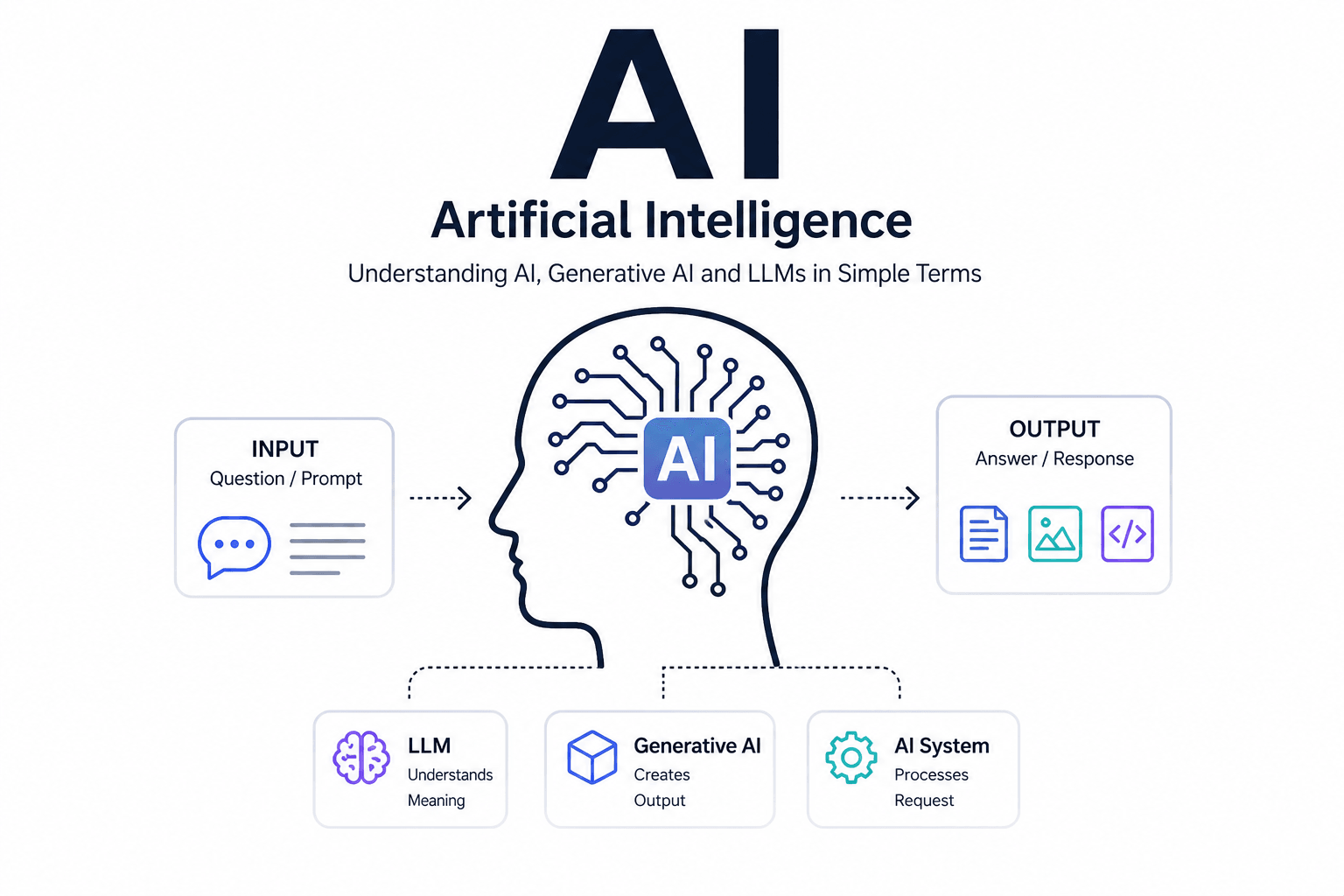
What is Artificial Intelligence (AI)? A Complete Beginner's Guide
Never studied computers? No problem. This guide explains Artificial Intelligence, Generative AI, and ChatGPT in plain everyday language, with real-life examples anyone can understand, and a clear step-by-step path to start learning AI from scratch.
You have heard the word Artificial Intelligence everywhere: on the news, at work, from friends, and probably from your children or grandchildren. But when someone asks you to explain what it actually is, you may find yourself unsure where to begin.
That is completely normal. And this article is written specifically for you.
No computer science degree needed. No technical background required. If you can read this sentence, you can understand AI. We will start from the very beginning and build up your understanding step by step, using examples from everyday life.
By the end of this guide, you will be able to explain AI to someone else, and more importantly, you will know exactly how to start using and learning it yourself.
Let's Start With a Simple Question: What Does "Intelligent" Mean?
Before we talk about Artificial Intelligence, let us think about what intelligence means in everyday life.
When we say a person is intelligent, we usually mean they can:
- Learn from experience (touching a hot stove teaches you not to do it again)
- Solve problems they have not seen before
- Understand language: reading a sentence and grasping its meaning
- Make decisions based on information available to them
- Recognise patterns: noticing that dark clouds usually mean rain
Intelligence is essentially the ability to learn, reason, and adapt.
Now, Artificial Intelligence is simply building that same ability (learning, reasoning, and adapting) into a machine or computer program. The word "artificial" just means "made by humans" (as opposed to natural intelligence, which comes from biology).
The simplest possible definition
Artificial Intelligence (AI) = A computer program that can learn from information and use that learning to perform tasks that normally require human thinking.
A Story to Make It Click
Imagine you are teaching a five-year-old child to recognise cats.
You show them a photo and say: "This is a cat." You show them another photo: "This is also a cat." After seeing hundreds of photos of cats, and being told which ones are cats and which are not, the child starts to recognise cats on their own, even in photos they have never seen before.
They have learned a pattern: cats have pointy ears, whiskers, a certain body shape, and so on.
This is exactly how AI learns.
You feed a computer program millions of examples. You tell it what is correct and what is not. Over time, the program learns the patterns in that data, and can start making correct judgements on new examples it has never seen before.
This process of learning from examples is called Machine Learning, and it is the foundation of modern AI.
How Is AI Different from Regular Computer Programs?
This is a really important distinction that many people miss.
A regular computer program follows fixed instructions. A calculator, for example, always adds numbers the same way. It cannot learn. It cannot improve. If you ask it something it was not programmed for, it fails.
An AI program is different. It learns from data and improves over time. It can handle situations it has never seen before, because it has learned patterns, not just specific instructions.
| Regular Program | AI Program | |
|---|---|---|
| How it works | Follows fixed rules | Learns from examples |
| Can it improve? | No | Yes, with more data |
| New situations | Fails if not programmed | Adapts using learned patterns |
| Example | A calculator | ChatGPT, Face ID, Netflix |
Types of AI, Kept Simple
There are many types of AI, but for a beginner, three are the most important to understand:
1. Narrow AI (What Most AI Is Today)
This is AI that is very good at one specific task.
- Face recognition on your phone: brilliant at recognising faces, useless at anything else
- Netflix recommendations: great at suggesting shows, cannot write a poem
- Spam filter in your email: expertly detects junk mail, cannot drive a car
Most AI you use every day is Narrow AI. It is specialised, powerful within its domain, and completely helpless outside it.
2. Generative AI (The Creative AI)
This is a newer and more exciting type of AI that can create new things: text, images, music, code, and more.
When you ask ChatGPT to write a letter for you, or when an AI tool creates an image from your description, that is Generative AI. It does not just analyse; it creates.
This is the type of AI that has captured the world's attention since 2022, and it is what most people mean when they say "AI" in conversation today.
3. Agentic AI (The Action-Taking AI)
This is the newest and most emerging type. Agentic AI does not just answer questions. It takes actions on your behalf.
It can browse the internet, book appointments, write and send emails, fill in forms, and complete multi-step tasks autonomously, like a very capable digital assistant that actually does things, not just says things.
We are still in the early days of Agentic AI, but it is developing rapidly.
Which type matters most for you right now?
If you are new to AI, start with Generative AI, specifically tools like ChatGPT, Gemini, or Claude. These are the most immediately useful, the easiest to access, and the best starting point for learning.
What is Generative AI? (The Creator)
Let us dig a little deeper into Generative AI since it is the most relevant type for most people today.
Think about a very well-read person who has read millions of books, articles, websites, and conversations throughout their life. Because of all that reading, they have a deep understanding of language, facts, stories, and how ideas connect.
When you ask this person a question, they do not just look up an answer in a book. They synthesise all of their knowledge and create a fresh, relevant response just for you.
Generative AI works in a similar way.
It has been trained on enormous amounts of text (and sometimes images, audio, and video). It has learned the patterns of language, knowledge, and creativity from all of that information. When you ask it something, it generates a new response. It does not copy and paste from a database.
What Can Generative AI Create?
| Input you give | What it can create |
|---|---|
| A question | A detailed, clear explanation |
| A topic | A full written article or report |
| A rough email draft | A polished, professional email |
| A description | An image matching your description |
| A problem | Working computer code to solve it |
| A few bullet points | A full presentation or document |
What is an LLM? (The Language Brain)
You may have heard the term LLM (Large Language Model). It sounds technical, but the idea is straightforward.
The word "model" just means a mathematical system that has learned patterns. The word "language" means it has learned specifically from text and language. The word "large" means it was trained on an enormous amount of data: we are talking billions of web pages, books, articles, and more.
So an LLM is simply: a very large AI system trained on vast amounts of text, which as a result understands and generates human language extremely well.
ChatGPT, Gemini, and Claude are all built on LLMs.
Think of an LLM as the engine under the bonnet of an AI chat tool. When you type a question into ChatGPT, the LLM is the part doing the actual thinking.
Why Are LLMs So Powerful?
Because of the sheer scale of what they have been trained on. An LLM like GPT-4 or Claude has processed more text than any human could read in a thousand lifetimes. As a result, it has developed a remarkably deep understanding of:
- Language and grammar across dozens of languages
- Facts, history, science, medicine, law, technology
- How to explain things clearly
- How different concepts relate to each other
- How to write in different styles and tones
How It All Works Together, A Simple Flow
Here is the complete picture, shown as a simple step-by-step flow:
A Real Example, Step by Step
You open ChatGPT and type: "Explain what a mortgage is in simple terms."
- ChatGPT receives your message
- The LLM understands you are asking for a financial explanation in simple language
- It draws on its knowledge of mortgages, finance, and plain-language communication
- It generates a fresh explanation specifically for you, not copied from anywhere
- You read a clear, simple explanation of what a mortgage is
The entire process takes about 2–3 seconds.
AI in Your Everyday Life Right Now
You may not realise it, but you are already using AI every day. Here are examples that will feel familiar:
| Where you encounter it | What the AI is doing |
|---|---|
| Google Search | Predicting what you want to find before you finish typing |
| Gmail | Suggesting "Smart Replies" and filtering spam |
| Netflix / YouTube | Recommending shows and videos based on your history |
| Google Maps | Predicting traffic and suggesting the fastest route in real time |
| Your phone's camera | Recognising faces, scenes, and automatically adjusting settings |
| Online shopping | "Customers also bought…" recommendations |
| WhatsApp / Keyboard | Autocorrect and word suggestions as you type |
| Bank fraud detection | Flagging unusual transactions and blocking fraud automatically |
| Customer service chat | The chatbot that answers basic questions before a human agent |
AI is not something coming in the future. It is already woven into tools you use today.
The Big Three AI Tools, Which One Should You Try?
If you want to start experiencing Generative AI directly, these are the three most important tools to know:
ChatGPT (by OpenAI)
The tool that started the current AI revolution when it launched in late 2022. ChatGPT is conversational, easy to use, and capable across a huge range of tasks. There is a free version available at chat.openai.com.
Best for: Writing, answering questions, explaining things, brainstorming ideas.
Gemini (by Google)
Google's AI assistant, built directly into Google Search and available as a standalone tool. Because it is connected to the internet, it can access current information.
Best for: Research, up-to-date information, summarising long documents, working with Google tools.
Claude (by Anthropic)
Widely considered the most thoughtful and nuanced of the three. Claude is particularly strong at understanding long documents, careful reasoning, and producing well-written, honest responses.
Best for: Reading and summarising long documents, careful analysis, writing assistance, coding.
Start with any one of them
Do not overthink which tool to start with. All three have free tiers. Pick one, open it, and type your first question. The best way to learn AI is to use it, not to read about it.
Common Myths About AI, Busted
There is a lot of confusion and fear around AI. Let us clear up the most common myths:
Myth 1: "AI is only for tech experts and programmers." False. The whole point of modern AI tools is that you interact with them in plain language. If you can write a WhatsApp message, you can use ChatGPT.
Myth 2: "AI will immediately take my job." The reality is more nuanced. AI is changing jobs. Some tasks within jobs are being automated, while new tasks are emerging. People who learn to work with AI will be more productive and more valuable than those who do not.
Myth 3: "AI always gives correct answers." This is important to understand. AI can be wrong, sometimes confidently wrong. Always verify important information from AI against reliable sources. Think of AI as a very knowledgeable but occasionally mistaken colleague, not an infallible oracle.
Myth 4: "AI is conscious and has feelings." Current AI models, including ChatGPT and Claude, are not conscious. They do not have feelings, desires, or awareness. They generate responses based on learned patterns. They can sound empathetic, but they do not experience anything.
Myth 5: "You need to understand AI deeply to benefit from it." You do not need to understand how a car engine works to drive one. Similarly, you do not need to understand neural networks to benefit from AI tools. Start using them and deepen your understanding over time.
Your Step-by-Step Learning Path
Here is a practical, no-overwhelm path for someone starting from zero:
Step 1: Try an AI tool today (Week 1)
Open ChatGPT, Gemini, or Claude (all free). Ask it something you are genuinely curious about. Ask it to explain something in simple terms. Ask it to help you write an email. Just play. There is no wrong way to start.
Step 2: Use AI for one real task each day (Weeks 2–3)
Pick one daily task and use AI to help with it. Drafting a message. Summarising a long article. Getting a recipe idea. Planning your week. The goal is making AI a habit, not a special occasion.
Step 3: Learn basic prompt writing (Week 4)
A "prompt" is just the instruction you give to an AI. Better prompts get better results. Start noticing what kind of instructions give you good responses versus vague ones. The key is being specific: instead of "write something about travel", try "write a short, friendly Instagram caption about a weekend trip to Amsterdam, keeping it under 50 words."
Step 4: Explore one new AI tool per month
Once comfortable with the basics, explore tools built for specific tasks. Canva AI for design. Notion AI for notes. Copilot in Microsoft 365 if your workplace uses it. Each tool will feel easier because you already understand the underlying concept.
Step 5: Follow AI news and learn the vocabulary
You do not need to become technical, but following AI developments keeps you current. Good beginner-friendly sources: the official blogs of OpenAI, Anthropic, and Google DeepMind. Follow a few AI educators on YouTube or LinkedIn. Read articles like this one.
Step 6: Apply AI to your specific field
AI looks different in every profession. A teacher uses it differently to an accountant, who uses it differently to a nurse. Once you understand the basics, start asking: "How could AI specifically help in my role or industry?" This is where real value begins.
Frequently Asked Questions
Do I need to pay to use AI tools? All three major tools (ChatGPT, Gemini, and Claude) have free tiers that are genuinely useful. Paid versions offer more features, faster responses, and higher usage limits, but you can learn and get real value without paying anything.
Is my data safe when I use AI tools? Be cautious about sharing sensitive personal information (like passwords, financial details, or private health information) with any AI tool. Treat it like any internet service: do not share what you would not want a third party to potentially see. Most AI providers have privacy policies that are worth reading.
Why does AI sometimes give wrong answers? AI models generate responses based on statistical patterns in their training data. They do not "look up" facts in a verified database. This means they can produce plausible-sounding but incorrect information, particularly on very recent events or highly specialised topics. Always verify critical information.
Can AI understand other languages? Yes. Modern LLMs like ChatGPT, Gemini, and Claude are highly capable in dozens of languages, not just English. You can ask questions and receive responses in Dutch, Hindi, French, Spanish, and many others.
How fast is AI improving? Extremely fast. The field has advanced more in the last three years than in the previous thirty. This is why learning the fundamentals now, rather than waiting, is so valuable. The tools will keep improving, but the core concepts will remain relevant.
Conclusion: You Are Already Ready
Artificial Intelligence is not magic, and it is not science fiction. It is a set of practical tools built on a straightforward idea: teaching computers to learn from experience and produce useful outputs from that learning.
You now understand:
- What AI is and how it learns
- The difference between Narrow AI, Generative AI, and Agentic AI
- What LLMs are and why they are powerful
- How AI is already present in your everyday life
- Which tools to start with and how to use them
- A clear, step-by-step path to go from zero to genuinely useful
The single most important thing you can do after reading this? Open one of those tools and type your first question. Not tomorrow. Right now.
The people who will thrive in the AI era are not the ones who understand it most deeply. They are the ones who started using it earliest and were willing to learn as they went.
That could be you. Starting today.

Written by
Chetan Yamger
Cloud Engineer · AI Automation Architect · Modern Workplace Consultant
Cloud Engineer, AI Automation Architect, and Modern Workplace Consultant based in Amsterdam, Netherlands. Specializing in scalable, secure enterprise solutions with Microsoft Azure, Intune, PowerShell, and AI-driven automation using ChatGPT, Gemini, and modern LLM technologies.
Stay in the loop.
New articles, straight to you.
Deep-dive technical articles on Intune, PowerShell, and AI — no noise, no spam.
Discussion
Share your thoughts — your email stays private
Leave a comment