
Why Companies Are Moving From Single-Model AI to Multi-Model AI Architectures
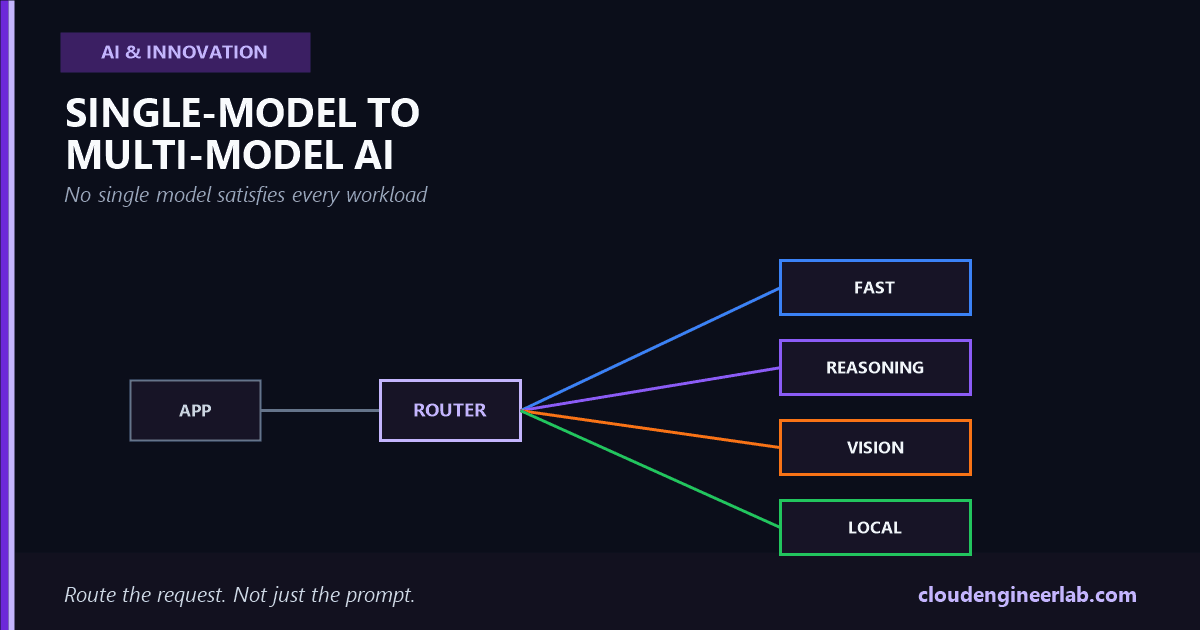
No single model satisfies every workload. Real companies now route requests across fast, reasoning, vision, and local models instead of picking just one.
A 2026 industry report from F5 found that organizations now operate or evaluate an average of seven AI models across their environments, and 78% run their own inference services rather than relying on a single external API. The report's own framing of why is blunt: "no single model satisfies every workload." That single sentence is the entire argument for this article.
The application that calls one LLM for everything was always the simplest thing to build. It's rarely the right thing to run once real usage, real cost, and real reliability requirements show up.
The one sentence to remember
A single model is a starting point, not an architecture. The moment cost, latency, and reliability actually matter, the question stops being "which model" and becomes "which model, for this specific request, right now."
This is an architectural look at what's replacing the single-LLM application: model routing, the specific cost and latency wins it unlocks, why specialized and fallback models both matter, and the real tradeoffs between open-source and proprietary models once you're choosing several instead of one.
From One Model to a Router
The router is the actual architecture now
In the single-model version, the interesting engineering decision was the prompt. In the multi-model version, the interesting engineering decision is what the router sees before it picks a model: task complexity, latency budget, cost ceiling, compliance requirements, whether the input includes an image at all. Get that decision wrong and you're either overpaying for simple requests or under-serving hard ones.
Model Routing
A routing layer sits between the application and every model it can call, inspecting each request and sending it to whichever model actually fits, based on cost, latency, complexity, or business rules, rather than the application deciding once, in code, at build time.
Route on signals, not guesses
Real routing gateways classify requests by content (does this need reasoning, or just retrieval), by header or metadata (which customer tier, which compliance zone), or by explicit rules (this endpoint always uses the fast model). The router's whole job is picking correctly before any model is ever called, not after.
Treat the router itself as infrastructure, not a script
Purpose-built AI gateways now exist specifically for this, some open-source and built for sub-microsecond routing overhead, because at real request volume the router's own latency becomes part of the budget it's supposed to be protecting.
Make routing decisions auditable
Emerging practice in this space, sometimes called a "route receipt," treats which model handled a request as a fact worth logging, not just an implementation detail, so a routing decision can be reviewed or disputed after the fact the same way any other system decision can.
Cost Optimization
Frontier model pricing and fast-tier model pricing can differ by an order of magnitude or more for the same token. Sending every request, including the trivial ones, to the most capable model available is the single most common source of avoidable AI spend.
The pattern that actually saves money
Route the easy majority of traffic, classification, simple extraction, short factual lookups, to a fast, cheap model, and reserve the expensive, high-reasoning model for the smaller share of requests that genuinely need it. This is the same principle covered in more depth in The AI Inference Revolution: cost per token varies enormously across model tiers, and routing is what actually captures that gap instead of leaving it on the table.
Latency Optimization
Latency and reasoning depth trade against each other. A model capable of genuinely deep, multi-step reasoning is rarely the fastest model available, and forcing every request through it means even trivial requests inherit that latency cost.
Routing lets an application hold both: a fast model in front for anything latency-sensitive and simple, with the slower, more capable model reserved for the specific requests where a user or a business process can actually tolerate, or benefits from, the extra time it takes to think something through properly.
Specialized Models
A general-purpose model handles a huge range of tasks acceptably. It rarely handles every specific task as well as a model built specifically for it.
| Specialized model type | Why it earns its place in the architecture |
|---|---|
| Vision models | Purpose-built for image understanding, consistently outperforming a general model asked to handle vision as one capability among many |
| Code-specialized models | Trained with a much higher density of code, catching patterns and idioms a generalist model trained on broader text handles less reliably |
| Embedding models | A completely different task from generation, retrieval quality depends on this being genuinely good, not just adequate |
| Local/on-device models | Smaller by necessity, but the only option when the actual requirement is offline operation or data that structurally can't leave the device |
Specialization is why the router has more than two branches
A router that only ever chooses between "fast" and "capable" is really just tiering one model family by size. Real multi-model architectures route by kind of task at least as often as by difficulty, because the vision model isn't a smaller reasoning model, it's a genuinely different tool.
Fallback Models
Every model provider has outages. A single-model application experiences that outage as a full stoppage. A multi-model application with a real fallback chain experiences it as degraded service instead.
Define the fallback chain before you need it
A defined sequence, primary model, then a secondary provider, then a third, means a failure at any one point in the chain doesn't take the whole feature down. Improvising a fallback path during an actual outage is a worse time to design one.
Know when the fallback shouldn't be another model
For the most critical processes, the safest fallback isn't a different LLM at all, it's a deterministic, rule-based path, or a human in the loop, the same failure-handling principle covered in AI Agents Are Not Chatbots: not every failure should be retried with more AI.
Open-Source vs Proprietary Models
Neither is categorically better. They win different parts of a real multi-model deployment.
| Proprietary models | Open-source models | |
|---|---|---|
| Best for | Frontier reasoning, safety-sensitive tasks, capability you can't yet get elsewhere | Data residency and compliance requirements, cost control at real scale, deep customization |
| Cost shape | Usage-based, scales with volume | Infrastructure-based, you're paying for the hardware whether it's busy or not |
| Control | You call an API; the provider controls the weights, updates, and availability | You can self-host, fine-tune, and fully control what's running and where |
| Typical real use | The reasoning and vision branches of the router | The fast, high-throughput, and local branches, where cost or data control matter more than raw capability |
This is a portfolio decision, not a loyalty decision
Real multi-model deployments mix both deliberately: a proprietary frontier model for the requests that need it, and open-source models like Llama, Mistral, or DeepSeek variants where the task doesn't need frontier capability and the cost or compliance profile favors running it yourself. Treating this as "which one company do we standardize on" misses the entire point of routing in the first place.
Model Selection
The router needs a real, defined basis for choosing, not a single hardcoded default with occasional exceptions.
| Signal | What it should decide |
|---|---|
| Task complexity | Whether this request needs deep reasoning or a fast, shallow pass is enough |
| Latency budget | Whether the caller (a human waiting, or another automated step) can tolerate a slower, more capable model |
| Cost ceiling | Whether this request category can justify frontier pricing at the volume it runs |
| Compliance and data residency | Whether the data in this request is even allowed to leave a specific environment |
| Modality | Whether the request includes an image, audio, or anything a text-only model simply can't process |
Write the selection logic down
If the actual reason a request goes to one model over another lives only in one engineer's head, it isn't a model selection strategy, it's an accident waiting to be inconsistent. A router's rules should be explicit enough that a second engineer could predict where any given request will end up.
Reliability
Beyond fallback chains for individual failures, multi-model architecture is itself a reliability strategy. A single-provider application has a single point of failure, that provider's availability, pricing, and roadmap decisions all become the application's own risk, with no leverage to do anything about it.
Spreading real workload across multiple providers changes that relationship: an outage at one provider degrades rather than breaks the system, and having genuine alternatives in production gives an organization actual negotiating leverage on pricing and terms, not just a theoretical one.
The Bottom Line
The single-model application isn't wrong, it's a starting point that stops being sufficient the moment cost, latency, specialization, or reliability actually start to matter at real scale. Seventy-eight percent of organizations already run their own inference infrastructure and manage an average of seven models for exactly this reason: no model, however capable, is simultaneously the cheapest, fastest, most specialized, and most reliable choice for every request an application makes.
The question worth asking about your own architecture
If your application calls one model for everything, which of these five, cost, latency, a specialized task type, a fallback for outages, a compliance constraint, is quietly costing you the most by not having a router in front of it yet? That's usually where the first routing rule belongs.
The model you started with got you to a working product. The router is what gets you to a system that's actually built to run.

Written by
Chetan Yamger
Cloud Engineer · AI Automation Architect · Modern Workplace Consultant
Cloud Engineer, AI Automation Architect, and Modern Workplace Consultant based in Amsterdam, Netherlands. Specializing in scalable, secure enterprise solutions with Microsoft Azure, Intune, PowerShell, and AI-driven automation using ChatGPT, Gemini, and modern LLM technologies.
Stay in the loop.
New articles, straight to you.
Deep-dive technical articles on Intune, PowerShell, and AI — no noise, no spam.
Discussion
Share your thoughts — your email stays private
Leave a comment