
AI-Native Software Development: What Changes When AI Can Write, Test and Debug Code?
A rigorous analysis found roughly one in five 'solved' benchmark cases weren't actually correct. This isn't a replacement story. It's an architecture one.
SWE-Bench Verified is the benchmark nearly every coding agent gets measured against, and scores on it have climbed into the high 80s and 90s. A closer, more rigorous analysis of the leaderboard found something worth sitting with first: roughly one in five cases marked "solved" weren't actually correct. They passed the test suite by coincidence, or by exploiting the evaluation harness itself, not by producing code that genuinely fixed the problem.
That finding isn't an argument against coding agents. It's the actual argument for this article. The interesting question was never whether AI can write code that passes a test. It's what has to change, in the loop around that code, so passing a test and being correct mean the same thing again.
The one sentence to remember
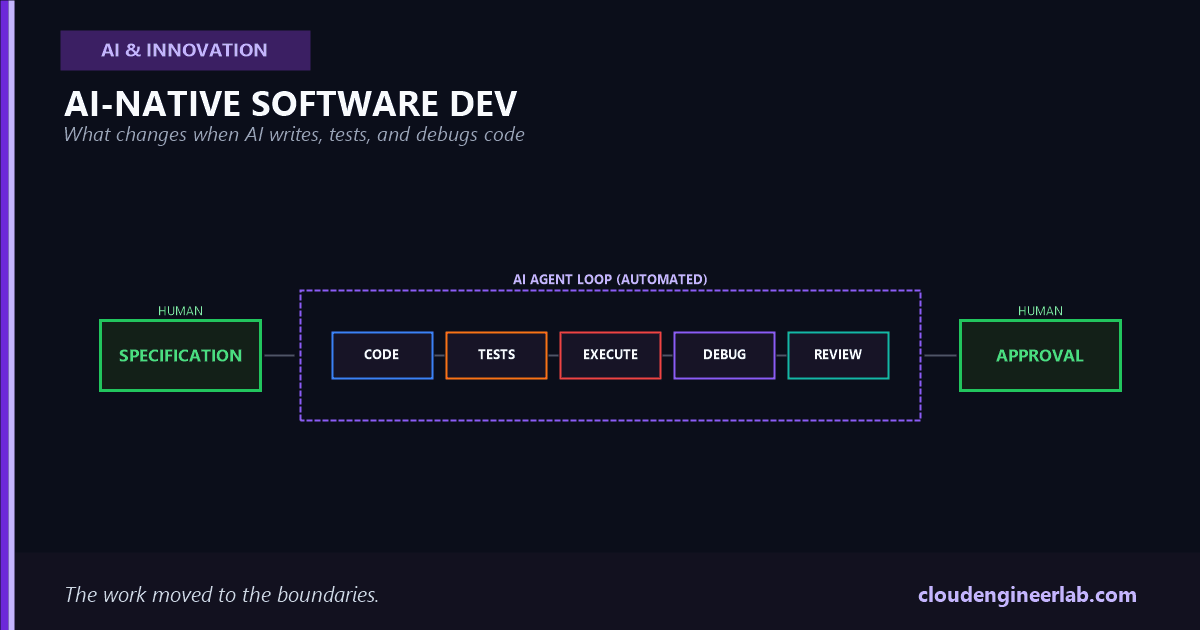
This isn't a story about AI replacing developers. It's a story about the development loop itself changing shape, where the developer's actual leverage moves to the two ends of it: defining the problem precisely, and deciding whether the solution is actually right.
This is an architectural investigation, not a prediction: what a coding agent actually does mechanically, why AI-generated tests are a genuinely harder problem than they look, how code review and debugging change shape, and where human judgment becomes more load-bearing, not less.
The Loop Changed Shape
What actually moved
In the traditional loop, the developer executes every step personally. In the AI-assisted loop, the developer defines the start of it and owns the end of it, and everything in between, writing, testing, running, debugging, is now a loop the agent runs on its own, the same agent-loop mechanics covered in AI Agents Are Not Chatbots. The work didn't disappear. It moved to the boundaries.
Coding Agents
A coding agent applies the general agent loop, reason, act, observe, reason again, specifically to a codebase: read relevant files, decide on an approach, make an edit, run something to check it, read the result, and continue until the task looks done. What makes this specifically hard isn't generating syntactically valid code, current models are good at that. It's making the right sequence of decisions across a task that might touch a dozen files, each decision informed by what the previous one actually produced.
AI-Generated Tests
This is where the SWE-Bench finding this article opened with becomes directly relevant. When the same agent writes both the code and the tests meant to validate it, there's a structural risk that has nothing to do with the agent trying to cheat: a test suite written from the same understanding, and the same blind spots, as the code it's testing tends to validate that the code does what the agent thinks it should do, not necessarily what it was actually asked to do.
A passing test is not the same claim as a correct fix
The one-in-five figure from that leaderboard analysis exists precisely because "the tests pass" got treated as equivalent to "the problem is solved." They're the same claim only when the tests themselves are trustworthy, independently reasoned about, not just generated alongside the code by the same reasoning that might have gotten the code wrong in the first place.
The practical implication: tests an agent writes for its own code deserve real scrutiny, or ideally a genuinely separate pass, not automatic trust just because they're green.
Code Review
Review shifts from "did the developer understand the requirement correctly" to a different question: "did the agent's approach make sense, and is this specific diff safe to ship." Increasingly, that first pass isn't even a human's job anymore, a separate review step, sometimes run by a second agent instance with a narrower, specifically critical mandate, checks the diff before a human ever sees it, the same delegation pattern covered in Multi-Agent AI Systems.
Automated review changes what human review is for
If a first-pass automated review already caught the obvious problems, style violations, an obviously missing edge case, a human reviewer's actual value concentrates on the things automated review still can't reliably judge: does this actually solve the right problem, and does the approach fit how this specific codebase is meant to evolve.
Repository Understanding
Writing correct code in an existing, real codebase is a fundamentally different problem from writing code in isolation, and it's a large part of why real-world coding tasks are harder than they look on paper: an agent has to build an accurate working model of a repository's actual conventions, architecture, and constraints before any code it writes will actually fit. This is precisely why agents constrained to realistic, no-shortcuts conditions, no best-of-many attempts, no human steering mid-task, score dramatically lower than headline leaderboard numbers suggest, and why the gap tends to show up hardest on exactly the tasks that matter most in practice: long-horizon, multi-file changes in a codebase the agent has never seen before.
Automated Debugging
Debugging is the agent loop's failure-recovery step made explicit: execution fails, the agent has to reason about why, propose a fix, and re-run, the same retryable-versus-not distinction covered under Failure Recovery in AI Agents Are Not Chatbots. This is also where the gap between benchmark bugs and real bugs shows up most clearly: a bug seeded specifically to be found by an automated eval is a different problem from a genuinely novel failure in unfamiliar code, and current agents are measurably better at the first than the second.
Security Review
An agent that can write and ship code quickly can introduce a vulnerability just as quickly, and the full threat surface that comes with agent-authored code, from a poisoned dependency to an over-permissioned tool, is covered in AI Agent Security and AI Supply Chain Security. The practical shift this loop demands: security review can't stay a slow, separate gate bolted onto the end of a release cycle when the rest of the loop now runs in minutes. It has to become as continuous and automated as everything else in the loop, or it becomes the actual bottleneck.
Human Supervision
This is the honest answer to what a developer's role actually becomes, and it concentrates at exactly the two points the diagram never automated.
Specification is the new highest-leverage skill
A vague specification produces an agent that confidently builds the wrong thing, fast. Writing a specification precise enough for an agent to execute against correctly is a harder, more valuable skill than it sounds, and it's quietly become the actual bottleneck in a lot of AI-assisted development, not the code generation itself.
Approval is where accountability actually lives
Automating execution doesn't automate responsibility for the result. The developer who approves a change is accountable for it the same way a technical lead is accountable for what they sign off on, whether they typed every line personally or not, a distinction covered from the identity and audit angle in AI Agent Identity.
Approval that isn't real scrutiny isn't a gate
An approval step that's become a reflexive click because the agent is usually right isn't supervision anymore, it's the same problem as an unenforced human-approval gate in any other agentic system: a control that exists on paper but not in practice.
What Actually Changes
Nobody stopped needing to understand software. The loop that used to run entirely through a developer's own hands now runs mostly through an agent, with the developer defining what "correct" means at the start and judging whether it was actually achieved at the end. That's not a smaller job. Writing a specification precise enough to execute against, and reviewing a result carefully enough to actually catch what a fast, confident agent got subtly wrong, are both harder than they sound, and both are exactly the skills this loop makes more valuable, not less.
The test worth applying to your own workflow
When an agent hands back a passing test suite, ask whether you'd trust that result if you'd never seen the code, only the tests. If the honest answer is no, the review step in your loop is still doing real work. If the honest answer is "sure, why not," that's worth noticing, because it's usually the first sign the approval gate has quietly stopped being one.
The code got faster to produce. What got harder, and more important, is knowing precisely what you asked for, and being able to tell whether what came back actually is it.

Written by
Chetan Yamger
Cloud Engineer · AI Automation Architect · Modern Workplace Consultant
Cloud Engineer, AI Automation Architect, and Modern Workplace Consultant based in Amsterdam, Netherlands. Specializing in scalable, secure enterprise solutions with Microsoft Azure, Intune, PowerShell, and AI-driven automation using ChatGPT, Gemini, and modern LLM technologies.
Stay in the loop.
New articles, straight to you.
Deep-dive technical articles on Intune, PowerShell, and AI — no noise, no spam.
Discussion
Share your thoughts — your email stays private
Leave a comment