
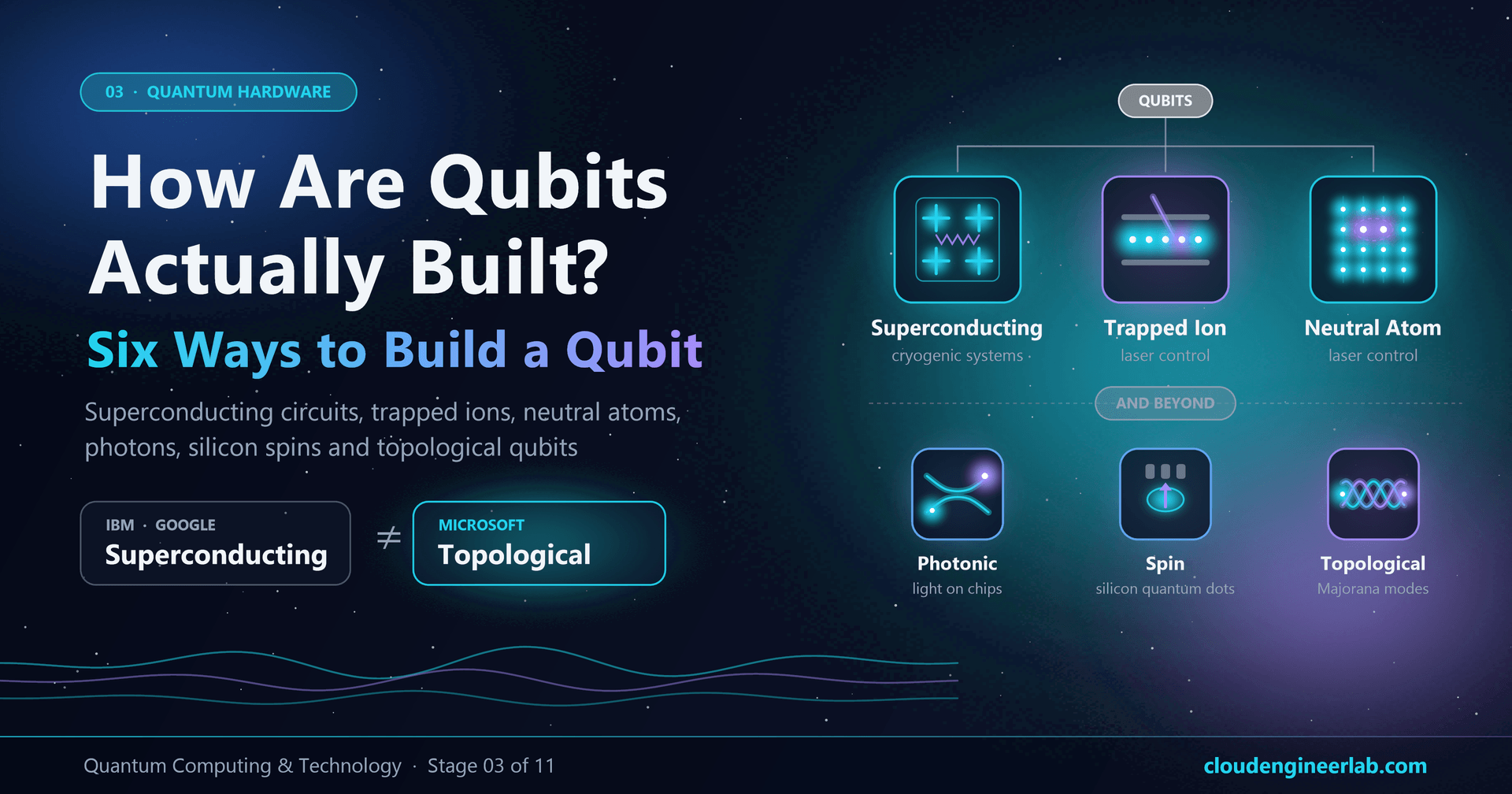
How Are Qubits Actually Built? Six Ways to Build a Quantum Computer
Superconducting circuits, trapped ions, neutral atoms, photons, silicon spins and topological qubits compared: how each works, who builds it, and the trade-offs.
Ask "what does a quantum computer look like?" and you'll get completely different answers depending on who you ask. At IBM or Google, it's a gold chandelier-shaped refrigerator with a chip at the bottom. At Quantinuum or IonQ, it's a vacuum chamber where a row of single atoms floats above a chip, lit by lasers. At QuEra or Pasqal, it's thousands of atoms held in a grid of light. At PsiQuantum, it's photons racing through silicon chips made in a semiconductor fab. At Microsoft, it's an exotic new material designed to host a kind of particle-like state that has never been used for computing before.
They are all building quantum computers, and they are all building them differently. There is no single universal quantum computer architecture. Not yet, and possibly not ever.
This post explains how qubits are physically built in each of the major approaches, what each is good and bad at, who is betting on which, and how to judge them without getting lost in marketing numbers.
Stage 03 of the learning path
This is stage 03, Quantum Hardware, in the Quantum Computing & Technology learning path. It builds on How Does a Quantum Computer Actually Work?, which follows one circuit through a superconducting machine in engineering detail. This post zooms out and compares that approach with every serious alternative.
First: What Does It Take to Be a Qubit?
A qubit can be built from almost anything that has two distinct quantum states you can control: a current flowing around a superconducting loop, the energy levels of an atom, the polarisation of a photon, the spin of an electron. Physics offers dozens of candidates. Very few make good computers.
In 2000, physicist David DiVincenzo wrote down what a practical quantum computer needs. His list is still the standard checklist, and it's the fairest way to compare technologies:
| DiVincenzo criterion | In plain language | Why it's hard |
|---|---|---|
| 1. Scalable, well-defined qubits | You can make many of them, and each really has two usable states | Making 10 is a lab experiment; making a million is an industry |
| 2. Reliable initialisation | You can reset every qubit to 0 at the start | Leftover heat or errors leave some qubits in the wrong state |
| 3. Long coherence, compared to gate time | The quantum state survives long enough to run many gates | What matters is the ratio: slow gates need long coherence |
| 4. A universal set of gates | You can perform any computation, including two-qubit gates | Two-qubit gates require qubits to interact strongly, but only when you want them to |
| 5. Qubit-specific measurement | You can read each qubit's result accurately | Reading one qubit must not disturb its neighbours |
He added two more for quantum networking: converting stationary qubits into "flying" qubits (usually photons) and sending them reliably between locations. Those two matter for stage 10, Quantum Networking, and they're where photonic approaches shine.
Every technology below satisfies these criteria to some degree. They differ in which ones come easily and which are a constant fight.
The Big Three Today
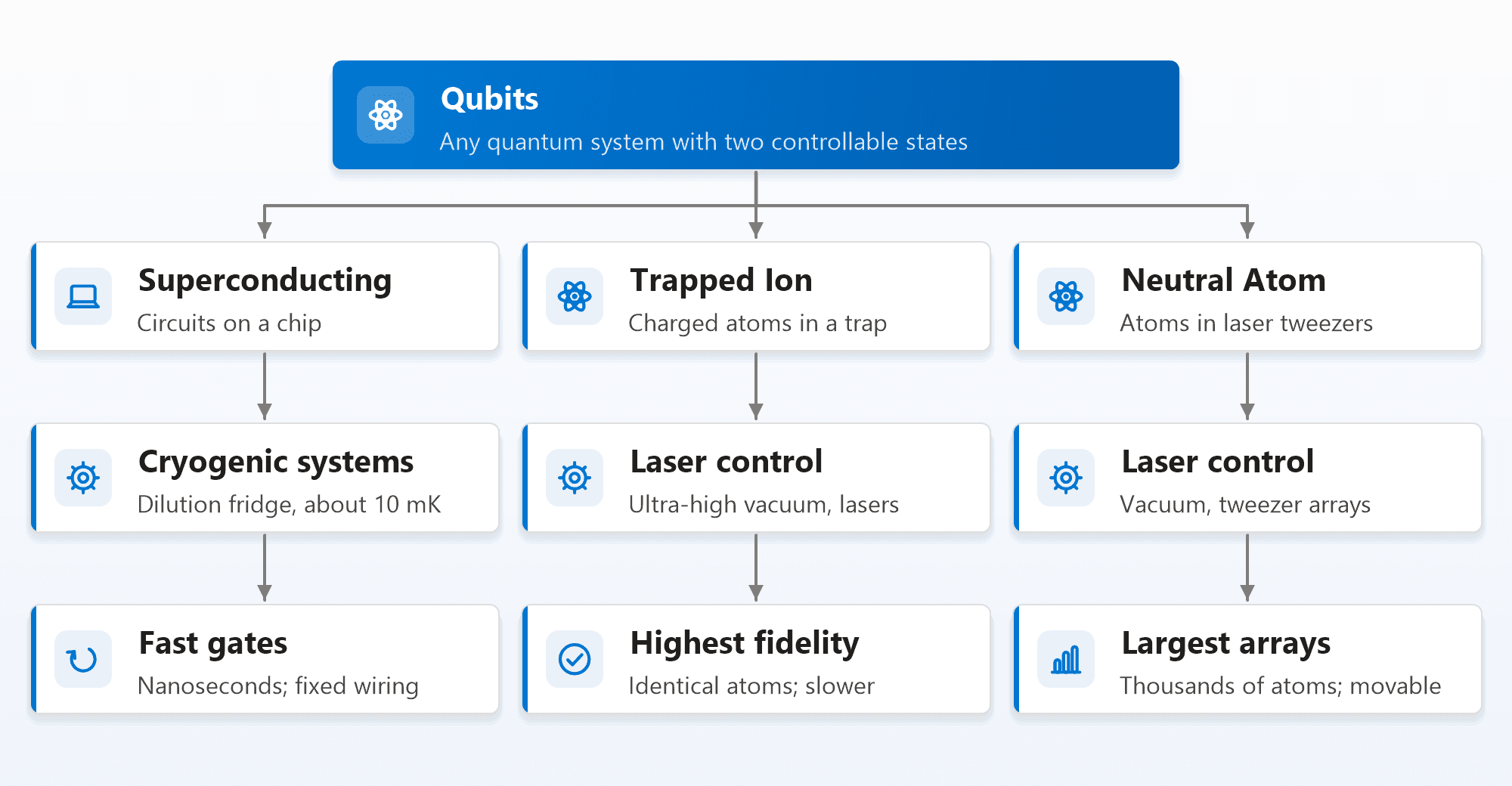
Most of today's cloud-accessible quantum computers use one of three technologies:
1. Superconducting qubits: artificial atoms on a chip
How it works. A superconducting qubit is a tiny electrical circuit, made of aluminium or niobium patterned on a silicon or sapphire chip, cooled until it superconducts and carries current with zero resistance. The key component is a Josephson junction, two layers of superconductor separated by a barrier a few atoms thick. It makes the circuit's energy levels unevenly spaced, so the lowest two can be addressed on their own and used as 0 and 1. The most common design is the transmon. Because it behaves like an atom but is engineered rather than found in nature, it's often called an artificial atom.
How it's controlled. Microwave pulses at around 4 to 6 GHz rotate the qubit; neighbouring qubits interact through couplers built into the chip; each qubit is read out through its own microwave resonator. The stage 02 flagship walks through every part of this in detail.
What it needs. A dilution refrigerator at around 10 millikelvin, with hundreds of cables running down into it. (Why Quantum Computers Need Extremely Cold Temperatures explains why.)
Strengths.
- Fast. Gates take tens of nanoseconds; a full shot takes microseconds.
- Made with chip fabrication. Qubits are patterned with lithography, using techniques from the semiconductor industry.
- Most mature software ecosystem, and the longest record of public cloud access.
Weaknesses.
- No two qubits are identical. Fabrication variation means every qubit has a slightly different frequency and quality, and needs individual calibration.
- Fixed, limited connectivity. Each qubit talks only to the few neighbours it's wired to, so distant interactions need extra SWAP gates.
- Wiring and refrigeration limits. Every qubit adds cables and heat load, which makes scaling to millions of qubits an engineering challenge in itself.
- Material defects. Microscopic flaws in the chip absorb energy and make coherence fluctuate.
Who's building it. IBM (its Heron and newer processors, with a published roadmap towards a fault-tolerant system called Starling around 2029), Google (the Willow chip, which in late 2024 showed error correction improving as the code grew), plus Rigetti, IQM, Fujitsu with RIKEN, and others. Amazon and Alice & Bob are exploring "cat qubits", a superconducting variant designed so that one type of error is naturally suppressed, which could reduce the overhead of error correction.
2. Trapped-ion qubits: nature's identical qubits
How it works. Take an atom (commonly ytterbium, barium or calcium), remove one electron so it has an electric charge, and it becomes an ion. Electric fields from a chip-like electrode structure can then hold it suspended in an ultra-high vacuum, a fraction of a millimetre above the surface. A row of ions sits in a line, repelling each other like magnets with the same pole facing. Two energy levels of each ion's remaining electrons are the qubit's 0 and 1.
How it's controlled. Precisely tuned laser beams (or, in some newer designs, microwaves and magnetic field gradients) drive single-qubit gates. For two-qubit gates, the ions are made to vibrate together as a group: because they're all pushing on each other, a shared motion links them, and that link is used to entangle any pair. Measurement shines a laser on each ion: an ion in one state glows (it scatters light), an ion in the other stays dark, and a camera or photon detector sees which is which.
What it needs. Ultra-high vacuum, very stable lasers and optics, and often some cryogenic cooling, though not the millikelvin temperatures superconducting qubits need.
Strengths.
- Every qubit is identical. Every ytterbium ion in the universe is exactly the same. There's no fabrication variation in the qubit itself.
- The highest fidelities. Trapped ions hold many of the records for gate and measurement accuracy, with the best two-qubit gates reported at or above 99.9%.
- Long coherence, from seconds up to much longer in some setups.
- Excellent connectivity. In a single trap, any ion can interact with any other directly, so compilers need far fewer SWAPs.
Weaknesses.
- Slow. Gates take microseconds to hundreds of microseconds, roughly a thousand times slower than superconducting gates. Since what matters is coherence compared with gate time, the long coherence compensates, but total run time is longer.
- Scaling one trap is hard. A long chain of ions becomes unstable and harder to control. The leading answer is the QCCD (quantum charge-coupled device) architecture: a chip with many zones, where ions are physically shuttled between storage, gate and readout areas.
- Complex optics. Many precisely aimed laser beams are hard to scale and maintain.
Who's building it. Quantinuum (its H-series and newer Helios systems, built on the QCCD design) and IonQ (which in 2025 acquired Oxford Ionics, whose approach replaces many lasers with electronic, microwave-based control on the chip), plus Alpine Quantum Technologies, eleQtron and others.
3. Neutral-atom qubits: thousands of atoms held by light
How it works. Neutral atoms (no charge), such as rubidium, caesium, strontium or ytterbium, are cooled by lasers to microkelvin temperatures and then caught, one by one, in optical tweezers: tightly focused laser beams that hold a single atom at their focus. A device that splits one laser into hundreds or thousands of beams creates a whole grid of tweezers. Two energy levels of each atom are the qubit.
How it's controlled. For two-qubit gates, a laser briefly excites atoms into a Rydberg state, where the outermost electron is pushed far from the nucleus and the atom becomes enormous. Two Rydberg atoms close together interact strongly, and one can block the other from becoming excited (the "Rydberg blockade"), which produces an entangling gate. Readout is by imaging: a camera photographs which atoms glow.
What it needs. Ultra-high vacuum, many lasers and optics, and cameras. The atoms are laser-cooled, so the system doesn't need a dilution refrigerator.
Strengths.
- Huge arrays. Neutral atoms don't repel each other, so they can be packed into large 2D and even 3D grids. Arrays of more than 6,000 trapped atoms have been demonstrated in research.
- Identical qubits, just like ions.
- Movable connectivity. Tweezers can physically move atoms mid-computation, rearranging which qubits are neighbours, and can apply the same operation to many atoms at once.
- Strong early results on logical qubits. Some of the first experiments with dozens of error-corrected logical qubits used neutral atoms.
Weaknesses.
- Atom loss. Atoms occasionally escape their tweezers and must be detected and replaced, ideally without stopping the computation. Continuous reloading is an active area of research.
- Slower cycles. Readout by imaging, and moving atoms around, is slow compared with superconducting systems.
- Gate fidelity has improved fast but has generally trailed the best ions.
Who's building it. QuEra (working with Harvard and MIT researchers), Pasqal, Atom Computing (which has worked with Microsoft on logical qubits) and Infleqtion, among others.
Beyond the Big Three
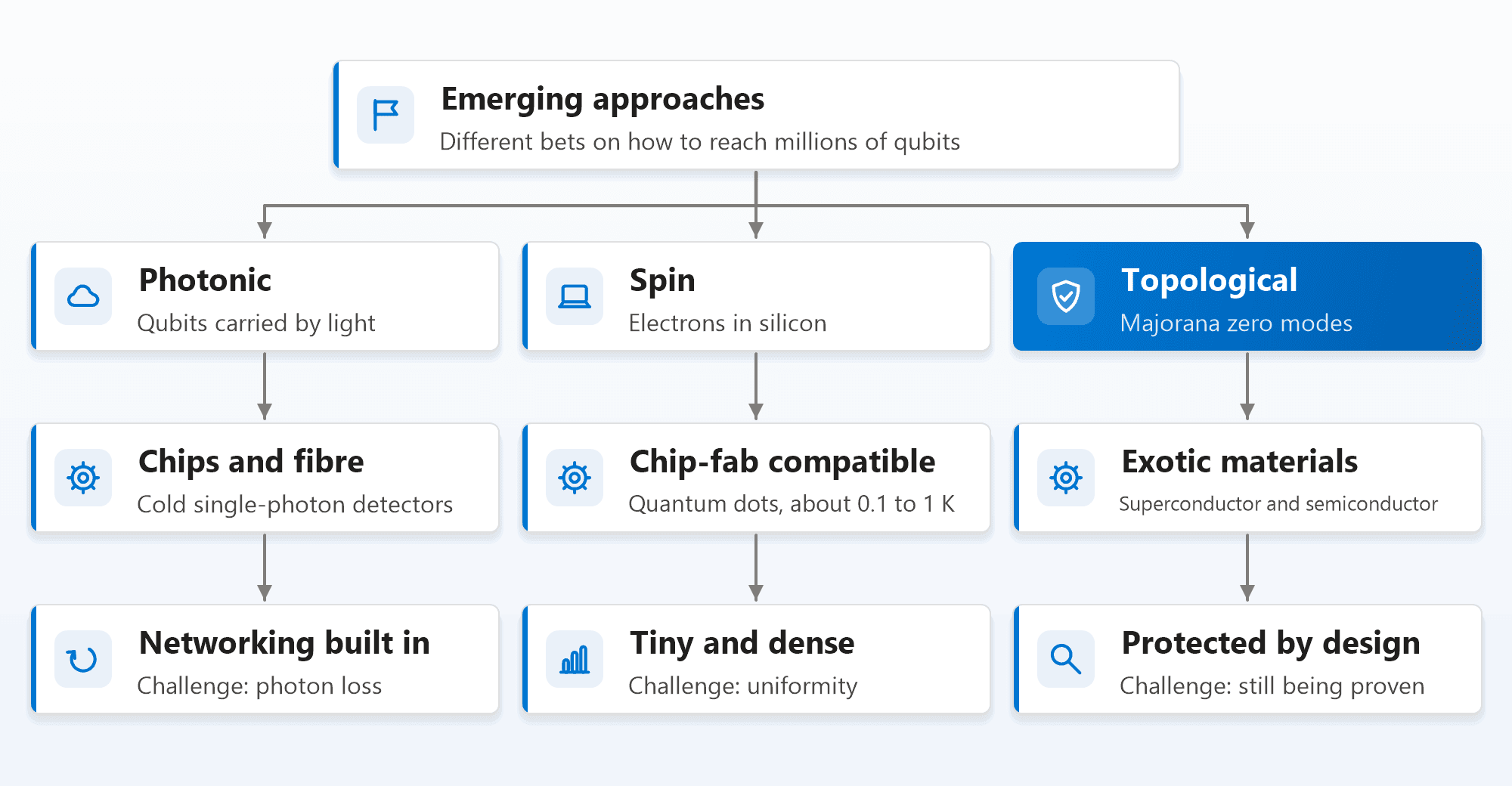
Three more approaches are earlier in their development, but each is a serious bet with major investment behind it, because each attacks a scaling problem the big three haven't solved.
4. Photonic qubits: computing with light
How it works. A single particle of light, a photon, can carry a qubit in several ways: in its polarisation, in which of two paths it takes through a chip, or in its arrival time. Photonic quantum computers guide photons through networks of waveguides etched into silicon or silicon-nitride chips, where beam splitters and phase shifters act as gates.
The twist. Photons barely interact with each other, which is great for coherence (they hardly decohere at all) but terrible for two-qubit gates. So photonic machines use a different model of computation. Instead of applying a sequence of gates, they create large entangled states of many photons and then measure them in carefully chosen ways; the measurements themselves drive the computation. This is called measurement-based quantum computing, and the leading variant, fusion-based quantum computing, builds big entangled states by repeatedly "fusing" small ones.
Strengths.
- Most of the system runs at room temperature, and photons travel through standard optical fibre.
- Manufactured in semiconductor foundries, using the same processes as chips for telecoms and data centres.
- Natural networking. Photons are already the "flying qubits" DiVincenzo's networking criteria call for, which is why photonics matters for the quantum internet.
Weaknesses.
- Loss is the enemy. Every lost photon is a lost qubit, and every component loses a little light.
- Making photons on demand is hard. Many sources produce single photons only some of the time.
- Detectors still need cooling. The most efficient single-photon detectors are superconducting and operate at a few kelvin, though that's far easier than millikelvin.
Who's building it. PsiQuantum (fusion-based, manufacturing with GlobalFoundries, and planning utility-scale machines at sites in Australia and the US), Xanadu (which uses squeezed light and a special kind of error-correctable photonic state), Quandela, ORCA Computing and others.
5. Spin qubits: quantum computing on a silicon chip
How it works. An electron has a quantum property called spin, which behaves like a tiny magnet that can point up or down: a natural 0 and 1. Spin qubits trap single electrons (or holes, the absence of an electron) in quantum dots, tiny regions of a silicon chip defined by nanoscale electrodes, or bind them to individual phosphorus atoms placed in silicon. Microwave or electric pulses rotate the spin; neighbouring spins interact when the barrier between their dots is lowered.
Strengths.
- Tiny. A spin qubit is around a hundred nanometres across, thousands of times smaller than a superconducting qubit, so millions could fit on one chip.
- Built in conventional chip fabs. It's the approach closest to how today's processors are manufactured, which is why Intel is invested in it.
- Warmer operation. Some spin qubits work at around 1 kelvin rather than 10 millikelvin, where far more cooling power is available, which could let control electronics sit right next to the qubits.
Weaknesses.
- Uniformity. Tiny variations in the silicon and electrodes make each dot slightly different, much like superconducting qubits but at a much smaller scale.
- Small systems so far. Two-qubit gates above 99% have been demonstrated, but devices remain small, typically a handful to a few dozen qubits.
- Wiring density. Packing qubits densely is the point, but getting control signals to millions of tiny qubits is its own problem.
Who's building it. Intel (its 12-qubit Tunnel Falls research chip, released in 2023), Diraq, Quantum Motion, Silicon Quantum Computing (with phosphorus atoms placed one at a time) and Equal1, along with major research labs.
6. Topological qubits: protection built into the physics
The idea. Every approach above stores a qubit in something local (one circuit, one atom, one photon) and then fights to protect it from noise. A topological qubit stores information non-locally, spread across a pair of special states at opposite ends of a tiny wire, called Majorana zero modes. A local disturbance, like a stray bit of noise at one end, can't change the stored information, because the information isn't in any one place. The protection comes from the physics itself, rather than from layers of error correction added afterwards.
Why it would matter. If it works as intended, a topological qubit would be far less error-prone from the start, so each logical qubit might need far fewer physical qubits. That could make the path to a million-qubit machine dramatically shorter.
The catch. Majorana zero modes don't occur in ordinary materials. They have to be engineered in hybrid nanowires that combine a semiconductor (such as indium arsenide) with a superconductor (such as aluminium), cooled to millikelvin temperatures and tuned with magnetic fields. Proving they're really there, and not something that merely looks similar in measurements, has been one of the hardest problems in experimental physics.
Who's building it. Microsoft has centred its quantum roadmap on this approach. In February 2025 it announced Majorana 1, a chip built on what it calls a "topoconductor" material, as the first step towards a topological qubit architecture designed to scale to a million qubits on a single chip. The announcement was significant, and it was also met with scientific debate: the accompanying peer-reviewed paper did not by itself establish that the observed states are Majorana modes, and independent researchers have asked for stronger evidence. In the meantime, Microsoft has also partnered with Quantinuum (trapped ions) and Atom Computing (neutral atoms) on logical-qubit demonstrations, and its Azure Quantum cloud offers access to other companies' hardware. Nokia Bell Labs and academic groups are pursuing topological approaches too.
Treat this one as the highest-risk, highest-reward bet
Topological qubits are the least proven of the six approaches. If they work as hoped, they could leap ahead; if the physics turns out to be harder than expected, other technologies will get to useful error-corrected machines first. Both outcomes are still possible, and the debate around Majorana 1 is a normal part of how a new physical claim gets tested.
Others worth knowing
- Diamond colour centres (NV centres). Defects in a diamond crystal whose spins act as qubits, working at or near room temperature. Leading candidates for quantum sensing and quantum networking nodes, less so for large-scale computing.
- Quantum annealers. D-Wave builds superconducting machines that solve optimisation problems by gradually relaxing a large system into a low-energy state. They are not general-purpose gate-based quantum computers, so they're a separate category from everything above.
The Six Approaches Side by Side
| Superconducting | Trapped ion | Neutral atom | Photonic | Spin (silicon) | Topological | |
|---|---|---|---|---|---|---|
| The qubit is | A circuit with a Josephson junction | The energy levels of a charged atom | The energy levels of a neutral atom | A property of a single photon | The spin of an electron | A non-local state of Majorana modes |
| Operating environment | About 10 mK | Vacuum, lasers, some cooling | Vacuum, lasers | Mostly room temperature, cold detectors | About 0.1 to 1 K | About 10 mK |
| Gate speed | Fastest (nanoseconds) | Slow (microseconds and up) | Moderate | Fast, but probabilistic | Fast | Unknown at scale |
| Two-qubit gate quality | High | Highest | High and rising | Depends on photon loss | High in small devices | Not yet demonstrated at scale |
| Connectivity | Fixed neighbours | Any to any (within a trap) | Reconfigurable by moving atoms | Set by chip and fibre | Fixed neighbours | Designed into the chip |
| Biggest scaling challenge | Wiring, defects, refrigeration | Shuttling, optics | Atom loss, cycle speed | Loss, photon sources | Uniformity, wiring | Proving the physics |
| Maturity | Most deployed | Mature, commercial | Rapidly maturing | Early, heavily funded | Early | Earliest |
| Examples | IBM, Google, Rigetti, IQM | Quantinuum, IonQ | QuEra, Pasqal, Atom Computing | PsiQuantum, Xanadu, Quandela | Intel, Diraq, Quantum Motion | Microsoft |
Figures in this space change quickly. Use the table to understand the trade-offs, and check each vendor's latest published specifications for current numbers.
How to Judge a Quantum Computer Without Getting Fooled
Press releases love one number: the qubit count. It's the least useful number on its own. A 1,000-qubit machine with poor gates can be less capable than a 50-qubit machine with excellent ones, because errors compound with every gate (the stage 02 flagship works through the maths: 200 gates at 99.5% leaves only a 37% chance of an error-free run).
Ask these questions instead:
1. How good are the two-qubit gates?
2. How does coherence compare with gate time?
3. What's the connectivity?
4. How many logical qubits, at what error rate?
5. How fast can it run error-corrected operations?
6. Can it be manufactured and scaled?
Why There's No Winner Yet
Classical computing has a useful precedent. Early computers were built from mechanical relays, then vacuum tubes, then discrete transistors, before the integrated circuit made silicon chips the clear winner. Each technology worked; each was replaced by one that scaled better. Quantum computing hasn't found its integrated circuit yet.
Each approach makes a different bet about which problem is hardest:
- Superconducting bets that fast gates and chip fabrication will win once wiring and refrigeration are engineered.
- Trapped ions bet that perfect, identical qubits and top fidelity matter most, and that shuttling can solve scale.
- Neutral atoms bet that scale and flexible connectivity are the shortest route to many logical qubits.
- Photonics bets that room-temperature, fab-made, naturally networkable hardware will scale best, if loss can be beaten.
- Spin qubits bet that the semiconductor industry's manufacturing machinery will eventually do for qubits what it did for transistors.
- Topological bets that building protection into the physics will leapfrog everyone, if the physics can be proven.
It's also possible there won't be a single winner. Future systems may combine technologies: for example, matter-based qubits for computing, linked by photons over fibre into larger networks.
What This Means for You
For most developers and IT professionals, the hardware race is something you can watch without having to bet on it:
- Cloud platforms span technologies. Amazon Braket offers several hardware types (including trapped-ion, superconducting and neutral-atom machines) through one service; Azure Quantum works with several providers; IBM offers its own superconducting systems. You can try more than one.
- Software is increasingly hardware-agnostic. SDKs such as Qiskit, Cirq and CUDA-Q let you write a circuit once and compile it for different backends. The compiler handles native gates and connectivity.
- Avoid lock-in. Just as with any cloud service, keep algorithms and data independent of one vendor's hardware, because the leader in five years may not be the leader today.
- Watch logical qubits, not physical ones. When the headlines move from "1,000 qubits" to "100 reliable logical qubits running millions of operations", that's the signal that useful quantum computing, and the security implications covered in stages 08 and 09, are getting close.
Quick Recap
- A qubit is any controllable two-state quantum system, and the DiVincenzo criteria are the fair way to compare candidates.
- Superconducting qubits (IBM, Google) are fast chip-based circuits that need a dilution refrigerator.
- Trapped ions (Quantinuum, IonQ) are identical, highly accurate, fully connected, and slow.
- Neutral atoms (QuEra, Pasqal, Atom Computing) offer the largest, rearrangeable arrays, controlled by lasers.
- Photonic qubits (PsiQuantum, Xanadu) use light, mostly at room temperature, and are natural for networking, but must beat photon loss.
- Spin qubits (Intel and others) are tiny and fab-compatible, but still small-scale.
- Topological qubits (Microsoft's roadmap) aim to build error protection into the physics, and are the least proven.
- There is no universal architecture yet. Judge machines on gate quality, connectivity and logical qubits, not raw qubit counts.
What's Next on the Learning Path
With the machines understood, stage 04, Quantum Programming, gets hands-on: setting up Qiskit, running circuits on a simulator, then on real cloud hardware, and reading the results properly. The full 11-stage path is listed at the end of the beginner's guide.
Written by
Chetan Yamger
Cloud Engineer · AI Automation Architect · Modern Workplace Consultant
Cloud Engineer, AI Automation Architect, and Modern Workplace Consultant based in Amsterdam, Netherlands. Specializing in scalable, secure enterprise solutions with Microsoft Azure, Intune, PowerShell, and AI-driven automation using ChatGPT, Gemini, and modern LLM technologies.
Stay in the loop.
New articles, straight to you.
Deep-dive technical articles on Intune, PowerShell, and AI — no noise, no spam.
Discussion
Share your thoughts — your email stays private
Leave a comment