
Why Quantum Computers Need Extremely Cold Temperatures
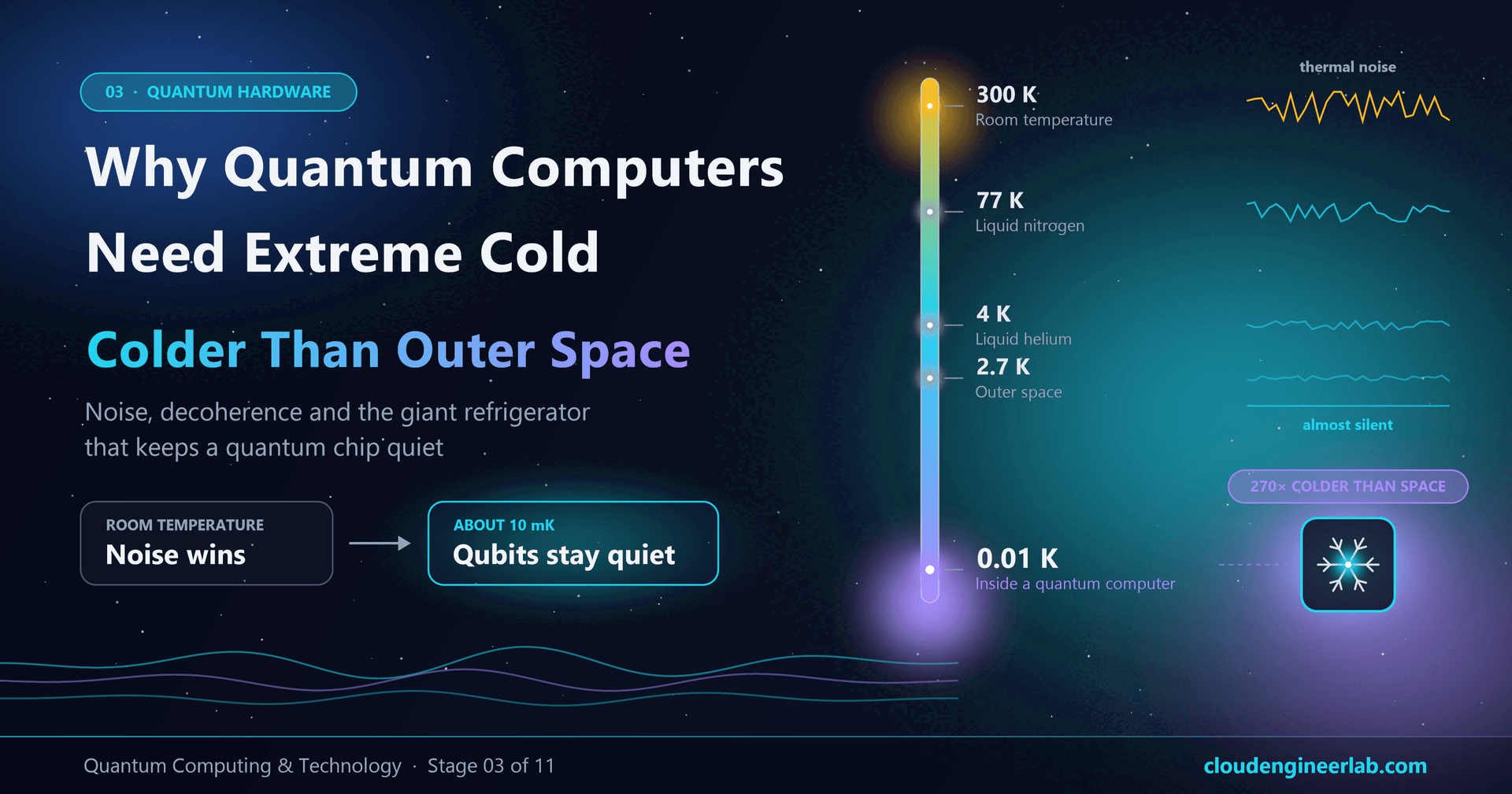
The inside of a quantum computer is about 270 times colder than outer space. Here's why heat destroys qubits, and why the machine looks like a giant chandelier.
Here's a fact that surprises almost everyone: some of the coldest places in the known universe are inside quantum computers.
Deep space, far from any star, sits at about 2.7 degrees above absolute zero, warmed only by the faint afterglow of the Big Bang. The chip at the heart of an IBM or Google quantum computer runs at about 0.01 degrees above absolute zero. That's roughly 270 times colder than outer space, maintained inside a machine in an ordinary building, next to people drinking coffee.
So why go to that much trouble? Not to stop the chip overheating, the way a gaming PC needs fans. A quantum chip produces almost no heat at all. The cold is there for a completely different reason: silence. This post explains what that means, why heat is a qubit's worst enemy, and why the result looks less like a computer and more like a giant golden chandelier.
Stage 03 of the learning path
This post is part of stage 03, Quantum Hardware, in the Quantum Computing & Technology learning path. It needs no background beyond knowing roughly what a qubit is; What Is Quantum Computing? A Beginner's Guide covers that in a few minutes. For the full engineering picture of the machine, see How Does a Quantum Computer Actually Work?.
How Cold Is "Extremely Cold"?
Scientists measure very low temperatures in kelvin (K). The scale starts at absolute zero (0 K, or −273.15 °C), the point where all thermal motion stops. Nothing can be colder. One kelvin is the same size step as one degree Celsius; the scale just starts at the bottom.
| Place | Temperature | In °C |
|---|---|---|
| A comfortable room | About 293 K | About 20 °C |
| Liquid nitrogen (used to freeze warts) | 77 K | −196 °C |
| Liquid helium (cools hospital MRI magnets) | 4.2 K | −269 °C |
| Deep space (the Big Bang's afterglow) | 2.7 K | −270.4 °C |
| Inside a superconducting quantum computer | About 0.01 K (10 millikelvin) | About −273.14 °C |
In Celsius, the last three rows look almost the same. That's misleading. What matters for physics is the distance from absolute zero, and on that scale, going from 2.7 K to 0.01 K is a 270-fold drop. Every one of those factors is hard-won.
What Temperature Really Is (and Why Qubits Hate It)
Temperature is just random motion. In a warm object, atoms jiggle, electrons jostle, and the object glows with faint invisible light. The hotter it is, the stronger and more frequent those random kicks are. That random energy is called thermal noise.
For everyday things, thermal noise doesn't matter. A cup of coffee doesn't forget it's a cup of coffee because its molecules are jiggling. But a qubit is different, because the information it holds is stored in a tiny amount of energy.
The whisper in a stadium
Think of a qubit as someone whispering a message, and thermal noise as a crowd. In a silent library, the whisper is perfectly clear. In a stadium during a goal, the whisper is completely lost. Nothing is wrong with the whisper; the room is just too loud.
For a superconducting qubit, the "whisper" is the energy difference between its 0 and 1 states. For a typical qubit running at 5 GHz, that energy corresponds to a temperature of about 0.24 K. So:
- At room temperature (about 300 K), the random thermal energy is more than 1,000 times bigger than the qubit's whisper. The qubit would be kicked between 0 and 1 constantly. In fact, at that temperature the chip doesn't even superconduct, so it isn't a qubit at all.
- At 10 millikelvin, the thermal energy is about 24 times smaller than the whisper. The crowd has gone home. The qubit stays where you put it.
How much the cold actually helps
Physics gives a precise answer to "how often does heat alone kick a resting qubit from 0 into 1?" It depends on the ratio between the qubit's energy and the temperature, and it falls off dramatically as things get colder:
| Temperature | Chance heat alone has put a 5 GHz qubit in 1 |
|---|---|
| Room temperature (300 K) | About 50%: completely random |
| 4 K (liquid helium) | About 48%: still useless |
| 1 K | About 44% |
| 100 mK | About 8% |
| 50 mK | About 0.8% |
| 20 mK | About 0.0006% |
| 10 mK | About 0.000000004% |
Notice the pattern. Liquid helium, the coldest substance most people have heard of, still isn't nearly cold enough: the qubit is as good as a coin flip. The useful range only starts below about a tenth of a kelvin. That's why "very cold" isn't enough; quantum computers need millikelvin temperatures.
(Real chips don't quite reach the ideal numbers at the bottom of the table. Tiny amounts of stray radiation leak in from warmer parts of the machine, so in practice a small fraction of a percent of qubits may start in the wrong state, and engineers actively reset them. But without the cold, there would be nothing to fix.)
The Problem at Room Temperature: Noise Becomes Lost Information
Here's what happens to a qubit when its surroundings are warm, step by step:
Noise is the random kicking. It can flip a 0 into a 1, or nudge the qubit's state by a small amount in a random direction.
Decoherence is the deeper problem. A qubit's power comes from its quantum state: its superposition, and the phase that decides how it interferes. Every random interaction with the warm environment acts like a tiny, accidental measurement: the surroundings "learn" a little about the qubit, and each time that happens, a little of the quantum behaviour leaks away. Eventually the qubit behaves like an ordinary, random classical bit.
An analogy: writing a message in the sand at the edge of the sea. On a calm day the message lasts for hours. In a storm, each wave erases a little more until nothing readable is left. Warmth is the storm. Decoherence is the erasing.
The Fix: A Cryogenic Environment
Now the same qubit, deep inside a refrigerator at about 10 millikelvin:
Side by side, the two paths look like this:
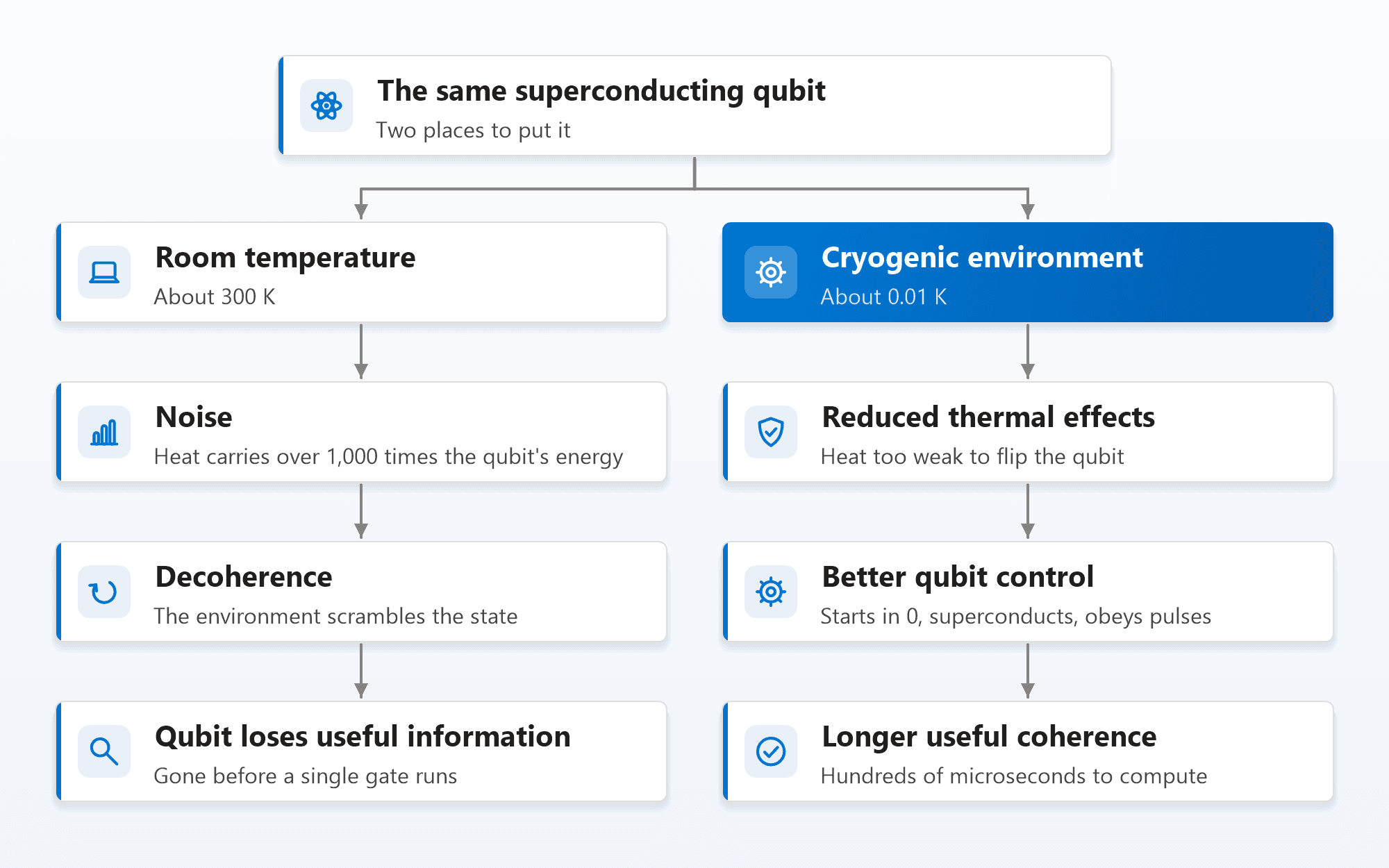
The cold does four separate jobs at once:
- It silences thermal noise. As the table above shows, at 10 mK heat simply can't supply enough energy to flip a qubit.
- It makes the qubit start in a known state. A computation has to begin with every qubit at 0. At millikelvin temperatures, qubits naturally settle into 0 and stay there.
- It makes the metal superconduct. Superconducting qubits are built from aluminium, which only becomes a superconductor below about 1.2 K (niobium, also used, below about 9 K). Superconductivity means current flows with zero resistance, so the circuit loses no energy as heat. A circuit with resistance is like a swing with friction: it quickly stops. A superconducting circuit can keep "swinging" in its quantum state for hundreds of microseconds. Going far below the threshold matters too, because it reduces stray broken electron pairs inside the superconductor that would otherwise steal energy from the qubit.
- It makes the readout possible. Reading a qubit means detecting a signal of just a handful of microwave photons. The special amplifiers that can catch something that faint only work properly when they're this cold too.
The result is longer useful coherence: today's best superconducting qubits keep their quantum state for around a hundred to a few hundred microseconds. That sounds tiny, but quantum gates take only tens of nanoseconds, so it's enough time for thousands of operations. At room temperature, the same chip wouldn't manage one.
Why the Machine Looks Like a Giant Refrigerator
Because it is one. The famous "golden chandelier" in photos of quantum computers isn't the computer; it's the inside of a dilution refrigerator, and the quantum chip is a small square at the very bottom, about the size of a fingernail.
The chandelier, explained
The chandelier is a stack of round plates, each one colder than the one above it. The machine is designed upside down compared with what you might expect: warm at the top, coldest at the bottom.
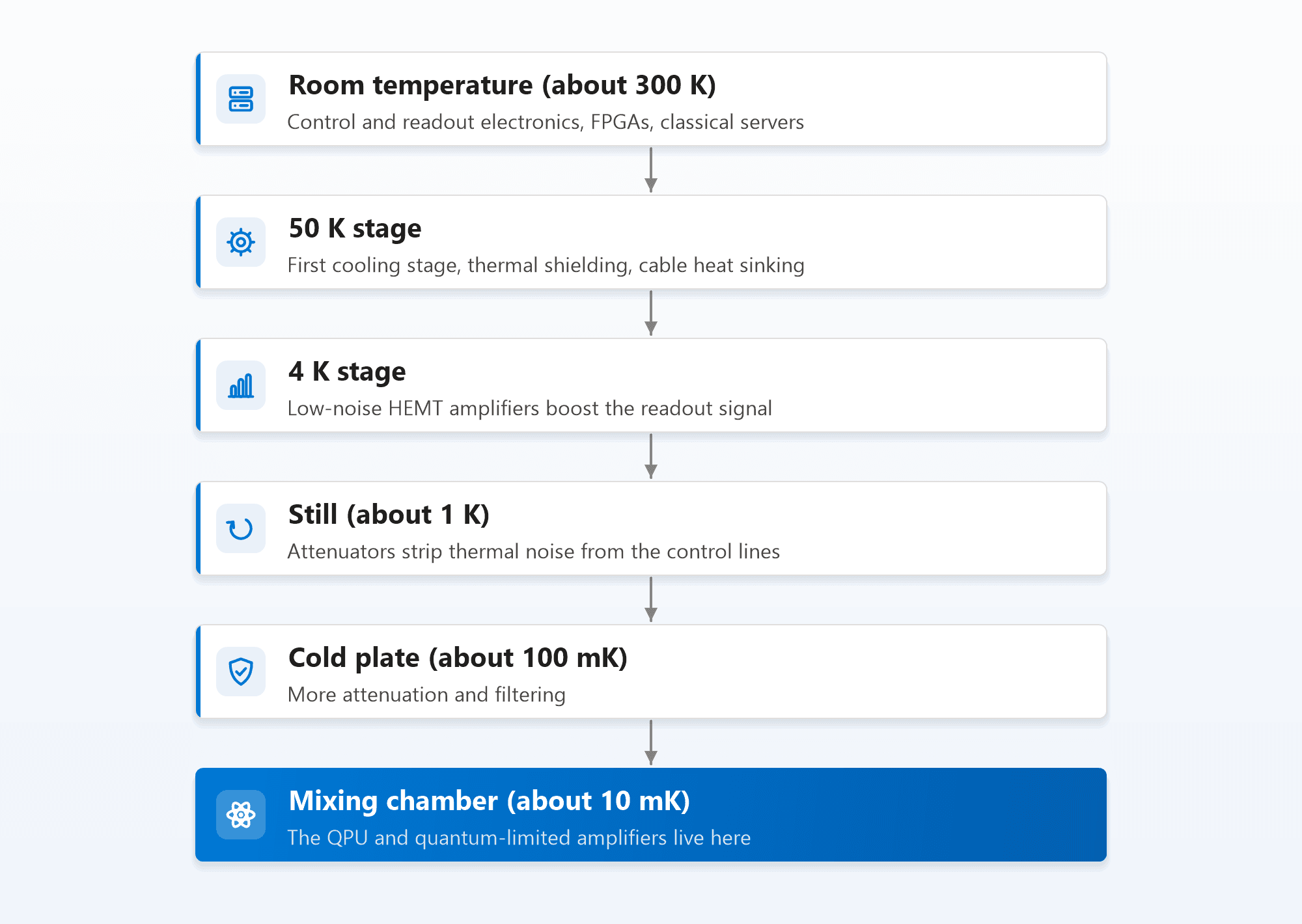
- Why gold? The plates are made of copper, which conducts heat extremely well, so each plate is the same temperature all over. They're plated with a thin layer of gold so the copper doesn't oxidise, which would spoil the thermal contact. The gold is functional, not decorative.
- Why stages? You can't cool something from room temperature to 10 mK in one step. Each stage removes heat at its own temperature, so very little heat reaches the next one down.
- Why so many cables? All the coiled wires running down the chandelier carry control signals to the qubits and readout signals back. Each cable is carefully anchored to every plate so it can't carry heat straight down to the chip.
- What you don't see. In operation, the chandelier is sealed inside nested metal cans: radiation shields at each temperature, an outer vacuum chamber (because air would conduct heat), and magnetic shielding, because stray magnetic fields disturb qubits too. The finished machine looks like a large, closed cylinder, often a couple of metres tall.
How do you get colder than outer space?
In two main steps.
Step 1: down to about 3 K with a pulse-tube cooler. This works on the same basic principle as the refrigerator in your kitchen, which cools by repeatedly compressing and expanding a gas. Here the gas is helium, the compressor sits outside the fridge, and the cycle is tuned to reach a few kelvin. Modern systems are "dry", meaning they don't need to be topped up with liquid helium like older machines did.
Step 2: down to 10 mK with a dilution unit. Below about 1 K, a mixture of two kinds of helium (helium-3 and helium-4) separates into two layers, a bit like oil and water. When helium-3 atoms are drawn across the boundary from one layer into the other, they absorb heat, much like sweat evaporating from your skin cools you down. The fridge keeps this happening continuously by pumping the helium-3 around a closed loop. That process happens in the mixing chamber, the bottom plate, and it's what reaches millikelvin temperatures.
"I never knew that": facts about the fridge
- Cooling takes days. Bringing a dilution refrigerator from room temperature down to 10 mK typically takes a day or two. Warming it up again to work on the chip takes about as long, so engineers plan hardware changes carefully.
- It has almost no cooling power at the bottom. At its coldest stage, a dilution refrigerator can remove only a few to a few tens of microwatts of heat, thousands of times less than a small LED indicator light uses. That's why every cable, every signal and every bit of electronics near the chip is a heat budget problem.
- The cables are a real limit. Each extra qubit needs more cables, and each cable brings a little heat and noise down from the warm world. Fitting enough wiring into the fridge is one of the main obstacles to building much bigger superconducting machines.
- The special helium is rare. Helium-3 is extremely scarce on Earth; most of it comes as a by-product of nuclear materials decaying. Its limited supply and high price are a genuine concern for an industry that wants to build many more of these fridges.
- It uses more power than you'd think. The pumps and compressors that run a dilution refrigerator draw roughly 10 to 25 kilowatts, in the range of several household ovens left on permanently. The quantum chip itself uses almost none of it.
Does Every Quantum Computer Need a Giant Fridge?
No, and this is one of the more surprising parts of the story. What every qubit needs is a quiet environment, but "quiet" can be achieved in different ways. (How Are Qubits Actually Built? compares these technologies in depth.)
| Technology | How it keeps qubits quiet | Temperature of the machine |
|---|---|---|
| Superconducting (IBM, Google) | A dilution refrigerator | Chip at about 10 mK |
| Topological (Microsoft) | A dilution refrigerator | Chip at millikelvin temperatures |
| Spin qubits in silicon (Intel and others) | A refrigerator, but not always as extreme | About 0.1 to 1 K; some designs work above 1 K |
| Trapped ions (Quantinuum, IonQ) | Lasers slow the ions' motion almost to a standstill, in an ultra-high vacuum | Ions are laser-cooled; the apparatus is often near room temperature, though some systems add cryogenic cooling for a better vacuum |
| Neutral atoms (QuEra, Pasqal) | Lasers cool and hold the atoms | Atoms at millionths of a kelvin; the machine itself at room temperature |
| Photonic (PsiQuantum, Xanadu) | Photons barely interact with their surroundings | Mostly room temperature; the light detectors are cooled to a few kelvin |
The atom-based approaches use a remarkable trick called laser cooling, which won the 1997 Nobel Prize in Physics. Precisely tuned laser light pushes against atoms moving towards it, slowing them down, a little like a stream of ping-pong balls gradually stopping a rolling bowling ball. Atoms cooled this way reach millionths of a degree above absolute zero, even though the vacuum chamber around them, and the room around that, are at ordinary temperatures.
So "cold" really means: the qubit itself must be still and undisturbed. For a circuit on a chip, the only way to achieve that is to cool the whole chip. For a single atom floating in a vacuum, lasers can do it directly.
Common Myths About the Cold
| Myth | Reality |
|---|---|
| "The fridge stops the chip overheating, like PC cooling." | The chip produces almost no heat. The cold is about silencing thermal noise, not removing waste heat. |
| "Colder makes the computer run faster." | Gate speed doesn't come from the cold. The cold makes qubits reliable for long enough to be useful. |
| "Liquid helium is cold enough." | At 4 K a superconducting qubit is still close to a coin flip. It takes millikelvin temperatures. |
| "Every quantum computer is a giant fridge." | Only some technologies need one. Trapped-ion, neutral-atom and photonic machines mostly avoid millikelvin refrigeration. |
| "The gold chandelier is the computer." | It's the refrigerator's inside. The quantum chip is a fingernail-sized square at the bottom. |
Where This Is Heading
Engineers are attacking the cold from several directions at once:
- Bigger, better fridges. Larger dilution refrigerators, and systems that link several fridges together, give more space and cooling power for more qubits.
- Fewer cables. Control electronics designed to work at cryogenic temperatures can sit inside the fridge and combine many signals onto fewer wires.
- Warmer qubits. Spin qubits that work around 1 K or above would make cooling dramatically easier, because a refrigerator has far more cooling power at 1 K than at 10 mK.
- Avoiding the problem. Atom-based and photonic approaches sidestep millikelvin refrigeration entirely, trading it for lasers, vacuum and optics.
Quick Recap
- Quantum chips run at about 0.01 K, roughly 270 times colder than outer space.
- Temperature is random motion, and a qubit stores information in an energy so small that room-temperature noise is more than 1,000 times bigger.
- Warmth leads to noise, decoherence and lost information. Cold leads to quiet qubits, reliable control and long enough coherence to compute.
- Even 4 K isn't enough: the useful range starts below about 0.1 K.
- The "chandelier" is a dilution refrigerator: warm at the top, coldest at the bottom, gold-plated copper plates, with the chip a tiny square at the base.
- Not every quantum computer needs one: lasers can cool individual atoms without cooling the whole machine.
What's Next on the Learning Path
Stage 04, Quantum Programming, gets hands-on: setting up Qiskit, running circuits on a simulator, then sending them to a real quantum computer sitting at the bottom of one of these refrigerators. The full 11-stage path is listed at the end of the beginner's guide.

Written by
Chetan Yamger
Cloud Engineer · AI Automation Architect · Modern Workplace Consultant
Cloud Engineer, AI Automation Architect, and Modern Workplace Consultant based in Amsterdam, Netherlands. Specializing in scalable, secure enterprise solutions with Microsoft Azure, Intune, PowerShell, and AI-driven automation using ChatGPT, Gemini, and modern LLM technologies.
Stay in the loop.
New articles, straight to you.
Deep-dive technical articles on Intune, PowerShell, and AI — no noise, no spam.
Discussion
Share your thoughts — your email stays private
Leave a comment