
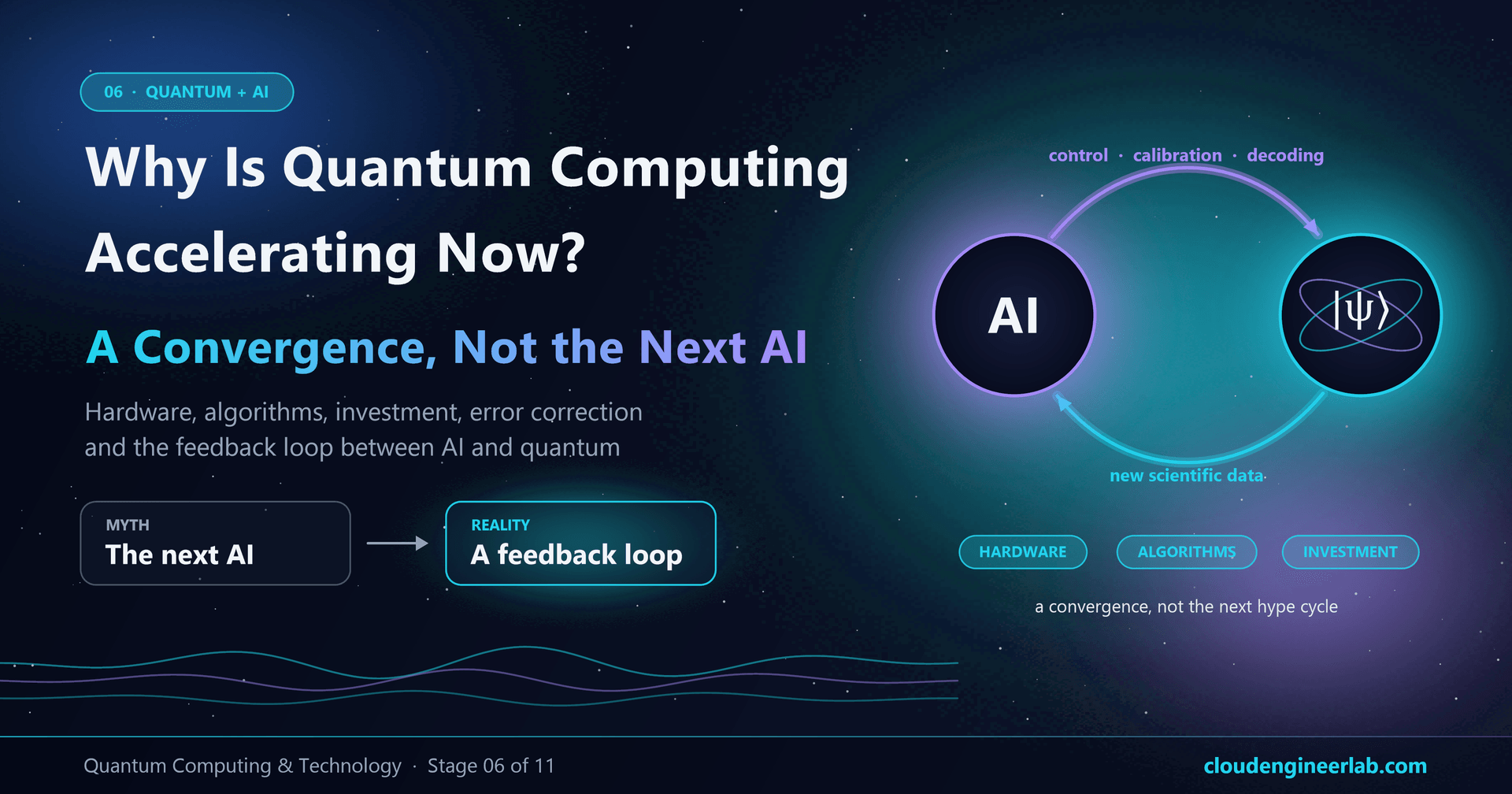
Why Is Quantum Computing Accelerating Now?
Quantum computing isn't the next AI. Hardware, algorithms, investment and error correction are converging, and AI and quantum now feed each other.
For most of the last forty years, quantum computing was a field where the next breakthrough was always ten years away. Then, within roughly two years, things changed. Google showed an error-corrected qubit that got better as it got bigger. IBM, Quantinuum, Microsoft and others put dates on fault-tolerant machines. Billions of dollars moved into quantum start-ups. Governments started telling banks and hospitals to replace their encryption.
So the question many people are now asking is a fair one: after AI, why is quantum computing suddenly getting so much attention?
The lazy answer is "because quantum is the next AI". It's also the wrong answer. AI isn't finished, and quantum computing is not going to repeat AI's story, because it is at a completely different stage of maturity. The real answer is more interesting: several independent trends reached a tipping point at the same time, and AI and quantum computing have started to speed each other up.
Stage 06 of the learning path
This post opens stage 06, Quantum + AI, of the Quantum Computing & Technology learning path. It builds on the error-correction ideas from stage 02 (Quantum Error Correction: How Do We Protect a Qubit?) and the algorithms from stage 05 (Quantum Algorithms: Why Are They Different?). You don't need any maths for this one.
Quantum Is Not "the Next AI"
It's worth killing the comparison first, because it sets the wrong expectations. AI's recent explosion happened because a mature hardware platform (the GPU) met huge datasets and a new model design (the transformer). The hardware already existed in every data centre. Quantum computing has no equivalent: the hardware itself is the thing still being invented.
| AI (2022 onwards) | Quantum computing (today) | |
|---|---|---|
| Hardware | Already mature (GPUs), scaled up | Still being invented and engineered |
| Who uses it | Hundreds of millions of people daily | Researchers, developers and pilot teams |
| What it's good for | A very wide range of everyday tasks | A narrow set of problems with special structure |
| Proof of value | Visible in products everyone uses | Strong in theory for a few problems, mostly unproven in practice |
| Main bottleneck | Data, compute cost and energy | Errors, and the scale of error correction |
| Industry revenue | Hundreds of billions of dollars | Around a billion dollars a year |
If quantum computing followed AI's curve, you would expect a "ChatGPT moment" any day. That isn't how it will happen. The progress is real, but it looks like a slow-building engineering programme (more like the early decades of the transistor than the last three years of AI), and the useful applications arrive one narrow problem at a time.
So why the attention now? Because of a convergence.
The Quantum Momentum Diagram
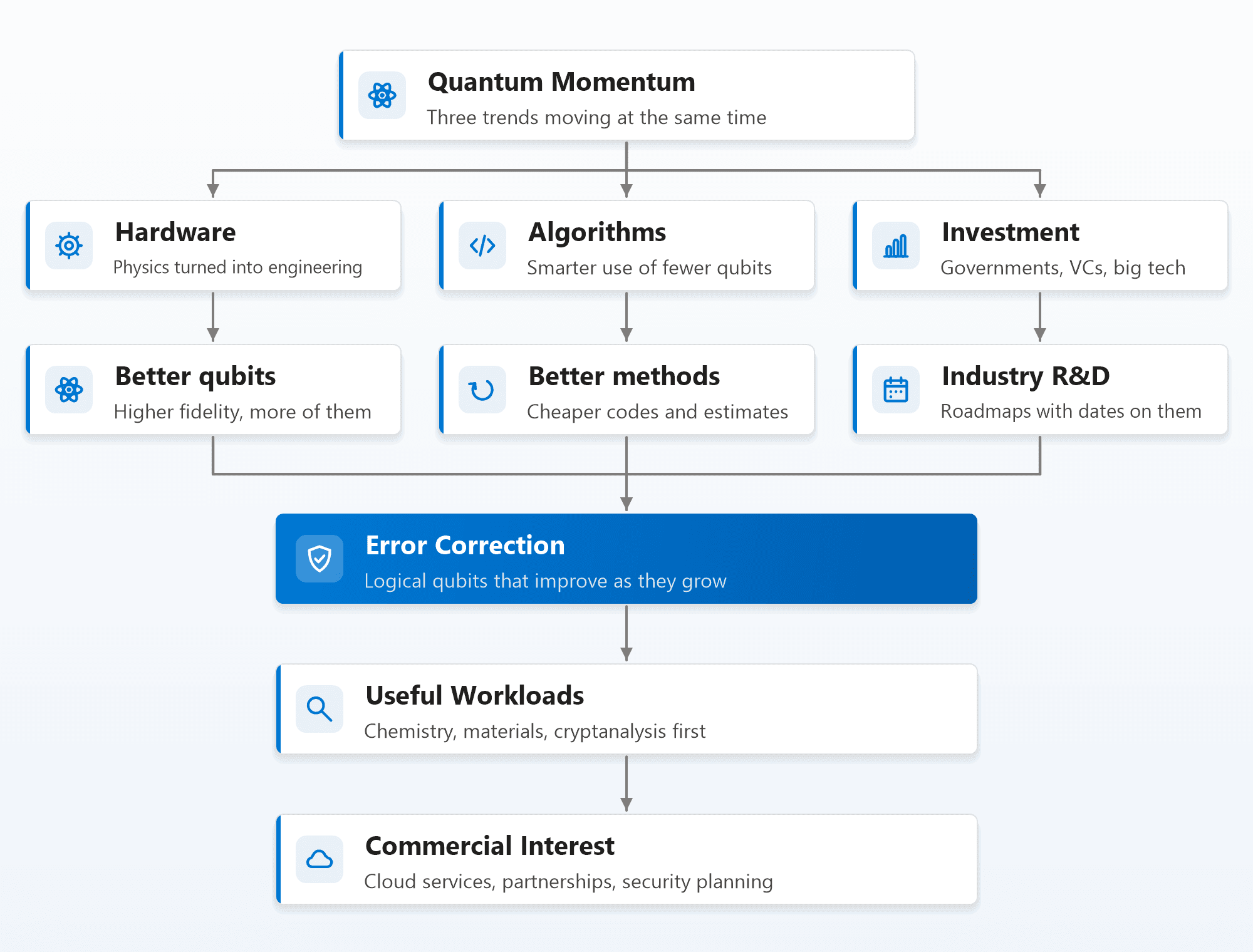
The important feature of this diagram is the merge. Better hardware alone wasn't enough, and nor was money or clever algorithms. Each one makes the others more valuable: better qubits make new algorithms testable, cheaper algorithms make smaller machines useful, and both make investors willing to fund the next generation of hardware. They all have to pass through one gate, error correction, before anything commercial can happen. Let's walk through each branch.
Branch 1: Hardware, Better Qubits
Ten years ago, the state of the art was a few dozen noisy qubits, and the honest question was whether anyone could build more without them falling apart. Today the problem has shifted from "can we do this at all?" to "how fast can we manufacture it?"
Qubits got cleaner. Gate fidelity (how often an operation does exactly what it should) is the number that matters most, as covered in Why Quantum Computers Make So Many Errors. The milestone everyone waited for was "three nines", 99.9% for two-qubit gates. Quantinuum's trapped-ion machines crossed it in 2024, and its Helios system, launched in late 2025, reports roughly that level across close to 100 qubits. Superconducting and neutral-atom platforms are a little behind but improving every year.
Qubits got more numerous. Neutral-atom arrays went from a few hundred atoms to more than 6,000 atoms held in place by lasers in a 2025 Caltech experiment, and Harvard showed an array of about 3,000 atoms running continuously for over two hours by refilling lost atoms on the fly. Counts on their own were never the goal (see How Are Qubits Actually Built?), but scale plus quality is.
It became engineering, not physics. The less glamorous change is the most important one. Companies now talk about yield, fabrication lines, cryogenic wiring, control chips and modular systems that link several processors together. When a field starts worrying about manufacturing, it has moved from "is this possible?" to "how do we build it at scale?". The cold-temperature post shows how much of that work is plain engineering of fridges and cables.
The number to watch
When you read a hardware announcement, look past the qubit count to the two-qubit gate fidelity. A machine at 99.9% with 100 qubits is far more useful than one at 99% with 1,000, because every error-correction scheme depends on the error rate being low enough first.
Branch 2: Algorithms, Better Methods
The second branch is quieter but just as powerful: the amount of hardware needed for useful work keeps falling, because theorists keep finding cheaper ways to do the same job.
The clearest example is breaking RSA encryption with Shor's algorithm. In 2019, the best estimate for factoring a 2048-bit RSA key was about 20 million noisy physical qubits running for eight hours. In 2025, Craig Gidney at Google published a new estimate: under one million noisy qubits, running for under a week. The hardware didn't change; the algorithm, the error-correction layout and the engineering tricks did. That's a 20 times smaller machine from better methods alone.
The same is happening elsewhere:
| Area | What improved | Why it matters |
|---|---|---|
| Error-correcting codes | qLDPC codes such as IBM's "gross" code protect 12 logical qubits with 288 physical ones, far fewer than the surface code needs | Smaller machines can hold more useful logical qubits |
| Resource estimates | Chemistry and cryptography estimates dropped sharply with better compilation and magic-state factories | The finish line moved closer |
| Error mitigation | Techniques such as zero-noise extrapolation and twirling get useful answers from noisy hardware | Today's machines can run larger experiments |
| Verification | New protocols let classical computers check some quantum results | Claims of quantum advantage can be tested, not just trusted |
Algorithms are also the honest brake on hype. As the algorithms post explained, classical computing keeps improving too, and several early "quantum advantage" claims were later matched by better classical methods. Both sides of the race are getting faster.
Branch 3: Investment, Industry R&D
The third branch is money, and it has changed character as well as size.
Big technology companies made long-term commitments. IBM, Google, Microsoft, Amazon and NVIDIA all run serious quantum programmes. IBM's roadmap targets Starling, a fault-tolerant machine with about 200 logical qubits running 100 million gates, in 2029, and Blue Jay, with around 2,000 logical qubits, after that. Google has published a staged plan towards a large error-corrected machine. Microsoft is pursuing topological qubits and, in parallel, building logical-qubit machines with partners such as Atom Computing and Quantinuum.
Private funding rounds got very large. In 2025 alone, PsiQuantum raised about $1 billion, Quantinuum raised about $600 million at a valuation of around $10 billion, and IonQ raised billions through share sales while buying several other quantum companies. A few years earlier, a $100 million round was big news.
Governments treat quantum as strategic. The US National Quantum Initiative, the UK's ten-year £2.5 billion programme, the EU's Quantum Europe strategy, India's National Quantum Mission, and major programmes in China, Japan, Canada and Australia all fund research, start-ups and skills. In the US, DARPA's Quantum Benchmarking Initiative is testing whether any company can build an industrially useful quantum computer by 2033, and evaluating them stage by stage. The United Nations even declared 2025 the International Year of Quantum Science and Technology, a hundred years after quantum mechanics was first formulated.
Investment is a signal, not a proof
Money flowing into a field shows that serious people believe it could work. It doesn't show that it will, or when. Quantum stocks have swung wildly on single comments: in January 2025, NVIDIA's CEO said useful quantum computers were 15 to 30 years away and several quantum company shares fell by around 40% in a day, before he walked the comment back a few months later. Treat funding news as evidence of commitment, and look at technical results for evidence of progress.
The Merge Point: Error Correction
All three branches meet in one place, and it's the single biggest reason the field feels different now.
For decades, error correction was a promise on paper. The threshold theorem said that if physical qubits were good enough, you could combine many of them into a logical qubit whose errors shrink as you add more. Nobody had clearly shown it happening on real hardware.
Then, in December 2024, Google's Willow chip did. Growing a surface-code logical qubit from distance 3 to 5 to 7 roughly halved the logical error rate at each step, and the largest logical qubit outlived the best physical qubit on the chip. That's what "below threshold" means in practice: scaling up finally made things better instead of worse. Other groups have since shown logical qubits on trapped ions and neutral atoms, including experiments with dozens of logical qubits.
This is why the diagram funnels everything through error correction. It is the step that converts:
- better hardware (branch 1) into qubits reliable enough to encode,
- better codes and algorithms (branch 2) into a smaller, cheaper path to a useful machine,
- investment (branch 3) into a roadmap with an engineering plan, not just a research agenda.
From Error Correction to Useful Workloads
Error correction is the gate, but it isn't the goal. The goal is a workload that's genuinely useful and that classical computers can't do. Where would the first ones be?
| Workload | Why it's a good candidate | Roughly what it needs |
|---|---|---|
| Chemistry and materials simulation | Molecules are quantum systems, so a quantum computer simulates them naturally | Hundreds to thousands of logical qubits for industrially important molecules |
| Physics simulation | Magnetism, superconductors and other many-particle systems | Some early results possible with fewer, very good qubits |
| Cryptanalysis (Shor's algorithm) | Breaks RSA and elliptic-curve cryptography | Around a million physical qubits, by current estimates |
| Optimisation, finance, logistics | Large market interest | Advantage unproven; see the algorithms post's honest section |
| Machine learning | Much discussed | Advantage unproven; loading data is a serious bottleneck |
Two things stand out. First, the strongest candidates are simulation of nature, which is exactly what Feynman proposed in 1981. Second, the list that excites investors (optimisation, finance, AI) is not the same as the list with the strongest scientific case. Stage 07 of this path, Quantum Applications, will go through each area properly.
In October 2025, Google reported its "Quantum Echoes" experiment: a physics measurement on Willow that it estimated ran about 13,000 times faster than the best classical method on a top supercomputer, and that, unlike earlier random-circuit demonstrations, produces a result that can be checked and is connected to a real scientific technique (studying molecules with nuclear magnetic resonance). It isn't a commercial application yet, but it's the kind of step the field has been waiting for: from "beyond classical" to "beyond classical and useful for science".
From Useful Workloads to Commercial Interest
The final step in the diagram is commercial interest, and it has three practical drivers you can see today.
1. Cloud access. IBM Quantum, Amazon Braket and Azure Quantum let anyone run circuits on real hardware without buying a machine, the same way cloud GPUs opened up AI. Companies can build skills and run pilots for a few thousand dollars instead of millions. If you followed Your First Quantum Program, you've already used it.
2. Integration with supercomputers. Quantum processors are being installed next to classical supercomputers and AI clusters, as accelerators rather than replacements (the relationship explained in Classical Computer vs Quantum Computer). NVIDIA's CUDA-Q software and its NVQLink interconnect, IBM's "quantum-centric supercomputing", and national supercomputing centres hosting quantum machines all point the same way: quantum becomes one more kind of processor in the data centre.
3. A security deadline. This is the driver that affects every organisation, quantum computer or not. Because a future machine running Shor's algorithm could break today's public-key encryption, NIST published its first post-quantum cryptography standards (FIPS 203, 204 and 205) in August 2024, and its transition guidance plans to deprecate RSA and elliptic-curve algorithms by 2030 and disallow them by 2035. Attackers can record encrypted traffic now and decrypt it later ("harvest now, decrypt later"), so data that must stay secret for ten years is already at risk. Stages 08 and 09 cover this in depth, and the PKI deep dive shows how much enterprise infrastructure depends on the algorithms involved.
The More Interesting Story: The AI ↔ Quantum Feedback Loop
Everything so far explains why quantum is accelerating. It doesn't yet explain the "after AI" part. The surprising answer is that AI isn't just the thing quantum is being compared to. AI has become one of the tools that builds quantum computers, and quantum computers may become a source of data that AI learns from.
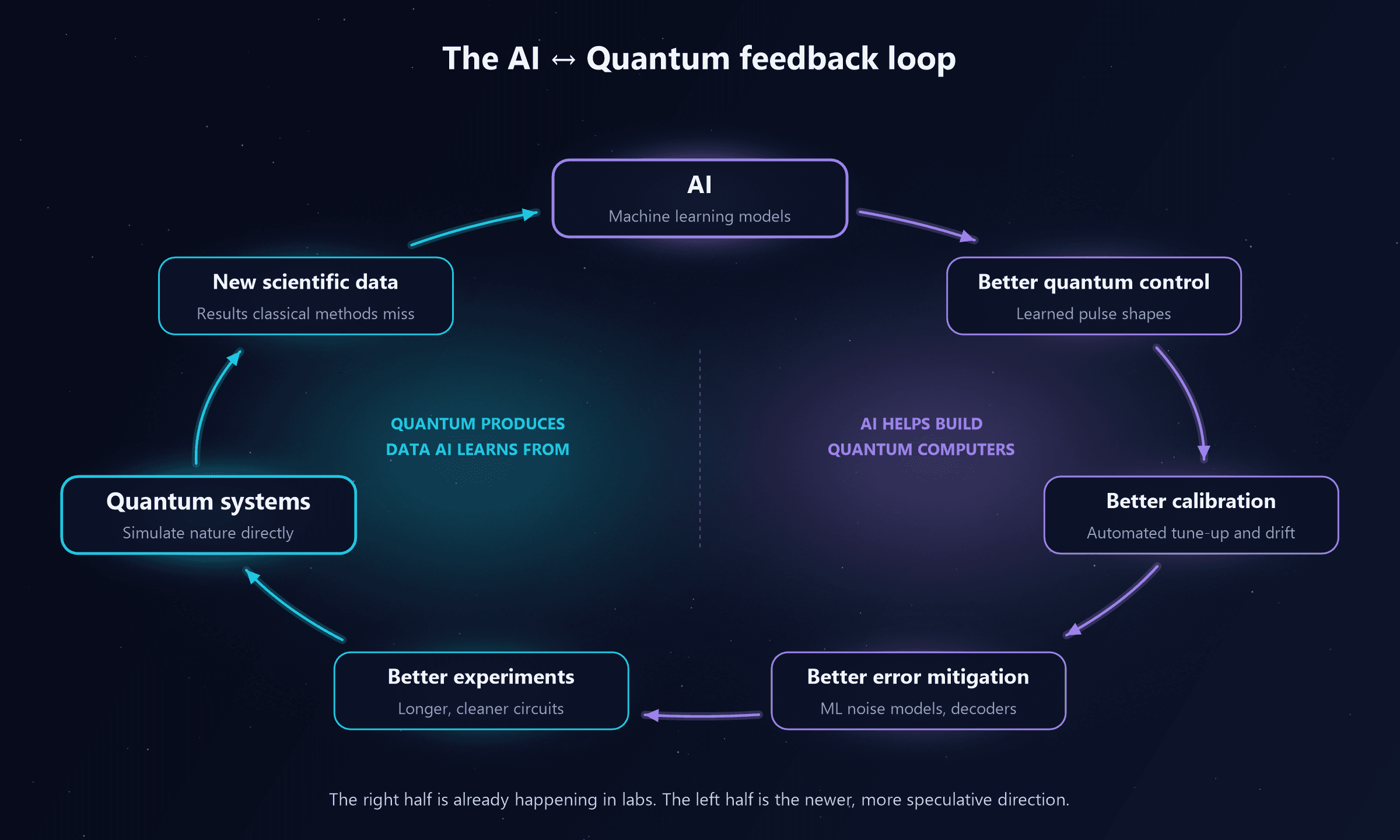
Let's go round the loop one step at a time.
AI → better quantum control
Every gate on a superconducting or trapped-ion machine is a carefully shaped pulse of microwaves or laser light (see How Does a Quantum Computer Actually Work?). Designing those pulses by hand is slow, and the "textbook" shapes are rarely optimal on a real, imperfect chip. Machine learning, especially reinforcement learning, can search for pulse shapes that produce higher-fidelity gates, learning directly from experiments rather than from an idealised model of the device.
Everyday analogy: it's like a racing team that stops tuning the car purely from engineering drawings and starts adjusting it from telemetry on the actual track.
→ better calibration
A quantum processor has hundreds of settings per qubit (frequencies, pulse amplitudes, timings, readout thresholds), and they drift: a chip that was perfectly tuned this morning is a little off by the afternoon. Calibrating a large machine used to take teams of physicists hours or days. Automated calibration, increasingly driven by machine learning, decides which settings to re-measure, spots drift early and fixes it without human help. For a machine with thousands of qubits, this isn't a nice-to-have; nobody could tune it by hand.
→ better error mitigation and decoding
Error correction produces a constant stream of syndrome measurements that must be turned into "which error most likely happened?" in real time. In 2024, Google DeepMind's AlphaQubit, a transformer-based neural network, decoded real data from Google's processor more accurately than the leading conventional decoders. It wasn't yet fast enough for real-time use on superconducting hardware, but it showed that learned decoders can capture messy, real-world noise better than hand-built models. Machine learning is also used for error mitigation on today's machines, learning a device's noise well enough to correct the averages of noisy results.
→ better quantum experiments
Better control, calibration and error handling add up to the thing that matters: longer, cleaner circuits. Each improvement lets researchers run experiments that would have drowned in noise a year earlier.
AI is helping on the software side too. IBM's Qiskit includes AI-assisted transpiler passes that route and simplify circuits, and code assistants built on large language models help people write quantum programs. Classical GPUs simulate quantum circuits at a scale that helps develop and check new algorithms before they reach real hardware.
→ quantum systems
Now the loop turns. Better quantum computers become better quantum simulators: machines that can model molecules, materials and exotic physics directly, because they follow the same rules as the systems they simulate.
→ new scientific data
This is where the payoff could be largest. Many AI models for chemistry and materials are limited by their training data, which today comes from classical approximations that are known to fail for strongly interacting electrons (the problem described in the algorithms post's simulation section). A quantum computer that can accurately simulate those cases could generate training data that no classical method can produce.
→ back to AI
AI models trained on that data could then predict the behaviour of millions of molecules or materials cheaply, using the quantum computer only for the hard cases. In that picture, the quantum computer doesn't replace AI; it teaches it. That, in turn, produces better AI for designing the next generation of quantum hardware, and the loop continues.
What's real and what's hoped for
It's important to be precise about which parts of this loop exist today:
| Step | Status today |
|---|---|
| ML for pulse design and quantum control | ✅ In active research and some commercial tools |
| ML-driven calibration | ✅ Used in labs and vendor software |
| Neural-network decoders (such as AlphaQubit) | ✅ Demonstrated on real data; real-time speed still a challenge |
| ML-based error mitigation | ✅ Demonstrated in published research |
| AI tools for writing and compiling quantum programs | ✅ Available today |
| Quantum computers generating useful training data for AI | ❌ Not yet at useful scale; needs fault-tolerant machines |
| Quantum computers speeding up AI training itself | ❌ No demonstrated advantage; data loading is a major obstacle |
AI is also quantum's competitor
There's a twist that hype stories leave out: AI also competes with quantum computing for some of the same problems. Machine-learning methods have made big advances in protein structure prediction and are improving at approximating molecular quantum chemistry. Every problem AI solves well classically is one less problem where a quantum computer is needed. This is good for science, and it's another reason to judge quantum claims against the best classical method, which increasingly includes AI.
So Why Now, Specifically After AI?
Putting it together, here's the honest answer to the original question:
1. The physics crossed a threshold
2. AI showed the value of specialised hardware
3. The infrastructure already exists
4. AI is a tool for building quantum computers
5. Security has a deadline
Notice what isn't on the list: "AI is finished" or "quantum will replace AI". The two are moving forward together, and increasingly helping each other.
How to Tell Real Progress From Hype
Acceleration brings noise as well as signal. These questions help separate them:
1. Are they reporting logical qubits and logical error rates?
2. Was the result compared with the best classical method?
3. Can the result be verified?
4. Is a roadmap milestone delivered on time?
5. Is it a business announcement or a technical result?
What This Means for IT Professionals
You don't need to buy a quantum computer to be affected by this acceleration. Three practical things are worth doing now:
- Start the post-quantum cryptography inventory. Find where your organisation uses RSA and elliptic-curve cryptography (certificates, VPNs, TLS, code signing, identity systems). This is the one part of quantum computing with a fixed deadline, and it's covered in stages 08 and 09.
- Build basic literacy. The same way cloud and then AI became part of every IT role, being able to read a quantum announcement critically is becoming a useful skill. The labs in stage 04 take an afternoon.
- Watch the hybrid stack. Quantum will arrive as a cloud service and as an accelerator in high-performance computing, next to GPUs. Teams that already run HPC or AI infrastructure are the ones most likely to manage it.
Quick Recap
- Quantum isn't the next AI. AI scaled on mature hardware; quantum's hardware is still being built, and its uses are narrower.
- The momentum is a convergence of three branches: better qubits, better algorithms and serious investment.
- Everything passes through error correction. Willow's below-threshold result in 2024 turned it from theory into engineering.
- Better methods shrink the target: the estimate for breaking RSA-2048 fell from about 20 million to under a million qubits.
- Useful workloads come first in simulation of chemistry, materials and physics, not in optimisation or AI.
- Commercial interest is driven by cloud access, integration with supercomputers and the post-quantum security deadline.
- AI and quantum form a feedback loop: AI already improves control, calibration, decoding and compilation; quantum may one day generate data that improves AI.
- Judge progress by logical qubits, verified results and delivered milestones, not by qubit counts, funding or share prices.
What's Next on the Learning Path
The next post in stage 06, Quantum Computing + AI: Competition or Partnership?, goes deeper into both directions of the loop, including quantum machine learning. Can a quantum computer actually make AI better, faster or cheaper, and what does the evidence say so far? The full 11-stage path is listed at the end of the beginner's guide.
Written by
Chetan Yamger
Cloud Engineer · AI Automation Architect · Modern Workplace Consultant
Cloud Engineer, AI Automation Architect, and Modern Workplace Consultant based in Amsterdam, Netherlands. Specializing in scalable, secure enterprise solutions with Microsoft Azure, Intune, PowerShell, and AI-driven automation using ChatGPT, Gemini, and modern LLM technologies.
Stay in the loop.
New articles, straight to you.
Deep-dive technical articles on Intune, PowerShell, and AI — no noise, no spam.
Discussion
Share your thoughts — your email stays private
Leave a comment