
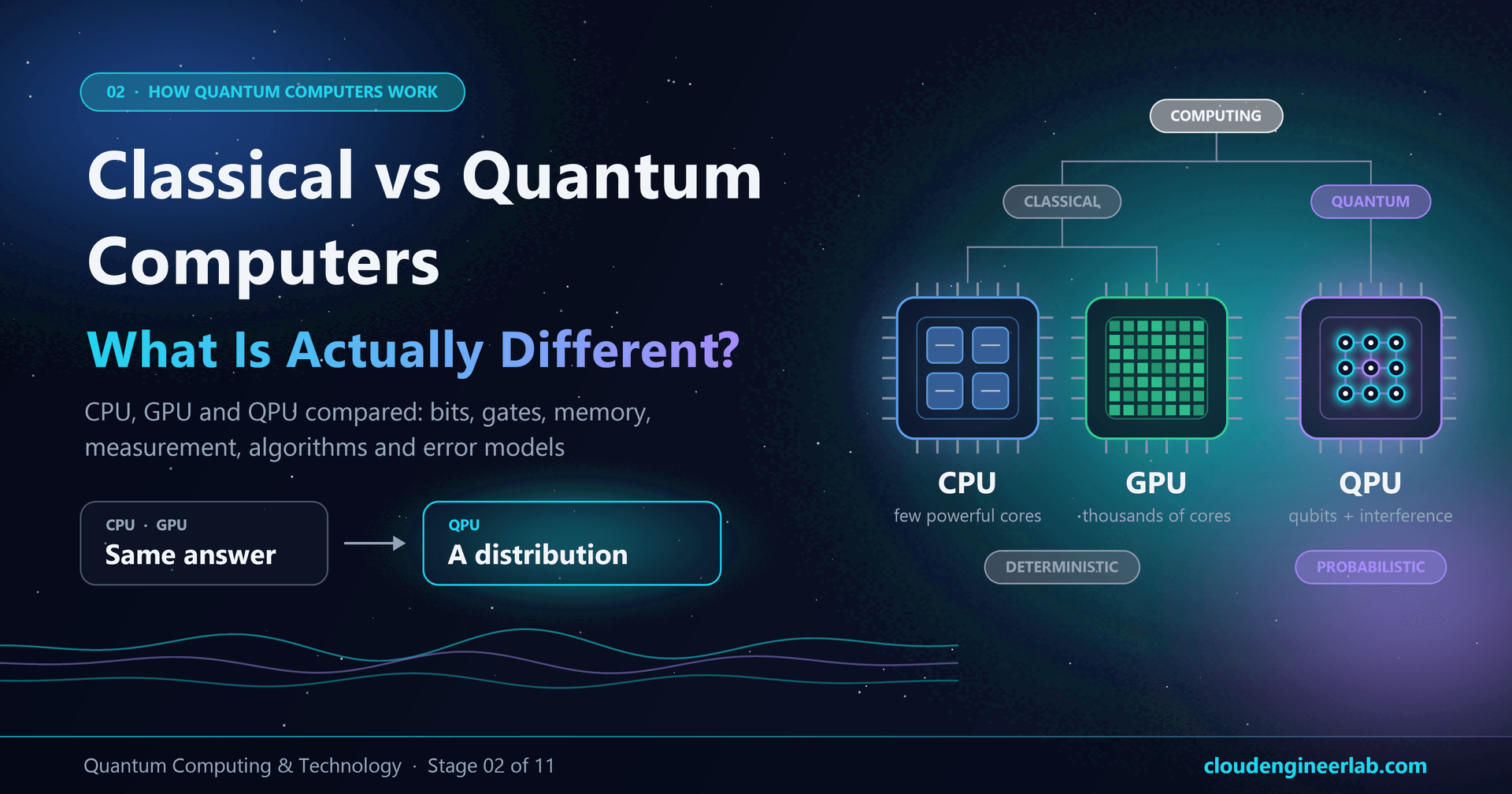
Classical Computer vs Quantum Computer: What Is Actually Different?
CPU, GPU and QPU compared on bits, gates, memory, measurement, algorithms and errors, and why we can't simply replace CPUs with quantum processors.
The easiest way to get quantum computing wrong is to treat it as the next version of the computer you already own. Classical is old, quantum is new, so quantum must be faster at everything and will eventually replace it.
None of that is true. A quantum computer is not a faster classical computer, in the same way a submarine is not a faster car. Both are machines for processing information, but they represent that information differently, change it by different rules, read it out differently, and fail in different ways. Each is excellent at things the other is bad at.
This post puts the two side by side, one layer at a time: the processors (CPU, GPU and QPU), the units of information (bit and qubit), the operations (logic gates and quantum gates), memory, measurement, algorithms and error models. Then it answers the question that ties it all together: why can't we simply replace CPUs with quantum processors?
Stage 02 of the learning path
This post is part of stage 02, How Quantum Computers Work, in the Quantum Computing & Technology learning path. It assumes you know what a qubit, superposition, measurement and entanglement are. If any of those are new, read What Is Quantum Computing? A Beginner's Guide first; this post builds on it rather than repeating it.
Two Branches of Computing, Not Two Generations
Here is the whole comparison on one page. Read it top to bottom: each row is one layer of a computer, with the classical version on the left and the quantum version on the right.
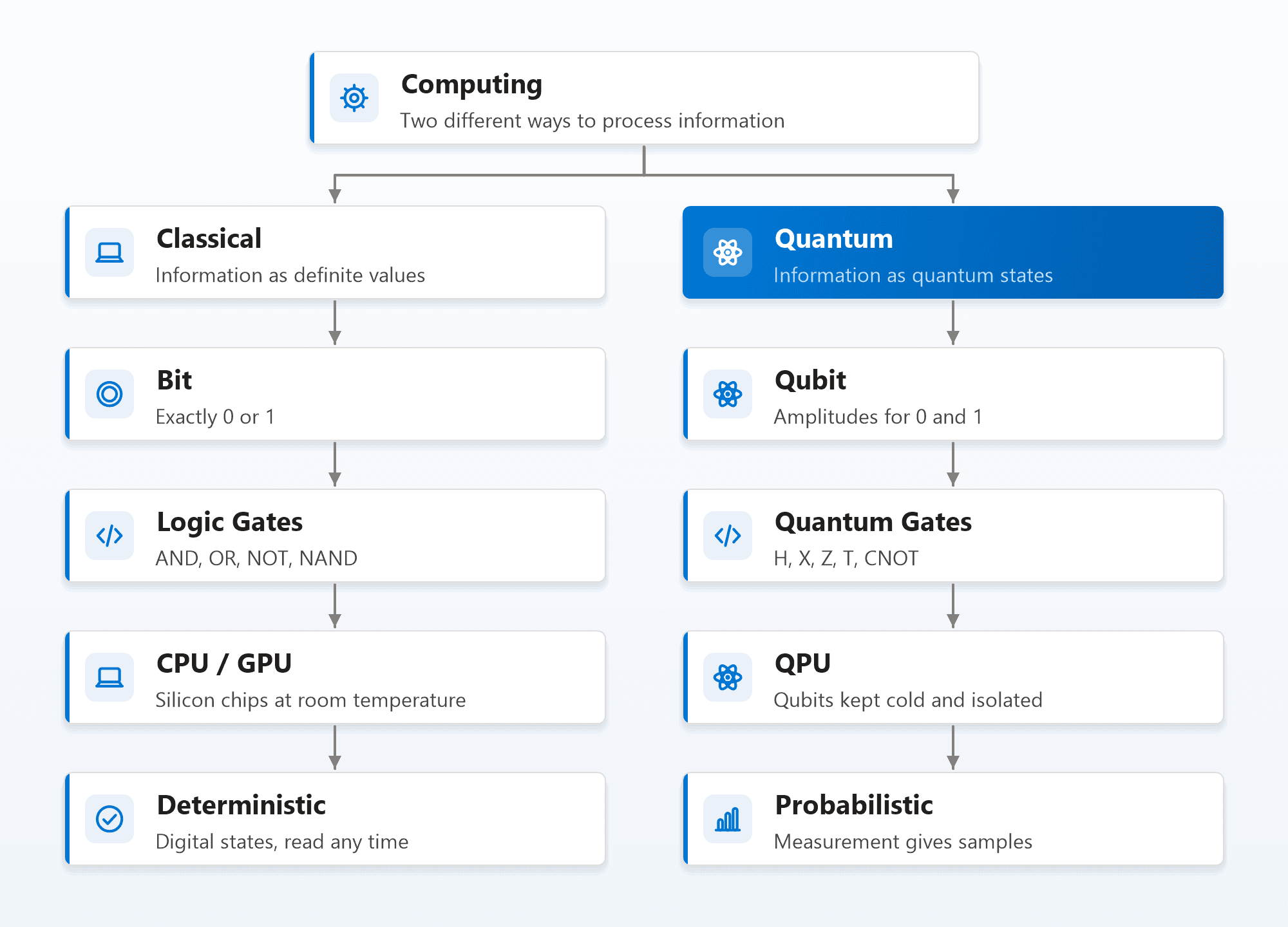
One detail is worth knowing before going further. Classical computers are not "non-quantum". The transistors inside every CPU only work because of quantum physics: semiconductors, band gaps and tunnelling are quantum effects. The difference is how information is represented. A classical computer uses quantum physics to build very reliable switches, then stores each piece of information as a definite on or off. A quantum computer stores information in the quantum state itself, with amplitudes, superposition and entanglement, and computes with those directly.
That one design choice explains every difference in the rest of this post.
The Processors: CPU, GPU and QPU
CPU: the general-purpose manager
The CPU (Central Processing Unit) is the part of a computer that runs everything: the operating system, your browser, a database, a PowerShell script. It is designed to be good at any task, especially tasks full of decisions.
- It has a small number of powerful cores: a handful in a laptop, up to a hundred or more in a large server.
- Each core runs billions of instructions per second, at clock speeds of a few gigahertz.
- Much of each core is not doing arithmetic at all. It is predicting which way the next
ifstatement will go, reordering instructions, and managing fast caches, so that messy, branching, unpredictable code still runs quickly.
Think of a CPU as a small team of very skilled generalists. Give them any job, however odd, and they'll get through it quickly.
GPU: the parallel specialist
The GPU (Graphics Processing Unit) was built to draw pixels: millions of them, each needing the same calculation with different numbers. So it takes the opposite approach to a CPU.
- It has thousands of small, simple cores.
- They work best when they all perform the same operation on different data at the same time.
- It is terrible at branching, decision-heavy code, and brilliant at large blocks of arithmetic, which is why it became the engine of modern AI (training a neural network is mostly multiplying huge matrices).
Think of a GPU as a stadium full of people who each do simple sums. Useless for writing an essay, unbeatable for adding up a million columns at once.
The most important thing about a GPU, for this post, is how it's used. A GPU does not replace the CPU. It is an accelerator. The CPU runs the program, sends the heavy parallel parts to the GPU, and takes the results back. Keep that relationship in mind, because it is exactly how quantum processors are used too.
QPU: the quantum accelerator
The QPU (Quantum Processing Unit) is the chip, or the trap, or the array of atoms, that holds the qubits, plus the hardware needed to control them. In practice a "QPU" is a whole system:
- The qubits themselves. Superconducting circuits, trapped ions, neutral atoms or photons, depending on the vendor (stage 03, Quantum Hardware, compares them).
- An extreme environment. Superconducting QPUs sit inside a dilution refrigerator at around 10 to 15 thousandths of a degree above absolute zero, colder than outer space. Ion and atom systems use ultra-high vacuum and precisely tuned lasers instead.
- Control electronics. Racks of classical equipment that turn each quantum gate into precisely timed microwave or laser pulses, and read the results back.
A QPU does not run an operating system, store files or execute a loop with if statements the way a CPU does. It receives a quantum circuit (a fixed sequence of gates), runs it, measures the qubits, and returns bits. That's it. Like a GPU, it's an accelerator for one specific kind of work, and it is always driven by a classical computer.
| CPU | GPU | QPU | |
|---|---|---|---|
| Built for | Any task, especially branching logic | The same operation on lots of data | Problems where interference gives a shortcut |
| Processing units | A few to ~100+ powerful cores | Thousands of simple cores | Tens to a few thousand physical qubits today |
| Works with | Bits | Bits | Qubits |
| Runs an operating system | ✅ | ❌ | ❌ |
| Operating environment | Room temperature | Room temperature | Near absolute zero, or vacuum and lasers |
| Relationship to the CPU | It is the CPU | Accelerator driven by the CPU | Accelerator driven by the CPU |
| Typical access | In every device | In PCs, servers, the cloud | Almost always through the cloud |
The Unit of Information: Bit vs Qubit
A bit holds exactly one value, 0 or 1, at all times. You can read it whenever you like and it doesn't change.
A qubit holds a quantum state: a pair of amplitudes for 0 and 1 that set how likely each result is when you measure it. The beginner's guide covers this in detail; here, the useful comparison is what happens when you have many of them.
- n bits hold one of 2ⁿ possible patterns at a time. 3 bits hold one of 8 values; 300 bits hold one 300-digit binary number.
- n qubits are described by 2ⁿ amplitudes at once, one for every possible pattern, and entanglement lets those amplitudes be linked in ways no list of separate qubits could describe. 300 qubits involve more amplitudes than there are atoms in the observable universe.
That sounds like quantum must win easily. The catch is the next two sections: you can't copy that state, you can't store it for long, and when you read it you only get n ordinary bits back. The huge state is real, but it is not a huge hard drive. It is a workspace that only an algorithm built around interference can make use of.
The Operations: Logic Gates vs Quantum Gates
Both machines compute by applying gates, but the rules are very different.
Classical logic gates (AND, OR, NOT, XOR, NAND) take bits in and produce bits out. Two properties matter here:
- Most are irreversible. An AND gate that outputs 0 could have had inputs 00, 01 or 10. The information about which one is gone for good.
- Copying is free. A wire can split and send the same bit to as many gates as you like.
A single gate type, NAND, is enough to build any classical computation, which is why chips are built from billions of almost identical transistors.
Quantum gates (X, H, Z, S, T, CNOT and others) transform the amplitudes of the qubit state. Their rules are stricter:
- Every quantum gate is reversible. Mathematically each gate is a rotation of the state, and every rotation can be undone. Nothing is ever thrown away until you measure.
- Copying is impossible. The no-cloning theorem means a quantum circuit can't fan an unknown qubit out to several places. Algorithms have to be designed around that.
- Gates act on phase, not just values. Some gates (Z, S, T) change nothing you could see if you measured straight afterwards. They change the signs and phases of amplitudes, which decides what cancels and what reinforces later. This is how interference is programmed.
- A small set is enough. H, S, T and CNOT together can approximate any quantum computation, in the same way NAND covers everything classical.
There is also a practical difference. A CPU instruction is the same on every Intel or AMD chip. Quantum hardware is not standardised yet: each QPU has its own native gates and its own map of which qubits are physically connected. Before a circuit runs, a classical compiler (called a transpiler) rewrites it into that particular machine's gates and routes around missing connections, often adding extra gates in the process. Fewer, simpler gates means fewer chances for errors, so this compilation step matters far more than it does for classical code.
| Classical logic gates | Quantum gates | |
|---|---|---|
| Act on | Definite bit values | Amplitudes and phases of a quantum state |
| Reversible | Mostly not (AND, OR) | Always |
| Copying inputs | Free (fan-out) | Impossible for unknown states (no-cloning) |
| Universal set | NAND alone | H, S, T and CNOT |
| Error per operation | So low that software ignores it | Roughly 0.1% to 1% for two-qubit gates today |
| Same on every machine | ✅ (within an instruction set) | ❌ Each QPU has its own native gates |
Memory: Where Quantum Computers Are Most Unlike Your PC
This is the difference people rarely mention, and it's one of the biggest.
A classical computer has a memory hierarchy: registers inside the CPU, several levels of cache, RAM, then SSD or disk. Data can be:
- stored for years (on disk) without changing,
- read as often as you like without being disturbed,
- copied freely, backed up, sent across a network,
- paused and resumed: a program can save its state halfway, and pick up again tomorrow.
A quantum computer has none of that for quantum data:
- The qubits are the memory. There's no separate quantum RAM chip in today's machines. The qubits that compute are also the only place the quantum state exists.
- The state only lives for a short time. A qubit keeps its quantum state for its coherence time: around a few hundred microseconds to milliseconds for good superconducting qubits, longer (up to seconds or more) for trapped ions. After that, the environment has effectively measured it and the information is gone. A circuit has to finish well inside that window.
- You can't save and reload it. Reading the state destroys it, and copying it is impossible. There is no "save to disk" for a superposition. Every run starts from scratch.
- Loading data is expensive. To process a large classical dataset, you first have to encode it into qubits with gates, and for general data that usually takes about as many operations as there are data points. That loading cost can erase any speed-up the algorithm would have given.
The last point is why "quantum computers will process big data instantly" is mostly a myth. Quantum computers are best when the problem is hard but the input is small: a molecule described by a few hundred numbers, or a single large integer to factor. They are not a faster way to crunch a 10 TB data warehouse. A quantum RAM that could load large data efficiently has been proposed in theory, but nothing practical at useful scale exists today.
Measurement: Reading the Answer
On a classical computer, reading a value is free and harmless. You can print a variable in the middle of a program, check it in a debugger, log it, and the program carries on unchanged. Run the same program on the same input and you get exactly the same output, every time. That's what deterministic means.
On a quantum computer, measurement is a one-way door:
- It returns one random result for each qubit, 0 or 1, with probabilities set by the amplitudes.
- It ends the superposition. Whatever the qubits were "in the middle of" is lost.
- So you can't peek at the state during a run. No print statements in the middle of the interesting part. (Some hardware supports measuring a few qubits mid-circuit, but those qubits collapse just the same.)
To get a usable answer, a quantum program is run many times. Each run is a shot, and the result is a histogram: how often each bit string appeared.
Classical program, run 1,000 times     Quantum circuit, 1,000 shots

Output   Count                         Output   Count
42       1000                          00       496
                                       11       504
The classical result is a single, certain answer. The quantum result is a distribution, and the answer is the shape of that distribution: which outcomes come up most, or the average of some value across them. The algorithm's job is to make the right answer come up with high probability; the shots are how you find it.
This has a practical side for developers. You debug quantum programs mostly on simulators, which run on ordinary computers and can show you the full state at every step, because it's just numbers in memory. That only works for small circuits: every extra qubit doubles the memory a full simulation needs, so somewhere around 50 qubits even the largest supercomputers can't hold the state. That limit is also, roughly, where quantum hardware starts to be genuinely interesting.
Algorithms: Different Machines, Different Recipes
A classical algorithm is a precise sequence of steps on definite values: compare these two numbers, swap them, move to the next. Speed comes from doing each step fast and doing as few steps as possible.
A quantum algorithm is a circuit designed so that the amplitudes of wrong answers cancel out and the amplitude of the right answer builds up, so that measuring gives the right answer with high probability. That only works for problems with a hidden mathematical structure the circuit can exploit. When such a structure exists, the speed-up can be dramatic. When it doesn't, there is no speed-up at all.
| Problem | Best classical approach | Quantum approach | Expected advantage |
|---|---|---|---|
| Factoring a large number (breaks RSA) | Grows almost exponentially with number size | Shor's algorithm | Exponential, but needs large fault-tolerant machines |
| Simulating molecules and materials | Cost explodes with the number of electrons | Quantum simulation | Exponential for some problems; the most promising near-term use |
| Searching an unsorted list | Check items one by one | Grover's algorithm | Quadratic: square root of the steps |
| Optimisation (routing, scheduling) | Excellent heuristics already | QAOA and similar | Unproven; an active research area |
| Sorting, databases, web servers, spreadsheets | Already very fast | None known | ❌ None |
| Training today's large AI models | GPUs | None proven | ❌ None known today |
The Grover row hides an important subtlety. Searching 1,000,000 items classically takes about 500,000 checks on average; Grover needs roughly 1,000 quantum steps. That sounds like a 500× win. But each quantum step is far slower than a classical check, has to be error-corrected, and the whole thing has to be repeated. Researchers estimate that a quadratic speed-up only pays off for very large problems, and possibly never for some realistic ones. An algorithmic advantage on paper is not the same as a faster computer in practice. Stage 05, Quantum Algorithms, goes into these in detail.
Error Models: How Each Machine Fails
This is the deepest difference, and the one that decides how fast quantum computing can become practical.
Classical errors: rare, discrete and fixable by copying
Classical hardware is astonishingly reliable. A bit flip from heat or a cosmic ray does happen, but so rarely that almost all software never thinks about it. Servers use ECC memory, which stores a few extra check bits so a single flipped bit can be detected and corrected automatically.
Classical errors are also discrete: a bit is either right or flipped, nothing in between. And the basic fix is simple: keep copies. Store a bit three times and take a majority vote.
Quantum errors: frequent, continuous and impossible to copy away
Quantum hardware is far noisier, and its errors are a different kind of thing:
- They are frequent. The best two-qubit gates today succeed around 99.9% of the time, and many machines are closer to 99% to 99.5%. That sounds high, but a circuit with a few thousand gates at 99.9% each will almost certainly contain errors.
- They are continuous. A qubit doesn't just flip. Its state can drift by a tiny angle, a little too much rotation here, a little phase shift there. Small errors build up quietly.
- There are two kinds of flip. A bit flip swaps 0 and 1, as in classical computing. A phase flip changes the sign between the amplitudes, which has no classical equivalent and silently ruins interference.
- The environment is always watching. Decoherence is the qubit's quantum state leaking into its surroundings. Energy loss is measured by a time called T1; loss of phase information by T2. Every gate and every microsecond of waiting adds risk.
- Measurement and crosstalk errors. Reading a qubit can return the wrong value, and driving one qubit can slightly disturb its neighbours.
The classical fix, "just keep copies," is ruled out by the no-cloning theorem. And you can't check a qubit directly to see if it's still right, because checking is measuring and measuring destroys it.
For a full tour of where each of these errors comes from, see Why Quantum Computers Make So Many Errors.
Quantum error correction: the clever workaround
Quantum error correction gets around both problems. Instead of copying a qubit, it spreads one qubit's information across many entangled physical qubits, forming a single, more reliable logical qubit. Extra helper qubits then repeatedly measure relationships between the data qubits (for example "are these two the same?") rather than their values. Those checks, called syndrome measurements, reveal whether and where an error happened without revealing, and destroying, the data itself. A classical computer then decodes the syndromes in real time and tells the QPU what to fix.
The cost is overhead. Common schemes such as the surface code need from around a hundred to a thousand or more physical qubits per logical qubit, depending on how good the physical qubits are and how reliable the logical one needs to be. Google's Willow experiment (late 2024) used about 100 physical qubits to build one logical qubit, and showed that making the code bigger made it more reliable, the key proof that the approach scales.
Until full error correction is available, today's machines use error mitigation: running circuits in deliberately varied ways and using classical statistics to estimate what a noise-free result would have been. It helps, but it costs many extra shots and doesn't scale to large circuits.
| Classical | Quantum | |
|---|---|---|
| How often errors happen | Extremely rarely | Around 1 in 100 to 1 in 1,000 two-qubit gates |
| Kind of error | Discrete bit flip | Continuous drift, bit flips and phase flips |
| Main cause | Heat, cosmic rays, failing hardware | Decoherence (T1, T2), imperfect control pulses, crosstalk |
| Basic fix | Keep copies, majority vote, ECC | Spread one logical qubit over many physical qubits |
| Can you check the data directly? | ✅ Yes | ❌ No, checking destroys it; use syndrome measurements |
| Overhead | A few extra bits | Roughly 100 to 1,000+ physical qubits per logical qubit |
A Quantum Program Is Always a Hybrid Program
Put the pieces together and you can see how quantum computing actually runs today. It's never "just the QPU". A classical computer does the setup, the compilation, the control, the error decoding and the final analysis. The QPU does one specialised step in the middle.
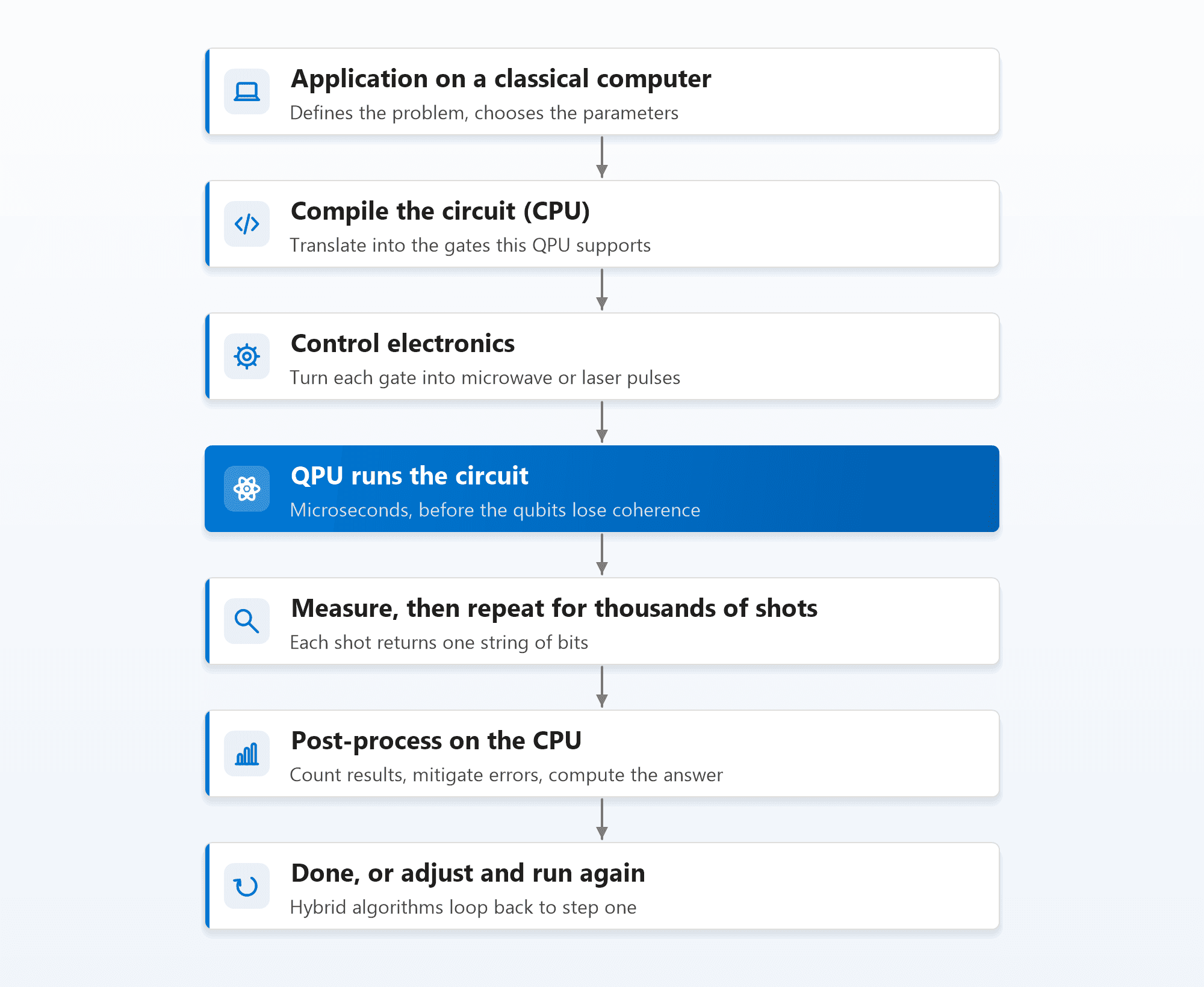
Many of today's most promising algorithms, such as the Variational Quantum Eigensolver (VQE) for chemistry, are explicitly hybrid. The QPU evaluates a circuit with some parameters, the CPU looks at the results and picks better parameters, and the loop repeats hundreds of times. The quantum part and the classical part are equally essential.
The Big Question: Why Can't We Simply Replace CPUs With Quantum Processors?
With everything above in place, the answer becomes clear. There isn't one reason. There are eight, and any one of them would be enough on its own.
1. Most software would gain nothing
2. Each quantum operation is slower and noisier
3. One run doesn't give you an answer
4. There is no quantum memory or storage
5. QPUs can't branch and loop like a CPU
6. Today's machines are too small and too error-prone
7. The physical requirements are extreme
8. The QPU itself needs a CPU to work
So the realistic future is not quantum instead of classical. It's heterogeneous computing: CPUs for general logic, GPUs for parallel arithmetic and AI, and QPUs for the specific problems where interference gives a shortcut, all working together. This is already how the industry is building it. Cloud providers offer QPUs as a service alongside classical compute, and supercomputing centres are installing quantum systems next to their existing machines, an approach IBM calls quantum-centric supercomputing. Stage 11's The Future of Computing: CPU + GPU + NPU + QPU goes much deeper, adding the NPU and showing how hybrid systems are actually built and run.
The one-line answer
We can't replace CPUs with quantum processors for the same reason we never replaced CPUs with GPUs. A QPU is an accelerator for one kind of problem, and it depends on classical computers to do everything else, including running the QPU itself.
Which Processor for Which Job?
| Task | Best processor | Why |
|---|---|---|
| Running a web server or a PowerShell script | CPU | Branching, general-purpose logic |
| Querying a database | CPU | Lots of data, lots of decisions, no quantum speed-up |
| Rendering graphics, video encoding | GPU | Same calculation on millions of pixels |
| Training or running a large AI model | GPU (or AI accelerators) | Massive matrix arithmetic |
| Simulating a new battery or drug molecule | QPU + CPU (emerging) | Quantum systems are naturally modelled by quantum hardware |
| Factoring RSA-2048 | Future fault-tolerant QPU + CPU | Shor's algorithm; not possible on today's machines |
| Hard optimisation problems | CPU/GPU today, maybe QPU later | Classical heuristics are strong; quantum advantage is unproven |
For IT and cloud engineers, the practical takeaway is that you'll meet QPUs the way you met GPUs: as a cloud resource you call from ordinary code. Services such as IBM Quantum, Azure Quantum and Amazon Braket already work this way. And the first place quantum computing will affect most enterprises isn't a workload at all; it's security, because a future fault-tolerant QPU running Shor's algorithm could break the RSA and elliptic-curve keys behind your PKI and certificates. Stages 08 and 09 of this path cover that in full.
Quick Recap
| Layer | Classical computer | Quantum computer |
|---|---|---|
| Processor | CPU (generalist) and GPU (parallel accelerator) | QPU (quantum accelerator) |
| Unit of information | Bit: 0 or 1 | Qubit: amplitudes for 0 and 1 |
| Operations | Logic gates, mostly irreversible, copying is free | Quantum gates, always reversible, no copying |
| Memory | Deep hierarchy, stores for years, read freely | Qubits only, lives for microseconds to seconds, can't be saved |
| Reading results | Any time, no effect, deterministic | Measurement ends the state; answers are distributions over many shots |
| Algorithms | Step-by-step on definite values | Interference that cancels wrong answers, for structured problems only |
| Errors | Very rare, discrete, fixed by copying | Frequent, continuous, fixed by spreading information across many qubits |
| Role | Runs everything | Accelerates a few specific problems, always driven by a classical computer |
The short version: classical and quantum computers aren't old and new. They're two different ways of representing information, each with its own strengths, and the future uses both.
What's Next on the Learning Path
To see the hybrid loop above in full engineering detail, read the stage 02 flagship, How Does a Quantum Computer Actually Work?: it follows one circuit from the compiler through the control electronics, cryostat, qubits and readout chain to classical post-processing.
The next stage, 03. Quantum Hardware, starts with How Are Qubits Actually Built?, which opens up the QPU itself: how superconducting circuits, trapped ions, neutral atoms, photons and topological qubits actually work, why each needs such an extreme environment, and the trade-offs between speed, quality and scale that decide which approach might win. The full path is listed at the end of the beginner's guide.

Written by
Chetan Yamger
Cloud Engineer · AI Automation Architect · Modern Workplace Consultant
Cloud Engineer, AI Automation Architect, and Modern Workplace Consultant based in Amsterdam, Netherlands. Specializing in scalable, secure enterprise solutions with Microsoft Azure, Intune, PowerShell, and AI-driven automation using ChatGPT, Gemini, and modern LLM technologies.
Stay in the loop.
New articles, straight to you.
Deep-dive technical articles on Intune, PowerShell, and AI — no noise, no spam.
Discussion
Share your thoughts — your email stays private
Leave a comment