
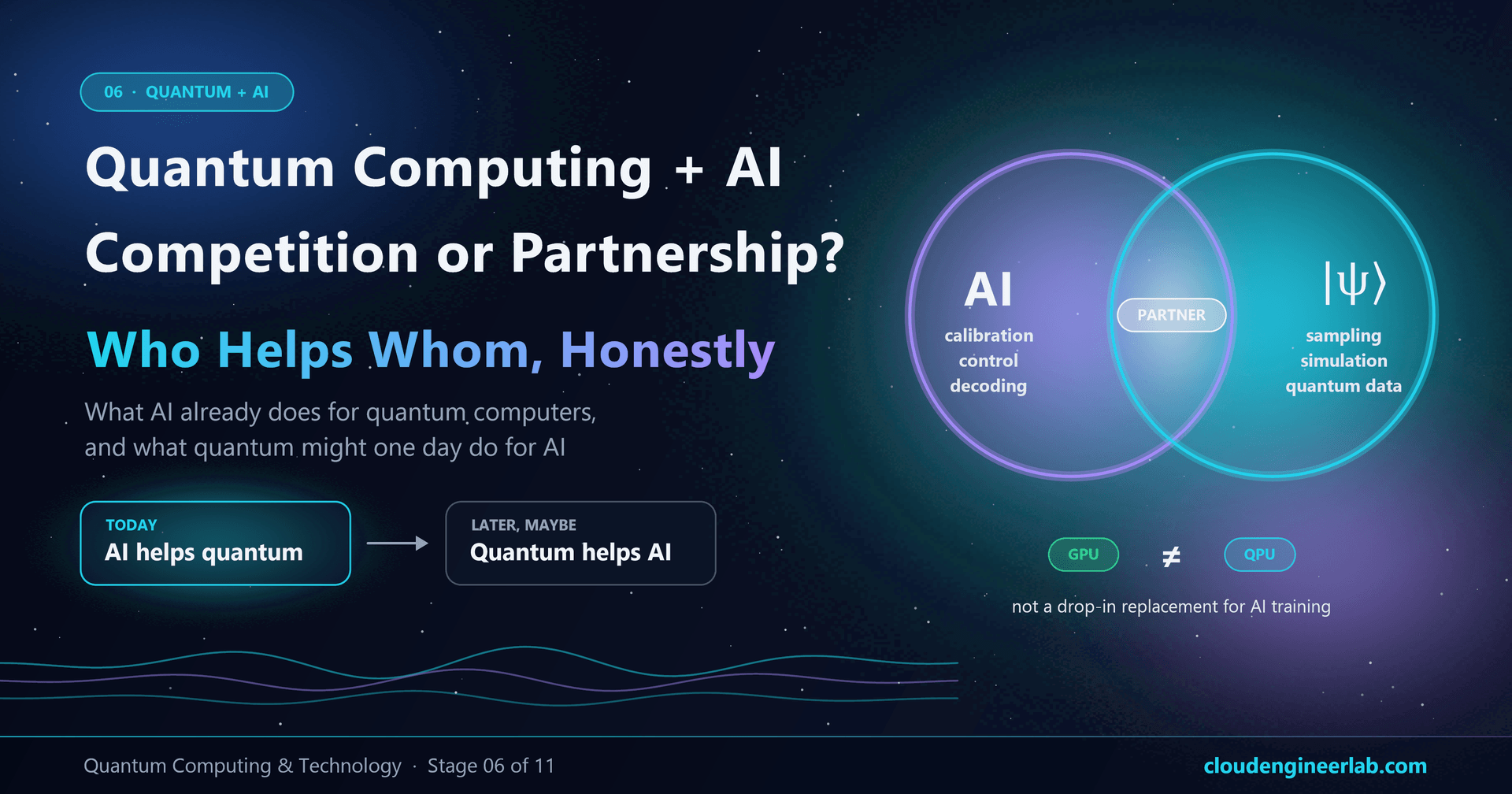
Quantum Computing + AI: Competition or Partnership?
What AI already does for quantum computers, what quantum might one day do for AI, and why a QPU is not a drop-in replacement for the GPUs that train AI.
Put "quantum" and "AI" in the same headline and you'll usually get one of two stories. In the first, they're rivals: quantum computing is the next big thing that will make today's AI hardware obsolete. In the second, they're a magical combination: "quantum AI" will be smarter, faster and more powerful than anything before it.
Both stories get the relationship wrong. The truth is more specific, and more useful. Right now, the relationship runs mostly in one direction: AI is helping to build quantum computers. The reverse direction, quantum computers helping AI, is real research with a few genuinely promising ideas, but most of it is unproven, and some of it is quite far away.
This post goes through both directions honestly, item by item, and then makes the distinction that matters most for anyone working in IT or AI today:
The one sentence to remember
Quantum computing is not currently a drop-in replacement for the GPUs used to train today's large AI models. It isn't faster at that job, it isn't cheaper, and on current evidence it isn't designed for it. The rest of this post explains why, and where quantum and AI really do help each other.
Stage 06 of the learning path
This is the second post in stage 06, Quantum + AI, of the Quantum Computing & Technology learning path. It goes deeper into the feedback loop introduced in Why Is Quantum Computing Accelerating Now?. It helps to know what quantum algorithms can and can't speed up.
The Scorecard First
Before the detail, here's the whole picture on one page. The left column lists what AI does for quantum computing; the right lists what quantum computing might do for AI. The status labels are the important part.
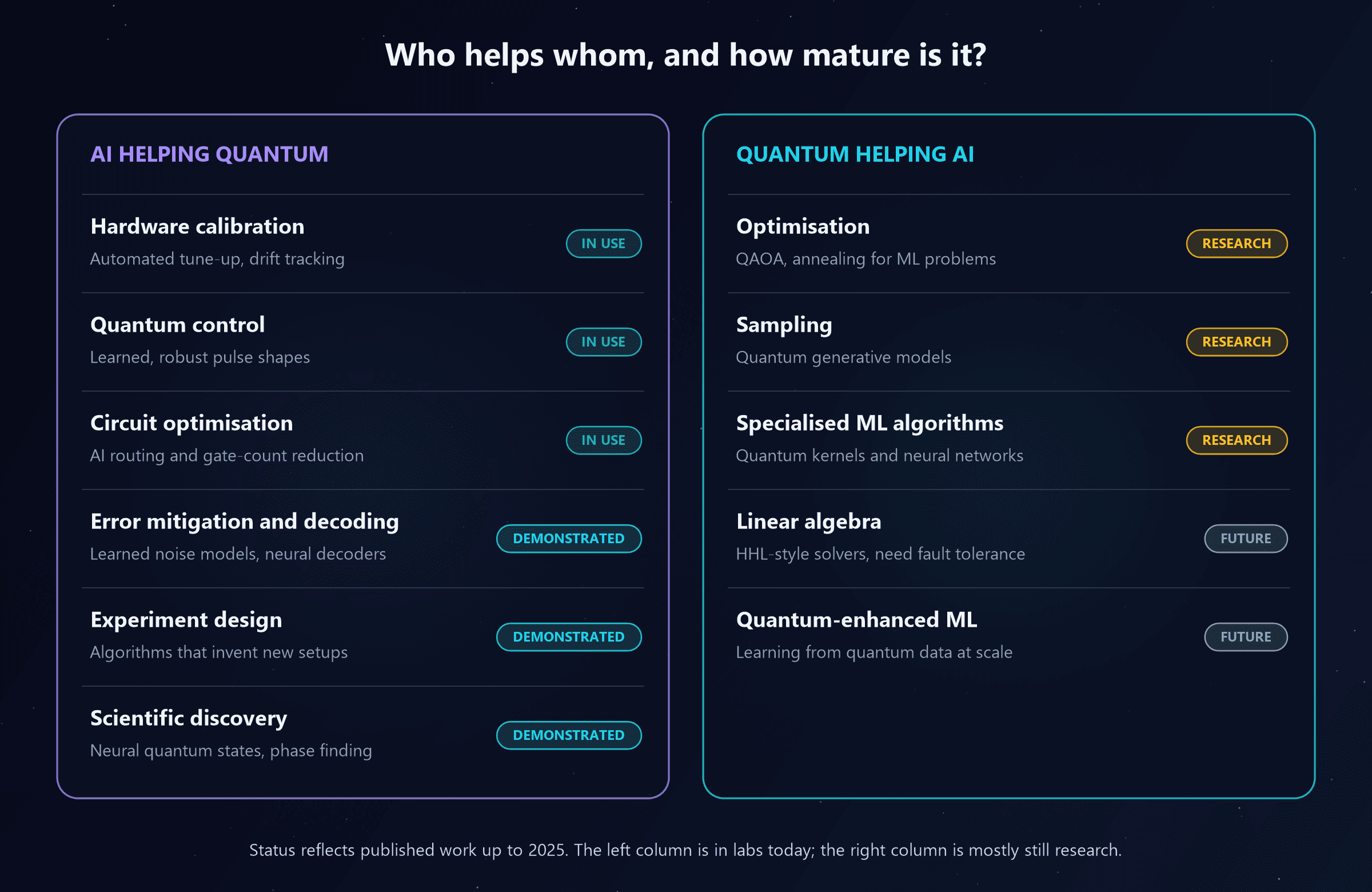
The asymmetry has a simple cause. AI runs on classical computers that already exist, so any lab can point a machine-learning model at its quantum hardware tomorrow. Quantum help for AI needs quantum computers that are much larger and more reliable than today's, plus an algorithm that beats GPUs by enough to cover the overhead. One direction needs a good idea; the other needs a good idea and a new kind of machine.
Part 1: AI Helping Quantum
A quantum computer is, in large part, a very difficult control problem. Hundreds of qubits, each with dozens of settings, each drifting over time, each slightly different from its neighbours, all of which must be tuned so that pulses of microwaves or light do exactly the right thing. (If that's new, How Does a Quantum Computer Actually Work? walks through the control stack.) That's exactly the kind of problem machine learning is good at: lots of data, a messy system nobody can model perfectly, and a clear measure of success.
1. Hardware calibration
The problem. Before a quantum processor can run anything, every qubit needs its frequency measured, its pulses tuned and its readout thresholds set. These values depend on each other (you can't tune a two-qubit gate until both single-qubit gates are tuned), and they drift as the chip's environment changes. On a large machine, a full calibration by hand would take far longer than the settings stay valid.
How AI helps. Calibration has become a graph of experiments with dependencies, run automatically. Google described this approach years ago, and calibration software from vendors and start-ups now automates most of the routine work. Machine learning adds three things on top:
- Smarter search. Bayesian optimisation and similar methods find good settings in far fewer measurements than a grid search, which matters when every measurement costs machine time.
- Drift detection. Models learn what "normal" looks like and flag a qubit before its errors grow, so only the drifting parts get re-calibrated.
- Reading the results. Many calibration experiments produce plots that a physicist used to judge by eye. Trained models now classify those results automatically, and research groups have tested AI agents, including ones built on large language models, that run whole calibration sequences.
Everyday analogy: it's the difference between tuning a piano by ear before every concert and having a tuning system that listens all the time and adjusts only the strings that have slipped.
Status: in use. Automated, increasingly ML-assisted calibration is how large machines are kept running. Nobody could tune a machine with thousands of qubits by hand.
2. Quantum control
The problem. A quantum gate is a carefully shaped pulse. The textbook pulse shapes assume a perfect qubit; real qubits leak into unwanted states, interact with their neighbours and respond slightly non-linearly. A pulse that works in theory gives a 99% gate in practice when 99.9% is needed.
How AI helps. Reinforcement learning treats pulse design as a game: try a pulse shape, measure how good the gate was, adjust, repeat. A 2019 Google study showed deep reinforcement learning finding gate controls that were both faster and more robust to noise than conventional methods in simulation, and since then learned and optimised pulses have been tested on real hardware across several platforms. Commercial tools now sell "robust control" pulses designed to keep working even as the hardware drifts.
The key advantage is that the model learns from the real device, not from an idealised equation. It can discover corrections for effects nobody fully understands.
Status: in use in research labs and commercial control software, though most production gates still rely on well-understood pulse families with careful tuning.
3. Circuit optimisation
The problem. Before a circuit runs, a compiler (the transpiler) must map it onto the real chip: choose which physical qubits to use, insert SWAP gates where qubits aren't connected, and convert everything into the chip's native gates. Every extra gate adds error, so a shorter compiled circuit is directly a more accurate one. Finding the best mapping is a very hard search problem.
How AI helps.
- Routing and synthesis. IBM added AI-powered transpiler passes, trained with reinforcement learning, that route circuits and synthesise parts of them with fewer gates than the standard heuristics, and offers them through its Qiskit tools.
- Expensive-gate reduction. On future fault-tolerant machines, one gate type (the T gate) is far more expensive than the rest, because it needs "magic states" (see the error correction post). Google DeepMind's AlphaTensor-Quantum applied the same kind of search that found faster matrix multiplication methods to cut the number of T gates in circuits, in some cases matching or beating the best known human constructions.
- Writing the code. Code assistants built on large language models help people write and debug quantum programs, which matters in a field with few experienced developers.
Status: in use. If you ran the first quantum program lab and sent it to real hardware, a heavily optimised compiler did the work.
4. Error mitigation and decoding
The problem. Today's machines are noisy, and future machines will rely on error correction, which constantly produces measurements that must be decoded in real time. Both tasks need a good model of how the hardware actually goes wrong, and real noise is messier than any textbook model. (Background: Why Quantum Computers Make So Many Errors.)
How AI helps.
- Error mitigation. A 2024 study led by IBM researchers trained machine-learning models (including random forests and graph neural networks) to map noisy results to mitigated ones, reaching accuracy comparable to standard techniques such as zero-noise extrapolation at a much lower runtime cost.
- Decoding. In 2024, Google DeepMind's AlphaQubit, a transformer-based neural network, decoded real error-correction data from Google's processor more accurately than the leading conventional decoders. It learns the device's real error patterns, including correlated errors and leakage that simple models ignore.
There's an important engineering catch. A superconducting decoder has to keep up with about a million rounds of checks per second, and large neural networks aren't yet fast enough for that. Expect hybrids: fast conventional decoders for real time, with learned models helping to tune them or to handle the hard cases.
Status: demonstrated on real data, and moving towards production, with speed the main obstacle.
5. Experiment design
The problem. Designing a quantum experiment (which lasers, crystals, beam splitters and detectors, arranged how) to create a particular quantum state is hard, partly because human intuition about entanglement is poor.
How AI helps. In 2016, a computer program called Melvin, developed in Anton Zeilinger's group in Vienna, searched through combinations of optical components and found experimental setups for complex entangled states that the physicists hadn't thought of. Some of its designs were built in the lab, and later tools extended the idea to design experiments people could understand and learn from. AI has also been used to choose which measurements to take next in an experiment ("active learning"), saving machine time when every data point is expensive.
Status: demonstrated, and an important example of AI not just tuning an experiment but suggesting new science.
6. Scientific discovery
The problem. Simulating many interacting quantum particles is exponentially hard for classical computers. That's the reason quantum computers were proposed in the first place, but it also limits what physicists can calculate today.
How AI helps, and where it competes. In 2017, Giuseppe Carleo and Matthias Troyer showed that neural networks can represent complex quantum states compactly ("neural-network quantum states"). Since then, neural networks such as DeepMind's FermiNet have computed molecular energies very accurately, and machine learning has been used to spot phases of matter in experimental snapshots from quantum simulators. AlphaFold, which predicts protein structures, earned a share of the 2024 Nobel Prize in Chemistry.
This is where the partnership gets complicated. Every time AI solves a quantum problem well on a classical computer, it removes a reason to build a quantum computer for that problem. More on that in the competition section below.
Status: demonstrated, and among the most scientifically important uses of AI anywhere.
Why this direction works so well
Look at what the six areas have in common: complicated physical systems, lots of measurement data, no perfect model, and a clear score (gate fidelity, circuit length, logical error rate). That's the profile of problems where machine learning shines, and it's why AI's help for quantum arrived first.
Part 2: Quantum Potentially Helping AI
Now the other direction. The honest summary is: there are real ideas here, a few with solid theory behind them, but no demonstrated advantage on a practical AI task yet. Each idea has a specific obstacle, and it's more useful to know the obstacle than the headline.
1. Optimisation
The idea. Machine learning is full of optimisation: choosing features, tuning hyperparameters, scheduling compute, training certain kinds of models. Quantum optimisation methods (QAOA on gate-based machines, and quantum annealing on machines like D-Wave's) could, in principle, find good solutions to some of these faster.
The obstacle. As explained in the algorithms post, the hardest optimisation problems are not expected to become easy even for quantum computers, and no quantum optimisation method has a proven advantage on practical problems. Classical solvers and the gradient methods that train neural networks are extremely good. There's also a mismatch: deep learning doesn't need the exact best answer, only a good-enough one found fast, which is exactly what classical methods already deliver.
Status: research. Worth watching for specialised combinatorial problems, not for neural network training.
2. Sampling
The idea. A lot of modern AI is about sampling: generative models produce new images or text by sampling from a learned probability distribution. A quantum computer is, naturally, a sampling machine: every run produces a sample from the distribution defined by its quantum state. Some of those distributions are believed to be extremely hard for classical computers to sample from, which is the basis of the "quantum supremacy" experiments.
So researchers study quantum generative models (such as "Born machines", named after the Born rule that turns amplitudes into probabilities) and quantum-assisted Boltzmann machines, hoping that quantum circuits can represent or sample some distributions more efficiently than classical networks.
The obstacle. Being hard to sample isn't the same as being useful to sample. The distributions that are provably hard classically aren't the ones we want for images, text or molecules, and training quantum generative models runs into the same scaling problems as other variational circuits (below).
Status: research. One of the more natural fits between quantum hardware and AI, but no practical advantage has been shown.
3. Linear algebra
The idea. Neural networks are mostly linear algebra: multiplying matrices and vectors. In 2009, Aram Harrow, Avinatan Hassidim and Seth Lloyd published the HHL algorithm, which solves certain systems of linear equations exponentially faster than classical methods. That sparked a wave of "quantum machine learning" algorithms built on it, promising exponential speed-ups for things like recommendation systems and data fitting.
The obstacle. The speed-up comes with fine print, as the computer scientist Scott Aaronson summarised in an influential 2015 article:
- Loading the data. The input has to be loaded into a quantum state, which needs a "quantum RAM" that doesn't exist yet. Loading N numbers the ordinary way takes at least about N steps, which wipes out an exponential speed-up.
- Reading the answer. The output is a quantum state, not a list of numbers. You can only extract a few properties of it; reading out the whole solution would take as long as the classical method.
- Conditions on the problem. The matrix must be well-behaved (sparse and well-conditioned, in the jargon).
- Classical catch-up. In 2018, Ewin Tang, then an undergraduate, showed that a famous quantum recommendation algorithm could be matched by a classical algorithm under the same data-access assumptions. Later work "dequantised" a whole family of quantum machine learning algorithms in the same way.
Status: future. HHL-style algorithms need large fault-tolerant machines, and their advantage for typical machine-learning data has largely disappeared under scrutiny. They remain important for specific scientific problems.
4. Specialised machine-learning algorithms
The idea. Instead of speeding up classical machine learning, design machine-learning models that are natively quantum:
- Quantum kernels. Map each data point into a quantum state and measure how similar two states are. In 2019, IBM researchers ran a quantum-kernel classifier on real hardware, and in 2021 a team proved a rigorous quantum speed-up for a kernel method, on a carefully constructed problem based on the same maths that Shor's algorithm breaks.
- Quantum neural networks. Variational circuits with adjustable rotation angles, trained like neural networks, the same hybrid loop as VQE in the algorithms post.
The obstacle. Two problems keep recurring. First, barren plateaus: as these circuits grow, the gradients used to train them typically become exponentially small, so training stalls (identified in 2018). Second, recent research suggests that many models designed to avoid barren plateaus become efficiently simulable on classical computers, which removes the reason to use quantum hardware. The proven speed-up exists, but for an artificial problem with a structure ordinary data doesn't have.
Status: research. Active, intellectually interesting, and with no advantage yet on real-world classical data.
5. Future quantum-enhanced ML
The idea that looks strongest. The most convincing results so far share one feature: the data is quantum to begin with. If the data comes from a quantum system (a molecule, a material, a quantum sensor, or another quantum computer), a quantum computer can work on it directly, without the expensive step of loading classical data.
In 2022, a team including Google and Caltech researchers showed, on Google's Sycamore processor, an exponential advantage in learning about a physical system when the learner could store and process quantum data directly, compared with a learner that measured everything into classical data first. That's an advantage for learning from quantum experiments, not for training a chatbot, but it points to where quantum-enhanced machine learning is most likely to matter:
- Quantum sensing and quantum networks, where data arrives as quantum states.
- Chemistry and materials, where a fault-tolerant quantum computer could generate accurate data that classical methods can't, to train classical AI models (the "teach AI" half of the loop in the previous post).
- Specialised subroutines inside larger hybrid workflows, where a quantum processor handles one small, hard piece.
Status: future. This is the direction with the strongest theoretical case, and it largely depends on fault-tolerant machines.
Why a QPU Is Not a Drop-In Replacement for a GPU
Now for the distinction that matters most in practice. Training a modern large language model takes something like 10²⁴ to 10²⁶ arithmetic operations, spread across tens of thousands of GPUs working for weeks or months. It's tempting to assume that a "more powerful" computer must do that job faster. A quantum computer doesn't, and the reasons are structural, not just a matter of today's machines being small.
A worked example: one training step
Take a modest model with 1 billion parameters (today's frontier models are hundreds of times bigger). Suppose, generously, that a quantum computer existed that could represent this model as a quantum circuit with a billion adjustable angles. How long would one training step take?
To train it, you need the gradient: how the result changes when each parameter changes. On a quantum computer, the standard method (the "parameter-shift rule") runs the circuit twice per parameter. Each run must be repeated many times (shots) to estimate an average, say 1,000.
params = 1e9                 # 1 billion parameters
circuits = 2 * params        # parameter-shift: 2 circuits per parameter
shots = 1000                 # repetitions to estimate each average

for seconds_per_shot in (1e-6, 1e-4):
    total = circuits * shots * seconds_per_shot
    print(f"{seconds_per_shot:.0e} s/shot: {total / 86400:,.0f} days")

# A GPU doing a forward and backward pass over a batch of a million tokens:
# about 6 x parameters x tokens = 6e15 operations, at roughly 1e15 per second
print(f"One GPU: {6 * params * 1e6 / 1e15:.0f} seconds")1e-06 s/shot: 23 days
1e-04 s/shot: 2,315 days
One GPU: 6 seconds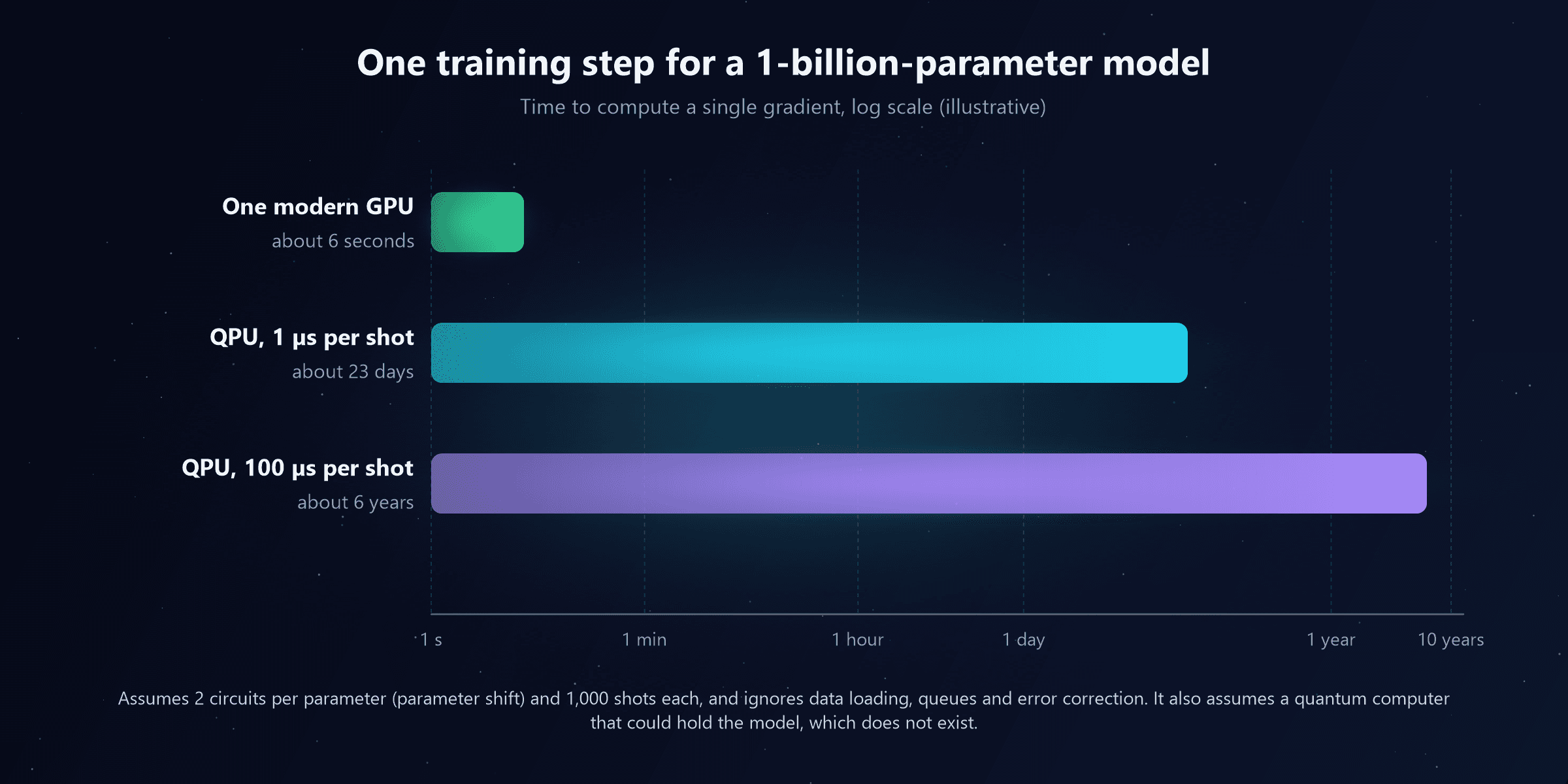
The numbers are rough and the assumptions generous, but the gap is so large (a factor of hundreds of thousands to tens of millions) that no realistic improvement closes it. And this is before counting the other problems.
The structural reasons
| What AI training needs | GPU | Quantum computer |
|---|---|---|
| Huge amounts of data fed in continuously | Reads data at enormous bandwidth from memory | Classical data must be encoded into quantum states, slowly; no quantum RAM exists |
| Billions of numbers stored (the weights) | 80 GB or more of fast memory per chip | No way to store large amounts of data; qubits hold a state for microseconds to seconds |
| Exact gradients, cheaply | One backward pass computes all gradients at once | Gradients estimated by repeated runs, one parameter at a time |
| Fast, simple operations at massive scale | Trillions of operations per second per chip | Logical operations on future error-corrected machines are expected to be far slower, perhaps thousands to millions per second |
| Answers you can read out in full | Every number is available | Measurement returns only bits; full readout needs many repetitions |
| Reliability | Effectively error-free arithmetic | Noisy today; error correction multiplies the hardware needed |
There's also a deeper point from the algorithms post: quantum computers don't speed up everything. They speed up problems with a special structure that interference can exploit. Multiplying large matrices of real numbers, the core of deep learning, is something GPUs are already superb at, and no known quantum algorithm offers a practical speed-up for it under realistic data-loading assumptions. A 2021 analysis by Google researchers made a related point for error-corrected machines in general: modest (quadratic) speed-ups are unlikely to pay off because of the large slowdown in each logical operation. Big wins need big, usually exponential, speed-ups.
So what will run AI in ten years?
Almost certainly GPUs and other classical AI accelerators, getting faster, more specialised and more energy-efficient. If quantum computers join AI data centres, they'll do so as specialised co-processors for particular sub-problems (simulation, sampling, chemistry), sitting next to GPUs, not instead of them. That's exactly the accelerator relationship described in Classical Computer vs Quantum Computer.
GPUs are helping quantum too
Ironically, GPUs are one of quantum computing's most important tools. They simulate quantum circuits so that algorithms can be developed and checked before real hardware exists; NVIDIA's cuQuantum and CUDA-Q software are widely used for this. They are being tested as real-time decoders for error correction. And they run the classical half of every hybrid quantum algorithm. The future data centre looks like GPUs and QPUs working together, linked by fast interconnects, with each doing what it's good at.
So: Competition or Partnership?
Mostly partnership, with real competition in a few specific places. It helps to separate the two clearly.
Where they compete:
- For the same scientific problems. AI methods for chemistry, materials and protein structure keep improving on classical hardware. Every quantum-chemistry problem that AI solves well enough classically is one less reason to wait for a quantum computer. The bar for "quantum advantage" now includes AI, not just traditional simulation methods.
- For money and attention. Investment, government budgets and talent are finite, and AI currently attracts far more of all three.
- For the "next computing paradigm" story. In public perception, the two are often framed as rivals, which encourages hype on both sides.
Where they work together:
- AI builds quantum computers: calibration, control, compilation, decoding, experiment design. This is the strongest and most concrete link.
- Classical AI hardware runs quantum's classical half: simulation, hybrid algorithms, decoding.
- Quantum may feed AI with data: accurate simulations of molecules and materials to train AI models, once fault-tolerant machines exist.
- Quantum data needs quantum learners: for sensing and quantum networks, the two fields merge.
| Area | Competition | Partnership |
|---|---|---|
| Building and running quantum hardware | — | ✅ AI is now part of the toolchain |
| Training large AI models | ❌ Quantum isn't a contender | — |
| Chemistry and materials | ✅ AI on GPUs competes with future quantum simulation | ✅ Quantum may produce training data for AI |
| Optimisation | ✅ Classical and AI methods set a high bar | Possible, unproven |
| Generative models and sampling | — | Research stage |
| Learning from quantum data | — | ✅ Strongest theoretical case |
| Investment and talent | ✅ Both compete for the same budgets | Overlapping skills in both fields |
How to Read a "Quantum AI" Headline
1. Which direction is it?
2. Is the data classical or quantum?
3. What was the classical baseline?
4. How big was the problem?
5. Does it need fault tolerance?
6. Is 'quantum' doing the work?
What This Means for IT and AI Teams
- Don't plan AI infrastructure around quantum computers. GPU and accelerator roadmaps are what matter for AI workloads for the foreseeable future.
- Expect AI inside quantum services. If your organisation runs quantum pilots in the cloud, much of the calibration, compilation and error handling behind them is already AI-assisted.
- Watch chemistry and materials closely. That's where the competition and partnership meet, and where the first real quantum-plus-AI workflows are most likely.
- Treat "quantum AI" products with the checklist above. Many are classical tools with a quantum label.
- Keep the security work separate. The urgent quantum topic for IT teams isn't AI at all; it's post-quantum cryptography, covered in stages 08 and 09.
Quick Recap
- The relationship is lopsided today. AI helping quantum is in use; quantum helping AI is mostly research.
- AI helps quantum with calibration, control, circuit optimisation, error mitigation and decoding, experiment design and scientific discovery, because quantum hardware is a data-rich control problem.
- Quantum might help AI with optimisation, sampling, linear algebra and specialised models, but each idea faces a specific obstacle: no proven advantage, data loading, readout, barren plateaus or classical catch-up.
- The strongest case is quantum data: learning from quantum systems, and generating accurate chemistry and materials data for classical AI.
- A QPU is not a drop-in replacement for a GPU. One training step of a 1-billion-parameter model would take weeks to years even on an imaginary quantum computer big enough to hold it.
- GPUs and QPUs are partners: GPUs simulate, decode and run the classical half of quantum workloads.
- They compete for some scientific problems and for investment, which keeps raising the bar for quantum advantage.
What's Next on the Learning Path
Stage 07, Quantum Applications, starting with Where Can Quantum Computers Actually Be Useful?, moves from "what could work in principle" to the industries betting on it: chemistry, materials, optimisation and finance, with an honest look at which use cases are closest. The full 11-stage path is listed at the end of the beginner's guide.

Written by
Chetan Yamger
Cloud Engineer · AI Automation Architect · Modern Workplace Consultant
Cloud Engineer, AI Automation Architect, and Modern Workplace Consultant based in Amsterdam, Netherlands. Specializing in scalable, secure enterprise solutions with Microsoft Azure, Intune, PowerShell, and AI-driven automation using ChatGPT, Gemini, and modern LLM technologies.
Stay in the loop.
New articles, straight to you.
Deep-dive technical articles on Intune, PowerShell, and AI — no noise, no spam.
Discussion
Share your thoughts — your email stays private
Leave a comment