
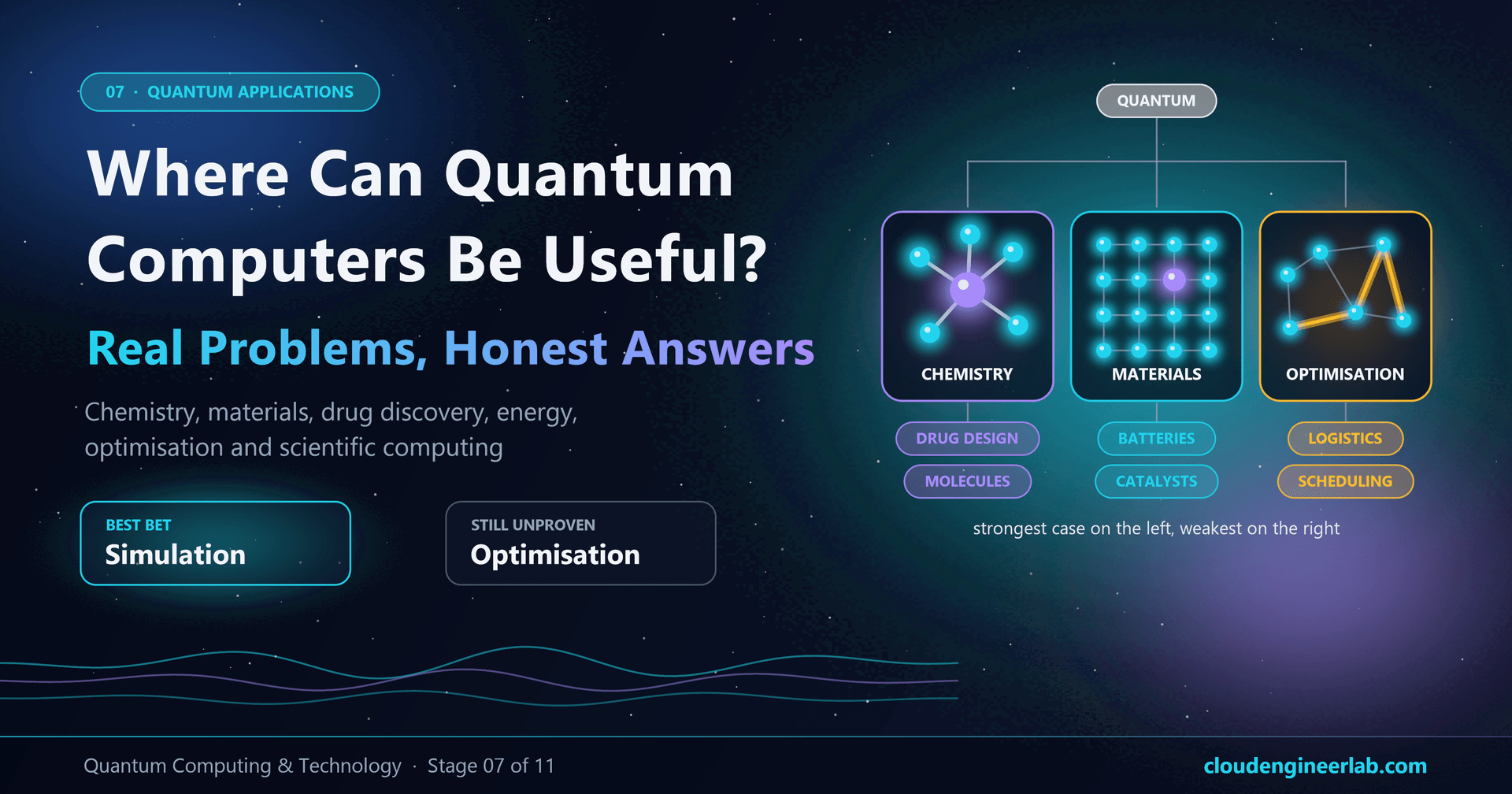
Where Can Quantum Computers Actually Be Useful?
Chemistry, materials, drug discovery, energy, optimisation and science: which real problems quantum computers could help with, and how strong each case is.
Every few weeks, an article claims that quantum computers will cure diseases, fix climate change, crash the stock market and deliver your parcels faster. The problem isn't that these claims are all false. It's that they mix together very different things: problems where there are strong scientific reasons to expect a quantum advantage, problems where the idea is plausible but unproven, and problems where classical computers are already so good that a quantum computer may never matter.
This post sorts them out. It's built around real problems, the kind a chemist, a materials scientist, a logistics planner or an energy company actually has, and for each one it asks the same three questions: what's the problem, why might a quantum computer help, and how strong is the case?
Stage 07 of the learning path
This post opens stage 07, Quantum Applications, of the Quantum Computing & Technology learning path. It builds on Quantum Algorithms: Why Are They Different?, which explains quantum simulation and optimisation algorithms, and on Quantum Error Correction, since most applications here need error-corrected machines.
The Map
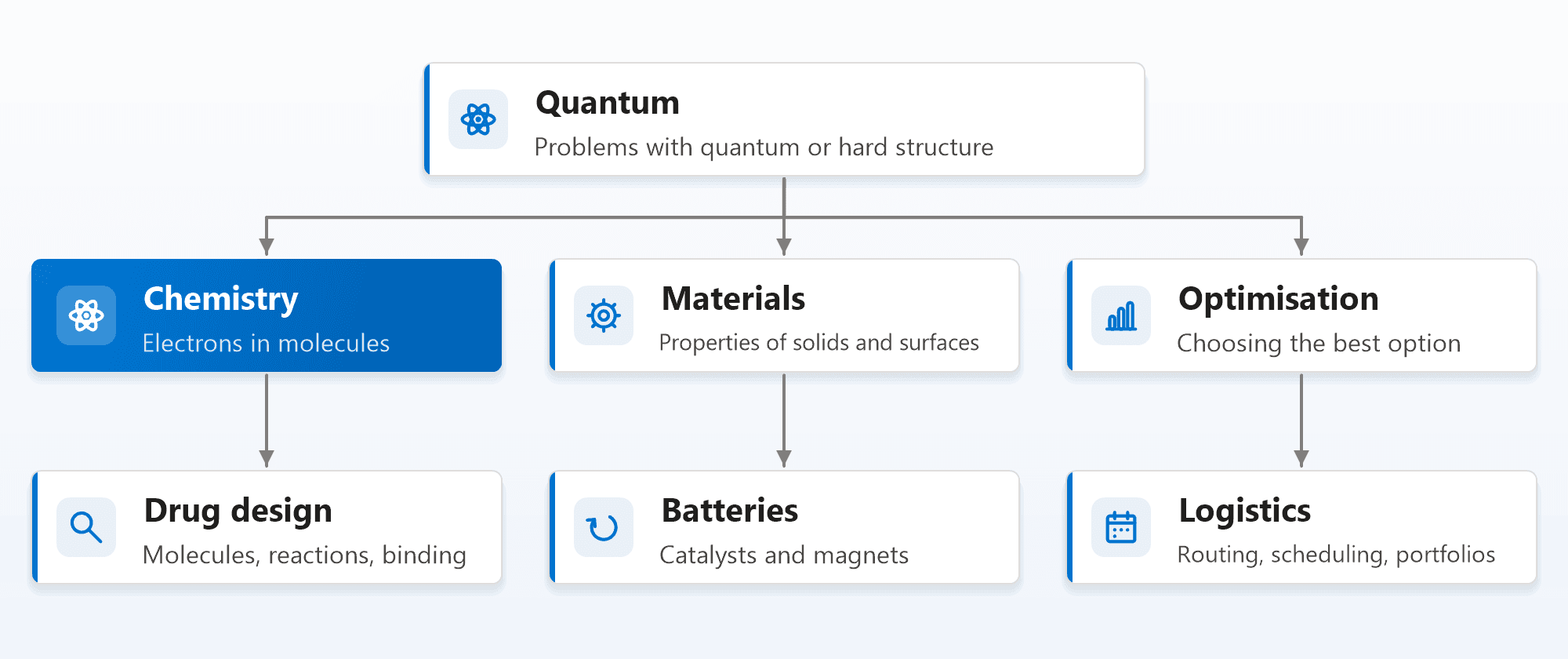
The most important thing about this diagram is that its three branches are not equally strong. Chemistry and materials are, underneath, the same problem: working out how electrons behave. Electrons follow the rules of quantum mechanics, so a quantum computer is a natural tool for simulating them. That's the idea Richard Feynman proposed in 1981, and it's still the strongest case for building quantum computers at all.
Optimisation is a different kind of problem. It's about choosing the best option from a vast number of possibilities, there's nothing quantum about a delivery route, and classical computers are extremely good at it. It's the branch that gets the most business attention and has the weakest evidence.
A quick test for any application
The algorithms post ended with three conditions that every real quantum advantage seems to need. They make a useful filter for everything below:
- Structure. The problem has a structure interference can exploit. Quantum physics itself is the clearest example.
- Small input, hard computation. The description of the problem is short (a molecule is a few hundred atoms), but solving it is exponentially hard classically. Loading big datasets into a quantum computer is slow, so huge-data problems are bad fits.
- A usable output. You need a few numbers out (an energy, a rate, a yes or no), not the whole quantum state.
Keep those three in mind. They explain almost every verdict in this post.
Chemistry: Simulating Molecular Systems
The problem
Chemistry is mostly about energy. Whether a reaction happens, how fast it goes, which shape a molecule prefers and how strongly a drug sticks to a protein all depend on the energies of different arrangements of atoms. And those energies are set by the electrons.
Computing them exactly is brutally hard, because electrons interact with each other. Each electron's behaviour depends on all the others, so you can't work them out one at a time. A full quantum description of a molecule's electrons, using 100 orbitals (a modest number), involves about 2¹⁰⁰, roughly 10³⁰ numbers. Doubling to 200 orbitals gives about 10⁶⁰. No classical computer will ever store that.
How chemists cope today
Chemistry is not stuck. Decades of clever approximations, such as density functional theory (DFT) and coupled-cluster methods, give excellent answers for a huge range of molecules. They run on supercomputers every day, and they're increasingly paired with AI models trained on their results.
The approximations struggle in one specific situation: strong correlation, where several electrons are tightly coupled and no simple picture describes them. That happens in:
- Transition metals (iron, copper, cobalt, manganese), which sit at the heart of many catalysts and enzymes.
- Bonds being broken or formed in the middle of a reaction.
- Excited states, important for light-driven chemistry and solar materials.
- Some magnetic and exotic materials.
These are exactly the cases where approximate methods can disagree with each other, and with experiment, by amounts that matter.
Why small errors matter
Chemists aim for "chemical accuracy", about 1 kcal/mol. That sounds tiny, but reaction rates depend exponentially on energy barriers. At room temperature, an error of just 1 kcal/mol in a barrier changes the predicted reaction speed by about 5 times, and an error of about 1.4 kcal/mol is a factor of 10. If your method can't tell which of two catalysts is better, it isn't much help for designing one.
Where a quantum computer comes in
A quantum computer can represent the electrons' state directly, using qubits in place of orbitals, and an algorithm called quantum phase estimation can then extract the energy with controlled precision. This is the clearest example of a problem that meets all three tests: quantum structure, a short input (the molecule), and a short output (an energy).
The catch is scale. Useful chemistry problems need error-corrected machines with hundreds to thousands of logical qubits running very long circuits. Variational methods like VQE (covered in the algorithms post) were designed to work on today's noisy hardware, but they haven't beaten classical chemistry methods on any problem of practical interest.
The poster child: nitrogen fixation
Fertiliser production uses the Haber-Bosch process, which needs high temperatures and pressures and is estimated to use around 1 to 2% of the world's energy. Some bacteria do the same job at room temperature, using an enzyme called nitrogenase whose active site, nicknamed FeMoco, contains iron and molybdenum atoms, a textbook strongly correlated system. Understanding exactly how FeMoco works could help design better catalysts.
In 2017, a team from ETH Zurich and Microsoft published a detailed estimate of what a quantum computer would need to simulate FeMoco, which made it the standard benchmark for quantum chemistry. Since then, better algorithms have cut the estimated cost by several orders of magnitude, although it still requires a large, fault-tolerant machine.
Verdict: strong case
Simulating strongly correlated molecules is the application with the best scientific case for quantum advantage. It needs fault-tolerant hardware, and the first useful results will probably come from carefully chosen small but classically hard problems, not from simulating whole drugs.
Materials Science: Discovering Materials With the Right Properties
The problem
Materials science asks why a material behaves the way it does and how to make a better one: a magnet that needs less rare-earth metal, a superconductor that works at higher temperatures, a solar cell that absorbs more light, a coating that resists corrosion. Like chemistry, it comes down to electrons, only now there are enormous numbers of them, arranged in repeating crystals and on surfaces.
Why it's hard
Many materials are well described by approximate methods. The hard ones are, again, the strongly correlated ones. The most famous is high-temperature superconductivity in copper-oxide materials (cuprates), discovered in 1986 and still not fully explained. Physicists study a simplified model of it, the Fermi-Hubbard model: electrons hopping on a grid and repelling each other. Even this simple-looking model becomes very hard to solve classically for larger grids.
Where a quantum computer comes in
Lattice models like Fermi-Hubbard are among the best early targets for quantum computers, for two reasons:
- They map neatly onto qubit grids. A grid of qubits can represent a grid of electron sites, with few wasted resources.
- They need fewer qubits than molecules. Resource estimates suggest some interesting Hubbard-model problems need a few hundred logical qubits, fewer than most chemistry targets.
Today's quantum computers already run small simulations of physics models, including the dynamics of magnetic systems: how spins evolve over time. Some of these experiments are at or beyond the edge of what exact classical simulation can handle, although classical approximation methods keep catching up.
Verdict: strong case
Simulating materials, especially lattice models of magnetism and superconductivity, is likely to be one of the first scientifically useful applications. Turning those insights into a new commercial material is a longer road: a simulation is one step in a discovery process that also needs synthesis, testing and manufacturing.
Drug Discovery: Potentially Improving Molecular Simulation
The problem
Bringing a new drug to market typically takes 10 to 15 years and, counting all the candidates that fail, often more than a billion dollars. The process runs roughly from target (which protein to act on), to hits (molecules that bind), to leads (the promising ones), to optimisation, preclinical testing and clinical trials.
Where quantum computing might fit
It's important to be precise here, because drug discovery is the most over-promised quantum application. A quantum computer won't design a drug. At best, it can improve one step: accurately simulating the electronic structure of a small, difficult part of a system. For example:
- How a drug binds to a metal atom at a protein's active site.
- How the body breaks a drug down. Enzymes in the cytochrome P450 family, which contain iron, metabolise most drugs. In 2022, researchers from Google and Boehringer Ingelheim estimated the quantum resources needed to simulate one of these enzymes accurately, and concluded it would need a large fault-tolerant machine, but one with a plausible advantage over classical methods.
- Reactivity and toxicity of candidate molecules, where electronic effects matter.
A whole drug bound to a whole protein in water is far too big for any quantum computer. The realistic approach is embedding: classical methods (and AI) handle the large surroundings, and the quantum computer handles only the small "active space" where classical approximations fail.
The honest picture
Most of the time and cost in drug development is in clinical trials, not computation. And AI has already transformed parts of early discovery on classical hardware, from protein structure prediction (AlphaFold, which shared the 2024 Nobel Prize in Chemistry) to screening huge libraries of molecules. Quantum computing, if it helps, will be one more tool in a mostly classical pipeline, used for the specific steps where electron behaviour is the bottleneck. Quantum Computing + AI: Competition or Partnership? explains why AI is both a partner and a competitor here.
Verdict: real but narrow
Quantum computing could improve specific molecular simulations inside drug discovery, mostly those involving metals or reactions. Claims that quantum computers will "discover drugs" or "cure diseases" skip over every other step of the process.
Optimisation: The Most Popular, Least Proven Application
The problems
Optimisation is everywhere in business, which is exactly why it gets so much attention:
- Logistics: how to load vehicles, which warehouse ships which order.
- Routing: the order in which delivery vans visit their stops (the vehicle routing problem).
- Scheduling: shifts, production lines, aircraft crews, hospital operating theatres.
- Supply chains: where to hold stock, what to order, how to handle disruption.
- Portfolio optimisation: how to divide money across investments to balance risk and return under constraints.
They all share one shape: a huge number of possible choices, rules that rule some of them out, and a score to maximise or minimise. The number of possibilities grows explosively: just 20 delivery stops can be visited in more than 10¹⁸ different orders.
Why quantum computers might help
There are three main quantum approaches, all covered in the algorithms post:
- Quantum annealing (the approach used by D-Wave): the problem is encoded as an energy landscape, and the machine settles towards low-energy states, which correspond to good solutions.
- QAOA, the Quantum Approximate Optimisation Algorithm: a variational circuit that alternates between "score the options" and "mix the options" steps on gate-based machines.
- Grover-style search: a proven speed-up, but only quadratic.
Companies have run many pilots with these: scheduling, routing (Volkswagen demonstrated a quantum-assisted bus-routing system in Lisbon in 2019, for example), portfolio selection and more.
Why the case is weak
- The hardest versions stay hard. Many of these problems belong to a class (NP-hard) that quantum computers are not expected to solve efficiently. At best, they might find good solutions somewhat faster.
- Classical solvers are superb. Decades of operations research have produced solvers and heuristics that handle millions of variables and constraints, and businesses usually need a good answer quickly, not the perfect one. That bar is very high.
- Quadratic speed-ups may not pay off. Error-corrected logical operations are expected to be far slower than classical ones, so a quadratic speed-up only wins on enormous problems that take a very long time. A 2021 analysis by Google researchers argued that, for many problems, this crossover point is impractically far away.
- Pilots usually aren't comparisons. Most quantum optimisation pilots show that a problem can run on quantum hardware, not that it ran better than a well-tuned classical solver.
Portfolio optimisation and finance deserve a note. A related problem, pricing complex financial products by Monte Carlo simulation, has a proven quadratic quantum speed-up (via amplitude estimation). But a 2021 study by Goldman Sachs and IBM researchers estimated that a practical advantage for derivative pricing would need thousands of logical qubits and much faster logical gates than current roadmaps plan.
Verdict: weak case, keep watching
Optimisation is the application with the biggest market and the least evidence. Quantum methods may eventually help with specific, structured problems, and quantum-inspired classical algorithms are already useful. But no quantum optimiser has been shown to beat the best classical methods on a real business problem.
Energy: Batteries, Catalysts and Energy Systems
Energy is less a separate application than a place where the others meet. It's worth looking at because it shows clearly which kinds of energy problem fit a quantum computer and which don't.
Battery materials
Better batteries need better materials: cathodes that hold more charge without degrading, electrolytes that are safer and work in solid form, and chemistries that rely less on scarce metals like cobalt and lithium. Many of the hard questions (how lithium ions move through a cathode, why a material degrades, what happens at the interface between electrode and electrolyte) involve transition metals and the strongly correlated electrons described above. That's why carmakers and battery companies have announced research partnerships with quantum computing firms.
There's a revealing counter-example, though. In 2024, Microsoft and the US Pacific Northwest National Laboratory used AI and classical high-performance computing to screen millions of candidate materials and identify a new solid electrolyte that uses substantially less lithium. No quantum computer was involved. Classical methods and AI will do most of the screening; quantum computing would earn its place only for the hard cases they can't resolve.
Verdict: moderate case. Real chemistry problems, but large fault-tolerant machines needed and strong classical competition.
Catalysts
Catalysts speed up chemical reactions, and better ones could make some of the most energy-hungry industrial processes cheaper and cleaner: making fertiliser (the nitrogen fixation example above), producing hydrogen by splitting water, turning captured carbon dioxide into fuels or chemicals, and refining. Catalysts often rely on transition metals, so this is the chemistry case in its purest form.
Verdict: strong case, with the same caveat: fault-tolerant hardware required.
Energy systems
Running a power grid involves huge optimisation problems: deciding which plants to run (unit commitment), balancing supply and demand, planning network upgrades and integrating variable renewables. These are optimisation and large linear-algebra problems, so they inherit the weaknesses described above. Quantum linear-algebra algorithms (such as HHL) offer impressive theoretical speed-ups, but their fine print (loading the data, reading the answer) makes them a poor fit for big classical datasets like grid models, as explained in the AI post.
Verdict: weak case for the grid itself; quantum computing's energy contribution is far more likely to come through materials and catalysts.
Scientific Computing: Where Governments Are Already Investing
The application with the clearest near-term role isn't a commercial product at all. It's science.
Many questions in physics are exactly the kind of quantum many-body problem quantum computers are built for: magnetism, superconductivity, the behaviour of quarks and nuclei (lattice gauge theories), exotic phases of matter and even toy models of quantum gravity. For a physicist, a quantum computer is a new kind of experimental instrument: a fully controllable quantum system that can be programmed to imitate another one.
That's why scientific computing is a major focus of government quantum programmes. The US Department of Energy, which runs the national laboratories and some of the world's largest supercomputers, describes quantum computing as an emerging tool for scientific discovery. In practice, that means:
- Five National Quantum Information Science Research Centers, launched in 2020 and renewed in 2025, connecting national laboratories, universities and companies.
- Access programmes such as the Quantum Computing User Program at Oak Ridge National Laboratory, which gives researchers time on commercial quantum computers.
- Integration with supercomputers, so quantum processors work alongside the classical machines scientists already use.
Similar programmes run in Europe, the UK, Japan, India, Canada and Australia, often based at national supercomputing centres. Google's 2025 "Quantum Echoes" experiment, described in Why Is Quantum Computing Accelerating Now?, is a good example of where this leads: a physics measurement that is hard to reproduce classically and is linked to a real experimental technique.
Verdict: the nearest useful application
The first genuinely useful results from quantum computers are most likely to be scientific: new understanding of physical systems that classical methods can't simulate. Commercial value follows later, when that understanding feeds into chemistry, materials and engineering.
Putting It Together: The Readiness Map
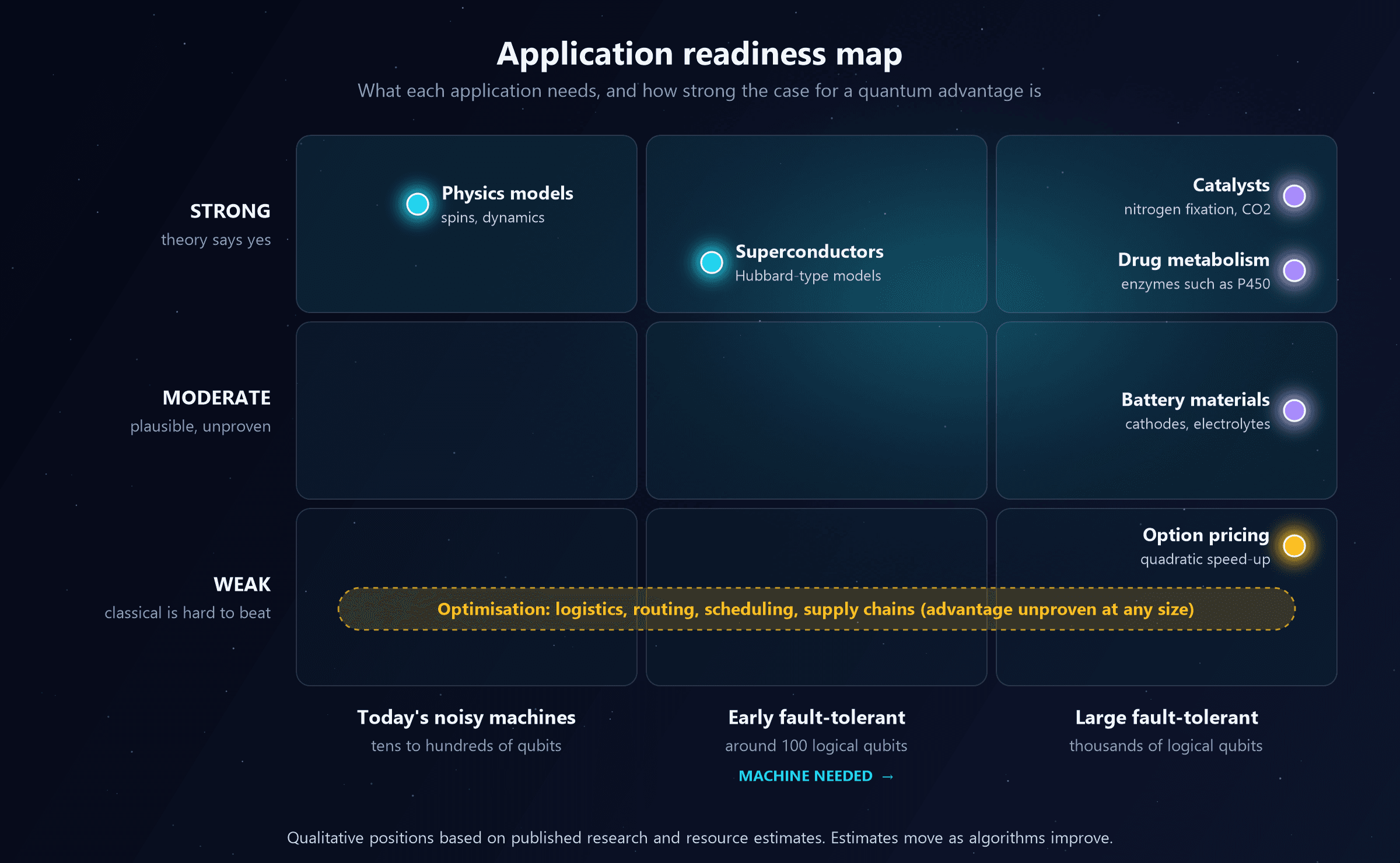
| Application | Why quantum fits | Classical competition | Likely needs | Strength of case |
|---|---|---|---|---|
| Physics simulation | Quantum systems simulating quantum systems | Strong approximations, but they fail on some dynamics | Today's best machines to early fault tolerance | Strong |
| Materials (lattice models, superconductors) | Electron grids map onto qubit grids | Good for many materials, weak for strongly correlated ones | Hundreds of logical qubits | Strong |
| Chemistry and catalysts | Strongly correlated electrons | DFT, coupled cluster, AI models | Hundreds to thousands of logical qubits | Strong |
| Drug discovery | Metal-containing active sites, reactions | AI and classical chemistry dominate most steps | Thousands of logical qubits, embedded in classical workflows | Real but narrow |
| Battery materials | Transition-metal chemistry | AI and HPC screening, as in the 2024 electrolyte discovery | Large fault-tolerant machines | Moderate |
| Optimisation (logistics, routing, scheduling, supply chains) | Huge search spaces | World-class solvers and heuristics | Unknown; no proven advantage | Weak |
| Portfolio optimisation and option pricing | Proven quadratic speed-up for Monte Carlo pricing | Fast classical Monte Carlo on GPUs | Thousands of logical qubits and fast logical gates | Weak to moderate |
| Energy systems (grids) | Large optimisation and linear algebra | Mature classical tools | Data loading makes it a poor fit | Weak |
Notice the pattern: the further an application is from "simulate electrons", the weaker its case.
What a Real Quantum Workflow Will Look Like
None of these applications will run on a quantum computer alone. A realistic workflow for, say, designing a new catalyst looks like this:
The quantum computer does a small, expensive, crucial job in the middle, exactly like the accelerator relationship described in Classical Computer vs Quantum Computer. The value comes from the whole pipeline, which is why the organisations best placed to benefit are the ones that already have strong computational chemistry, materials or physics teams.
How to Judge an Application Claim
1. Is the problem about electrons or quantum physics?
2. Was it compared against the best classical method?
3. What size of machine does it need?
4. Which step of the process does it improve?
5. Is it a pilot or a result?
What This Means for Organisations
- Chemicals, pharmaceuticals, materials and energy companies have the strongest reason to build quantum skills now, ideally inside existing computational science teams, so they're ready when fault-tolerant machines arrive.
- Logistics and finance teams should treat quantum optimisation as research to monitor, not a capability to buy. Quantum-inspired classical algorithms are worth evaluating on their own merits.
- Everyone should separate application planning from security planning. Whether or not quantum computers ever help your business, Shor's algorithm affects your encryption, which is the subject of stages 08 and 09.
Quick Recap
- Applications are not equal. Simulating electrons (chemistry and materials) has a strong scientific case; optimisation has the biggest market and the weakest evidence.
- Chemistry: strongly correlated molecules, such as catalysts with transition metals, are the clearest target. A 1 kcal/mol error changes a predicted reaction rate about five-fold.
- Materials: lattice models of magnetism and superconductivity are among the first realistic targets.
- Drug discovery: quantum computing could improve specific simulations inside a mostly classical, AI-heavy pipeline. It won't design drugs by itself.
- Optimisation: logistics, routing, scheduling, supply chains and portfolios face superb classical competition, and no quantum advantage has been proven.
- Energy: quantum's contribution is most likely through battery materials and catalysts, not through running the grid.
- Scientific computing is the nearest useful application, and governments, such as the US Department of Energy, are already investing in it.
- Real workflows are hybrid, with the quantum computer doing one small, hard step.
What's Next on the Learning Path
The next posts in stage 07 take individual applications in more depth, starting with chemistry and materials. After that, stage 08, Quantum Security, turns to the application nobody wants: breaking today's encryption, in Why Quantum Computers Threaten Today's Encryption. The full 11-stage path is listed at the end of the beginner's guide.

Written by
Chetan Yamger
Cloud Engineer · AI Automation Architect · Modern Workplace Consultant
Cloud Engineer, AI Automation Architect, and Modern Workplace Consultant based in Amsterdam, Netherlands. Specializing in scalable, secure enterprise solutions with Microsoft Azure, Intune, PowerShell, and AI-driven automation using ChatGPT, Gemini, and modern LLM technologies.
Stay in the loop.
New articles, straight to you.
Deep-dive technical articles on Intune, PowerShell, and AI — no noise, no spam.
Discussion
Share your thoughts — your email stays private
Leave a comment