
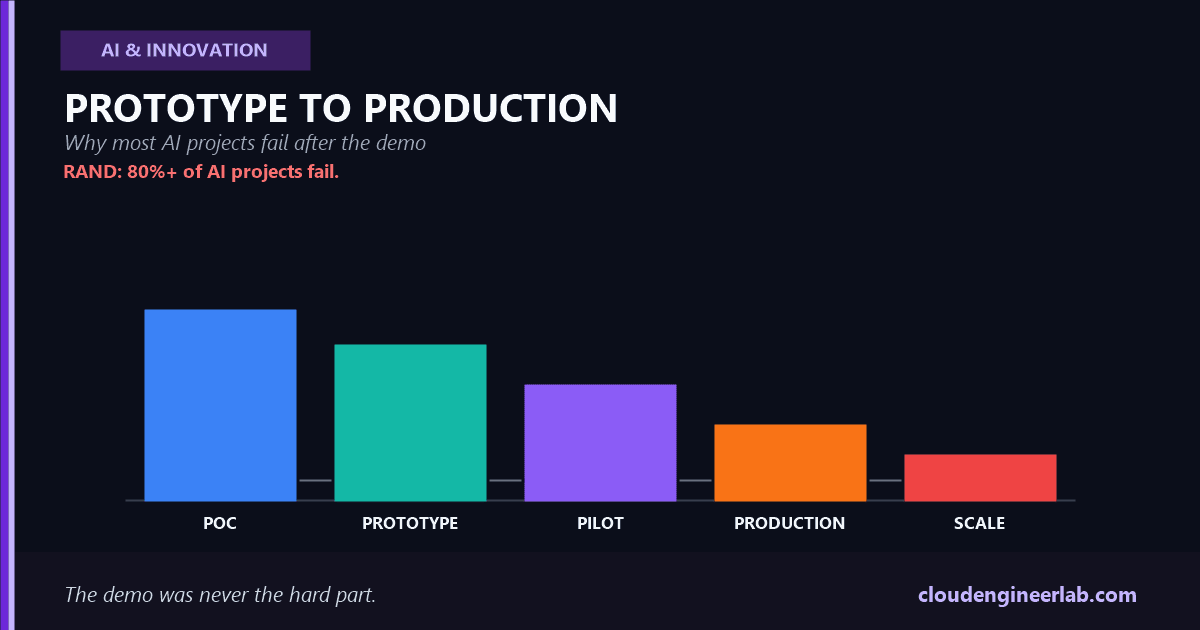
From Prototype to Production: Why Most AI Projects Fail After the Demo
The demo always works. RAND found over 80% of AI projects still fail, and MIT found 95% of pilots never show up on the P&L. Here's exactly where they die.
The demo goes well almost every time. Someone types a well-chosen question, the model gives an impressive answer, the room nods, budget gets approved. RAND Corporation's research puts the number that comes after that moment in stark terms: more than 80% of AI projects still fail, roughly twice the failure rate of a conventional IT project. MIT's Project NANDA found something even sharper: about 95% of generative AI pilots never show up as a measurable return on the actual profit-and-loss statement.
The demo was never lying about the model's capability. It was lying about everything around it.
The one sentence to remember
A demo proves a model can produce an impressive answer once, under ideal conditions, to a question someone chose in advance. Production requires it to do that reliably, affordably, securely, and repeatedly, to questions nobody chose in advance. Those are different problems, and the gap between them is where almost every AI project actually dies.
This is a walkthrough of that journey for the people who have to plan it, not just build it: the five stages a real AI project moves through, the real, cited data on exactly where projects stall or die at each one, and the nine specific problems that stay invisible right up until the stage where they suddenly aren't.
The Journey
Each stage isn't just bigger, it's qualitatively different
Moving from Prototype to Pilot isn't "the same thing with more users." It's the first time anyone outside the building the team already trusts is typing something the team never anticipated. Moving from Production to Scale isn't "the same thing but busier." It's the point where a failure mode that happened once a month at pilot volume starts happening several times a day.
Where Projects Actually Die
RAND's research breaks the failure down by exactly where in the journey it happens, and the shape of that breakdown is worth sitting with: 33.8% of AI projects get abandoned before ever reaching production at all. Another 28.4% reach production but fail to deliver the value that was expected of them. A further 18.1% make it into real production use and still never recover the investment that went into them.
Read that as a funnel, not a single failure point
Most of the mortality happens before production even starts, which means most AI project failure is a planning and expectations problem, not a production-readiness problem. The teams that fail after reaching production are often the ones who solved production readiness and never solved the business case underneath it.
The Nine Problems, and Where They Actually Surface
None of these nine problems are visible in a demo. Each one becomes visible at a specific, predictable stage, and being surprised by it there is usually a sign nobody planned for it earlier.
At the Pilot Stage: Hallucinations and Data Quality
A demo's inputs were chosen by the people who built it, which means they were chosen to work. Real pilot users ask things nobody anticipated, and that's exactly when hallucination rates that looked negligible in testing become visible for the first time. The mechanics of why this happens, and the concrete mitigations that actually work, are covered in AI Hallucinations Explained.
Data quality surfaces at the same stage for the same underlying reason. Gartner attributes 85% of AI project failures to poor data quality, and a pilot is usually the first time a system meets the organization's actual data, messy, inconsistent, full of edge cases nobody cleaned up for a demo.
At the Production Stage: Cost, Latency, Security, Evaluation, and Monitoring
The cost surprise is not small
MIT Sloan data puts average cost overruns at production scale at 380% compared to pilot-stage projections. A cost model built from pilot usage almost never survives contact with real production volume, because pilot usage was never representative of it.
Latency follows the same pattern: a demo runs under ideal conditions, on hardware and network paths nobody was contending for. Production runs under real concurrent load, where the actual cost-versus-latency tradeoffs covered in The AI Inference Revolution stop being theoretical and start showing up as user complaints.
Security is simply absent from a demo's threat model, nobody attacks a demo. Production is a real target, and the full threat surface, from prompt injection through supply-chain risk, is covered in AI Agent Security and AI Supply Chain Security.
Evaluation and monitoring share a root cause: a demo doesn't need either, because a human is watching every single output personally. Production has no human watching every output, which means the measurement discipline covered in LLM Evaluation and the tracing discipline covered in AI Observability aren't optional additions at this stage, they're the only way anyone finds out something went wrong before a user reports it.
At the Scale Stage: Reliability and User Adoption
An edge case that occurs once a month at pilot volume is a curiosity. The same edge case at scale volume happens several times a day, and a system that was never built to fail gracefully, the failure-handling discipline covered in AI Agents Are Not Chatbots, turns each occurrence into a real incident instead of a shrug. The hands-on toolkit for actually building that reliability in, retries that know what's safe to repeat, idempotency, validated output, fallback models, and checkpointing, is covered in From Prompt to Production.
User adoption is the failure mode least visible from an engineering seat, and Gartner names it directly: poor integration into real workflows is a recurring, named root cause of AI project failure. A system that works correctly but doesn't fit how people actually do their jobs gets quietly ignored, which looks nothing like a technical failure and everything like a wasted investment.
Why the Demo Was Always Going to Lie
Every one of the nine problems above shares a root cause: a demo, by construction, collapses each of these dimensions to near zero. Curated input removes the conditions that trigger hallucinations. A handful of queries removes real cost pressure. A quiet room removes real latency contention. Nobody attacking it removes the entire security question. One team watching every output removes any need for evaluation or monitoring. Occasional use removes any pressure on reliability. And the people using it chose to be there, removing the adoption question entirely.
A successful demo is evidence of exactly one thing
It proves the easy 20% is solved. It says nothing about the other 80%, and treating a great demo as proof the hard part is done is the single most common planning mistake behind the failure rates this article opened with.
A Gate Checklist for Each Transition
POC to Prototype: is this technically viable, not just technically possible?
A POC proves a model can do the task once. Before building a prototype, confirm it can do the task reliably enough, on realistic inputs, to be worth the next investment.
Prototype to Pilot: do you have a real evaluation baseline yet?
If the only quality signal is "it looked good when we tried it," you have no way to know if pilot users are getting a worse experience than your own testing did. Build the eval suite before the pilot starts, not after something goes wrong in it.
Pilot to Production: does the cost and latency model use real pilot data, not demo assumptions?
Given the 380% average cost overrun at this exact transition, a production cost estimate built on anything other than real, measured pilot usage should be treated as a guess.
Production to Scale: what happens when the rare failure becomes the common one?
Confirm the system's failure handling, monitoring, and fallback paths were built for the failure rate at scale, not the failure count at pilot volume. The same percentage failure rate is a completely different operational problem at ten times the traffic.
The Bottom Line
Gartner predicts more than 40% of agentic AI projects will be canceled outright by the end of 2027, and the median time from pilot approval to shutdown is already just 14 months. None of that is a statement about whether the underlying models are capable enough. It's a statement about how consistently organizations mistake a successful demo for evidence that production readiness, cost discipline, security, evaluation, and real user adoption are already solved problems.
The question worth asking after your next great demo
Which of the nine problems in this article has this project actually been tested against, not assumed away? If the honest answer is none of them yet, that's not a reason to stop. It's the actual project plan, the one the demo never had to survive.
The demo was never the hard part. It was the part everyone already knew how to do.

Written by
Chetan Yamger
Cloud Engineer · AI Automation Architect · Modern Workplace Consultant
Cloud Engineer, AI Automation Architect, and Modern Workplace Consultant based in Amsterdam, Netherlands. Specializing in scalable, secure enterprise solutions with Microsoft Azure, Intune, PowerShell, and AI-driven automation using ChatGPT, Gemini, and modern LLM technologies.
Stay in the loop.
New articles, straight to you.
Deep-dive technical articles on Intune, PowerShell, and AI — no noise, no spam.
Discussion
Share your thoughts — your email stays private
Leave a comment