
Building Production-Ready AI: Architecture Beyond the LLM
The model call is the easy 5%. Here's the architecture, security, cost, monitoring, and reliability work that turns a demo into a system you can trust.
A demo that answers three test questions correctly in front of a room of people proves almost nothing about whether it's ready for production. The actual system that has to run reliably, stay secure, hold its cost per request steady, and keep working when a tool call fails at 2 AM looks nothing like that demo. It looks like a real piece of infrastructure, because that's exactly what it is.
The one sentence to remember
Calling the model is the easy 5% of building production AI. The other 95% is the architecture that makes that call secure, affordable, observable, and reliable enough to bet a real product on.
This is a full architectural walkthrough of what actually sits around the model in a system built to last: the layers, what each one is responsible for, and the eight disciplines, architecture, security, scalability, cost, monitoring, evaluation, reliability, and deployment, that separate a demo from something you can put your name on.
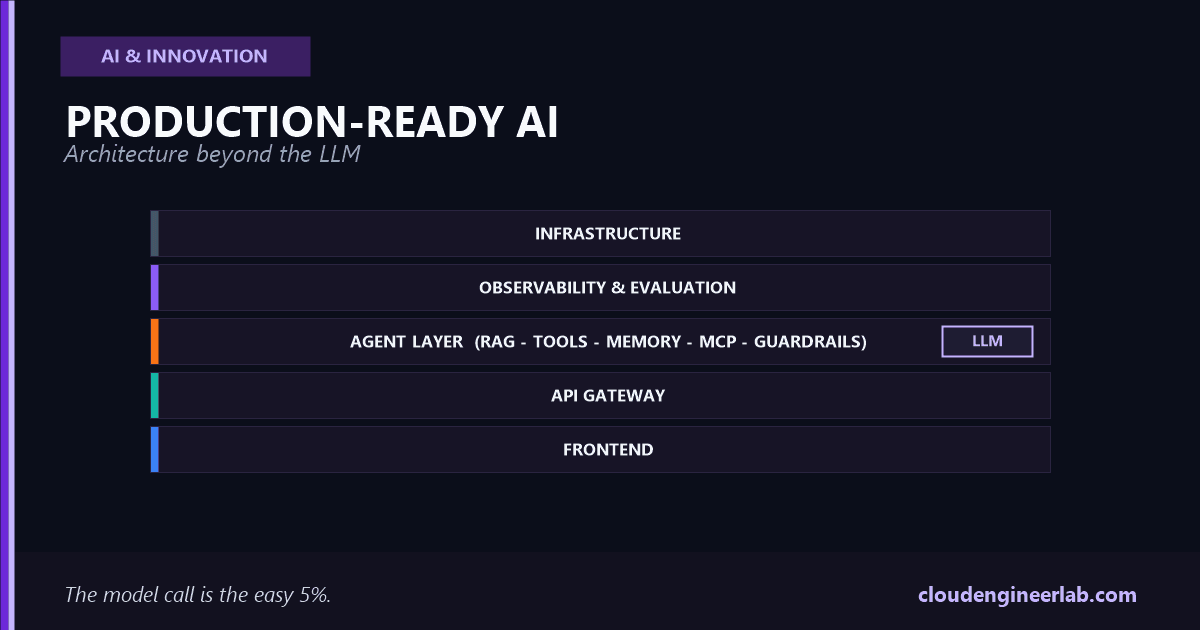
The Architecture
That's the backbone. The Agent Layer is where the real complexity lives, because it's not calling one thing, it's orchestrating several:
| Component | What it actually does |
|---|---|
| LLM | The reasoning engine itself. One component among several, not the whole system |
| RAG | Retrieves grounded, current information the model wasn't trained on, so answers are based on real data instead of memorized patterns |
| Tools | Structured actions the model can invoke, the mechanism covered in depth in AI Agents Are Not Chatbots |
| Memory | Persistent state across sessions, distinct from the conversation's working context |
| MCP | The standardized way tools, resources, and prompts actually reach the agent, covered in MCP Explained |
| Guardrails | Input and output checks that catch what the model itself won't reliably catch on its own |
| Evaluation | The measurement layer that tells you whether any of this is actually working, before your users find out the hard way |
Observability isn't a component, it's a lens
Notice where Observability sits in the diagram: wrapping the layers above it, not stacked as just another box. A production system needs visibility into the frontend, the gateway, the agent layer, and every component it orchestrates, all at once. Bolting on logging after the fact never gives you that.
Architecture
The core architectural decision is separation of concerns, drawn along the same lines that have always separated reliable systems from fragile ones, applied to a new kind of unreliable dependency: the model itself.
Keep the gateway thin and deterministic
Authentication, rate limiting, and routing should not depend on a model call to decide what happens. This layer needs to be fast, predictable, and testable the traditional way, because everything downstream of it is going to be comparatively slow and probabilistic.
Give the Agent Layer a real boundary
The orchestrator that runs the agent loop, decides which tools to call, and manages context is its own service, not logic scattered across the same codebase as your UI. This is what actually makes the loop from AI Agents Are Not Chatbots reliable to operate: one place owns the request from start to finish.
Treat Guardrails and Evaluation as cross-cutting, not inline afterthoughts
A guardrail check that only runs when someone remembers to call it isn't a guardrail, it's a suggestion. Wire input and output checks into the request path structurally, the same way you'd wire in authentication.
Security
Security for this architecture isn't a single control, it's the accumulation of decisions made at several of these layers together, and two dedicated deep dives already cover the hardest parts of it. Prompt Injection and Agent Hijacking covers what happens when untrusted content reaches the reasoning step before tool selection, exactly the RAG and Tools boundary in this diagram. AI Agent Identity covers who the system believes is actually making each call, and why that answer can't simply default to "whoever the user was."
What's specific to this architecture is the Guardrails layer itself:
| Guardrail type | What it catches |
|---|---|
| Input filtering | Content designed to manipulate the agent's reasoning before it ever reaches the model, the first line of defense against the injection patterns covered in the security deep dive |
| Output filtering | Responses that leak sensitive data, violate policy, or contain content that shouldn't reach the user, even if the model itself didn't intend to produce it |
| Tool-call validation | Checking a requested tool call against policy before execution, not just trusting that the model requesting it means it should happen |
Guardrails are a layer, not a prompt instruction
"Don't do X" in a system prompt is a request the model can be talked out of. A guardrail implemented as actual code, running outside the model's own reasoning, checking the model's input and output the way a linter checks code, cannot be argued out of doing its job.
Scalability
Scaling this architecture means scaling each layer according to what it actually bottlenecks on, not throwing more compute at the whole stack uniformly.
Keep the Agent Layer stateless where you possibly can
An orchestrator that doesn't hold session state in its own process memory can scale horizontally behind an ordinary load balancer. State belongs in an external store the agent reads and writes explicitly, the same principle covered under State in AI Agents Are Not Chatbots, and the same shift the MCP protocol itself made in its own July 2026 specification revision, removing protocol-level sessions specifically so servers could scale without sticky routing.
Queue long-running work instead of holding connections open
A task that might run for minutes shouldn't block a request thread waiting for it. Queue it, track its progress externally, and let the frontend poll or subscribe for updates, the long-running task pattern already covered architecturally in the agent series.
Scale RAG's retrieval layer independently
Vector search and document retrieval have entirely different scaling characteristics than the LLM call itself. Treat retrieval infrastructure as its own service with its own capacity planning, not an afterthought bolted onto the agent process.
Rate limit at the gateway, not the model provider's error response
Discovering your capacity limits from a 429 in production is backwards. Enforce your own limits at the gateway, informed by real usage patterns, before you ever hit someone else's.
Cost
Cost in this architecture is dominated by a small number of real, controllable levers, not a vague sense that "AI is expensive."
| Lever | What it actually saves |
|---|---|
| Prompt caching | Reused context, a frozen system prompt, a stable tool list, gets served at a small fraction of full input-token cost on a cache hit instead of full price every single call |
| Batching non-urgent work | Work that doesn't need an immediate response, bulk classification, offline evaluation runs, can process asynchronously at roughly half the real-time cost |
| Matching effort to the task | Not every request needs the model's deepest reasoning mode. Routine, well-defined tasks run cheaper at a lower effort setting without a meaningful quality loss; reserve the most expensive setting for the tasks that actually need it |
| Model tiering | A smaller, faster, cheaper model handling simple sub-tasks, with a more capable model reserved for the step that actually needs it, the same principle behind delegating to sub-agents in AI Agents Are Not Chatbots |
| Task budgets | Giving a long agentic loop a token ceiling it's aware of lets it pace itself and finish gracefully, instead of the alternative: an unbounded loop quietly running up a bill on a task that should have wrapped up ten steps earlier |
Measure before you optimize
Free wins come first: caching, trimming unnecessary context, and fixing a loop that retries too aggressively, before you ever reach for a cheaper model as a blanket policy. Judge cost per completed task, not per individual request. A cheaper model that needs three retries to finish the job isn't actually cheaper.
Monitoring
LLM observability extends traditional monitoring rather than replacing it: you still need the standard latency, error rate, and throughput signals, plus a genuinely new layer tracking prompts, tool calls, retrievals, guardrail triggers, and cost, correlated together per request, not scattered across disconnected dashboards.
Instrument with a standard, not a proprietary format
OpenTelemetry's GenAI semantic conventions give you a vendor-neutral way to capture model calls, token counts, and latency, so switching observability tools later doesn't mean re-instrumenting your entire codebase.
Run general infrastructure monitoring and LLM-specific tooling side by side
Standard APM tools were never built to inspect a prompt, a retrieved document, or a tool call's arguments. Purpose-built LLM observability platforms fill that specific gap; your existing infrastructure monitoring still covers everything else.
Track the metrics that are actually new here
Cache hit rate, tool-call success and error rates, cost per completed request, and time-to-first-token alongside your usual latency percentiles. A quietly dropping cache hit rate is often the earliest warning sign of a cost problem before the bill itself makes it obvious.
Evaluation
Evaluation is what separates "it worked when I tried it" from "it works." A production system needs both a pre-deployment eval suite and continuous evaluation of live traffic, because a model, a prompt, or an underlying data source can all drift after launch in ways a one-time test never catches.
Build a real eval set before you ship a change, not after something breaks
A representative set of inputs with known-good expected behavior, covering ordinary cases and the edge cases that have actually caused problems before, is what turns "I think this prompt change is an improvement" into a measured, defensible answer.
Sample production traffic continuously, not just at launch
A common, practical pattern is scoring a small percentage of live production traffic with a second model acting as a judge against a structured rubric, catching quality drift and hallucination rates in the wild that a static test suite, run once, will never surface.
Separate your training signal from your real test
If the same examples you tune a prompt against are the ones you also use to declare success, you're measuring how well you memorized the eval set, not how well the system actually generalizes to what a real user will ask.
Reliability
Tool calls fail, models occasionally decline a request, and networks have bad days. The difference between a reliable system and a fragile one is whether failure is something the architecture expects and handles, or something that takes the whole request down.
Not every failure deserves the same response
Retry a transient timeout, with backoff. Don't retry a permissions error or a malformed request; that just burns time confirming the same failure. This distinction, covered in depth under Failure Recovery in AI Agents Are Not Chatbots, applies just as much at the system level as it does inside a single agent loop.
Handle model-level failure explicitly, not as an unhandled exception
A model can decline a request for policy reasons, hit an output limit, or need to pause a long turn and resume it later. Each of those is a distinct, structured outcome your system should branch on deliberately, not a generic error your code happens to catch.
Build in graceful degradation, not just retries
A well-designed system can fall back to a different model when the primary one declines or is unavailable, serving a slightly different answer rather than no answer at all. That fallback path needs to exist before the moment you actually need it, not get improvised during an incident.
Set real timeouts, and expect to hit them
A request with no timeout isn't resilient, it's a slow leak. Every call to the model or a tool needs a timeout appropriate to what it's actually doing, and your system needs a defined behavior for what happens when that timeout fires.
Deployment
Deploying a change to a production AI system carries a risk traditional software deployments don't: the same code, calling the same model, can behave differently on inputs your test suite never anticipated, because the underlying behavior is probabilistic, not purely deterministic.
Pin model versions deliberately
Don't silently ride a provider's "latest" alias into production. A model update can shift behavior in ways your eval suite hasn't been re-run against yet. Upgrade on your own schedule, gated by your own evaluation results.
Roll out behind a canary, gated by evals, not just uptime
A traditional canary watches error rates and latency. A production AI canary needs to also watch the evaluation metrics from the section above, quality, hallucination rate, guardrail trigger rate, before a change reaches full traffic.
Keep a fast, real rollback path
When a prompt change or a model upgrade regresses quality in ways your canary metrics catch, the fix is reverting, immediately, not debugging live in production while real users see degraded answers.
Bringing It Together: A Production Readiness Check
| Discipline | The question to actually answer |
|---|---|
| Architecture | Is the Agent Layer a real, bounded service, or logic scattered across the codebase? |
| Security | Are guardrails enforced as code outside the model's own reasoning, not just a prompt instruction? |
| Scalability | Can the Agent Layer scale horizontally without session affinity? |
| Cost | Do you know your cost per completed task, and is caching actually landing hits? |
| Monitoring | Can you trace a single request across the frontend, gateway, agent layer, and every tool it called? |
| Evaluation | Is there a real eval suite gating changes, and continuous scoring on live traffic? |
| Reliability | Does a declined or failed model call have a defined, tested fallback path? |
| Deployment | Is the model version pinned, and is there a canary gated on quality metrics, not just uptime? |
If more than a couple of these are honest no's
That's not a reason to panic. It's a prioritized list. Fix the ones with the largest blast radius first, usually security and reliability, before the ones that mostly affect elegance, like deployment polish.
The Bottom Line
The model call at the center of this architecture is, genuinely, the easy part. Frontier models are good enough now that getting a reasonable answer out of a well-crafted prompt is rarely the hard problem. The hard problem, the actual engineering, is everything drawn around that call in the diagram at the top of this article: an architecture that separates concerns cleanly, security that doesn't depend on the model behaving itself, scaling that holds up under real load, cost that stays predictable, monitoring that tells you the truth before your users do, evaluation that catches drift, reliability that expects failure, and deployment that lets you move fast without betting the whole system on every change.
None of that shows up in a three-question demo. All of it shows up the first week a real system runs at real scale, and by then, it's a lot more expensive to build than it would have been to design in from the start.

Written by
Chetan Yamger
Cloud Engineer · AI Automation Architect · Modern Workplace Consultant
Cloud Engineer, AI Automation Architect, and Modern Workplace Consultant based in Amsterdam, Netherlands. Specializing in scalable, secure enterprise solutions with Microsoft Azure, Intune, PowerShell, and AI-driven automation using ChatGPT, Gemini, and modern LLM technologies.
Stay in the loop.
New articles, straight to you.
Deep-dive technical articles on Intune, PowerShell, and AI — no noise, no spam.
Discussion
Share your thoughts — your email stays private
Leave a comment