
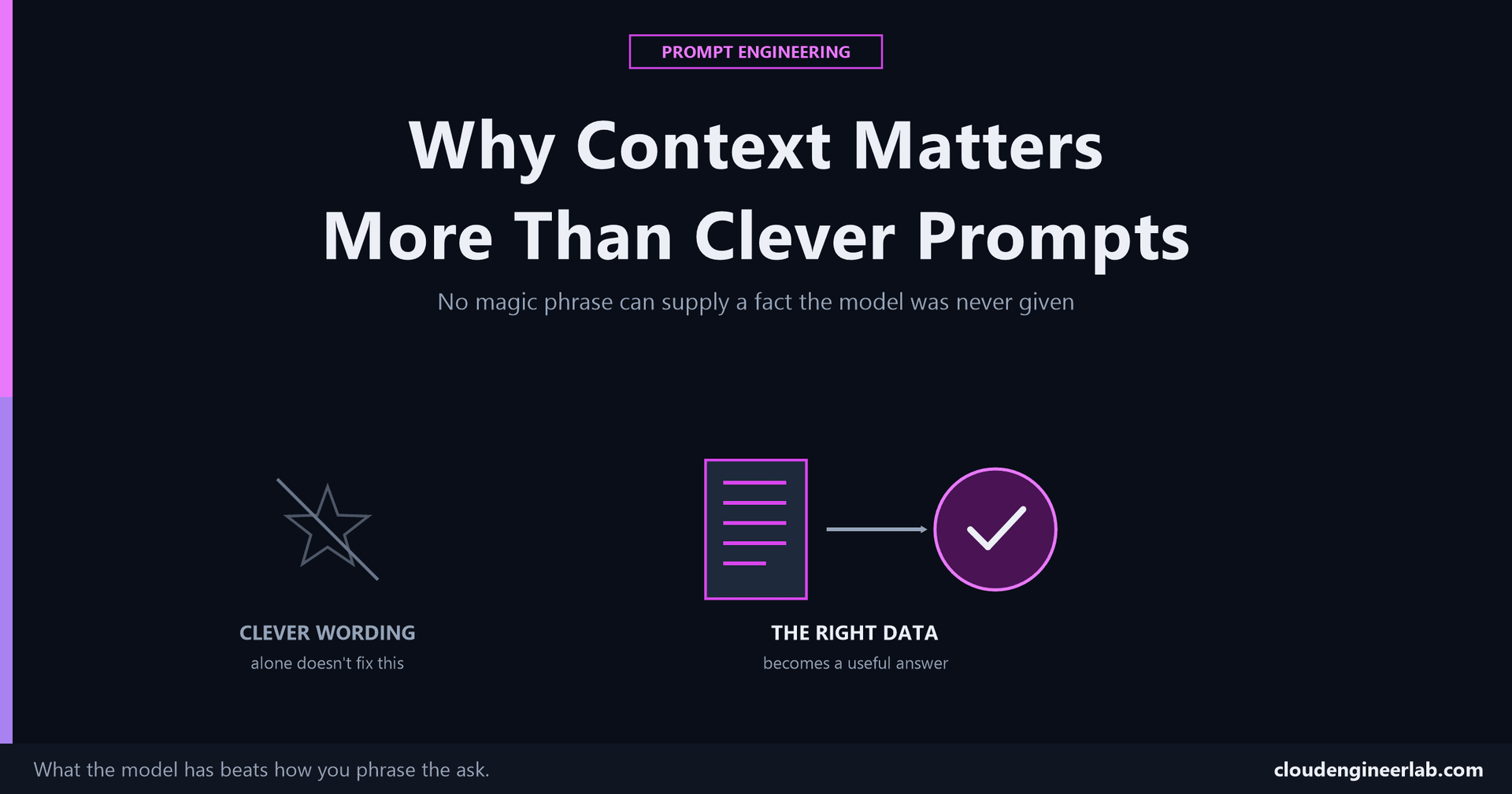
Why Context Matters More Than Clever Prompts
No magic phrase can supply a fact the model was never given. The real lever most people underuse isn't wording, it's what information actually reaches the model.
The internet is full of claims about magic phrases, tip the model $200, tell it your job depends on the answer, assign it an elaborate persona, and the output supposedly gets dramatically better. Some of these tricks have small, real effects. None of them can do what people actually need most of the time: supply a fact the model was never given in the first place.
Question
   +
Context
   +
Relevant Data
   +
Constraints
   ↓
LLM
   ↓
Useful Answer
This is additive, like the anatomy of a prompt
The same principle covered in full here: these four inputs combine into one request, they don't execute as separate steps. The point of this post is narrower, of the four, Context and Relevant Data usually matter more than how cleverly the Question itself is worded.
Why a Clever Prompt Can't Manufacture a Missing Fact
A language model answers by predicting what text plausibly comes next, based on its training and whatever you've actually put in front of it. If the specific fact you need, your company's actual VPN configuration, the exact error code your system just threw, isn't in the training data and isn't in your prompt, the model doesn't have access to it. Full stop.
What happens instead is not an error, it's a confident guess
The model still has to produce something. Without the actual fact, it produces the most statistically plausible-sounding answer instead, which is exactly the mechanism behind hallucination. A more cleverly worded question doesn't close this gap, it just asks the same under-informed model to guess more confidently.
What Clever Prompting Actually Does, and Its Real Limit
Role assignment genuinely works, but only within what the model already knows
Assigning an expert role narrows which part of the model's training the answer draws from. It can't narrow toward information that was never there.
Chain-of-thought genuinely helps reasoning tasks
Asking a model to reason step by step measurably improves accuracy on problems that require multi-step logic. It doesn't supply new facts, it improves how well the model uses the facts it already has.
Incentive-style tricks (tips, urgency, threats) have weak, inconsistent effects at best
Any real effect here is about tone and effort allocation in the response, not about the model suddenly knowing something it didn't know a moment ago.
Every one of these techniques operates on how the model uses what it has. None of them operate on what it has. That second lever, the actual information available at answer time, is the one this post is actually about.
A Worked Comparison
Task: diagnose why a specific device is failing Intune sync.
Clever prompt, no real data
"You are a senior Intune engineer with 15 years of experience. A device is failing to sync. Think step by step and give me a detailed diagnosis." This produces a genuinely well-organised list of common sync failure causes, DNS issues, certificate problems, connectivity, none of which is confirmed to be what's actually happening on this specific device.
Plain prompt, real data
"A device is failing Intune sync. Here's the actual error from the event log: Error 0x87D13B92, MDM Enroll: policy conflict detected, ConfigurationPolicy1234 and ConfigurationPolicy5678 assign contradictory Wi-Fi profiles. What's going wrong and how do I fix it?" This produces the actual answer, because the actual cause was in the prompt the whole time.
The second prompt isn't more cleverly worded, it's more informed
No persona, no step-by-step instruction, no incentive. Just the one piece of information that actually mattered, handed over directly. That's the entire difference in outcome.
This Is What Retrieval-Augmented Generation Exists to Automate
Manually pasting the right log snippet works for one question. It doesn't scale to a support team fielding hundreds of tickets, or a system that needs to answer questions against an entire internal knowledge base. Retrieval-Augmented Generation solves exactly this: automatically finding and injecting the relevant document or data into the model's context before it answers, so the right information reaches the model every time, without a human hunting for it and pasting it in manually first.
The connection worth remembering
RAG isn't a separate, unrelated AI engineering topic. It's the industrial-scale version of the exact principle this post is about: an LLM is only as good as the information actually in front of it, and building a system that reliably gets the right information in front of it matters more than any prompt wording choice downstream of that.
The Real Risk of Too Much Context, Too
More context isn't automatically better
Dumping an entire unfiltered log file or a whole document into the prompt "just in case" often performs worse than one relevant excerpt, the actual fact that matters can get diluted among irrelevant noise, and very long contexts measurably increase the odds the model weighs the wrong part of it. Relevant beats exhaustive.
The Checklist Before You Try to Write a Cleverer Prompt
Does the model actually have the fact it needs?
If the answer requires something specific to your system, your data, or your situation, and that specific thing isn't in the prompt, no wording fix solves it.
Is what you gave it the relevant piece, or everything you had?
Trim to what actually matters for this specific question, not a full dump of every document that might be tangentially related.
Only after both of those, consider wording
Role, structure, and reasoning instructions genuinely help once the model has what it needs. They're a real, worthwhile second step, just not the first one.
Summary
The one idea worth keeping
A model without the right information will still answer, confidently, and that confidence is exactly what makes a missing-context failure harder to spot than an obvious error. Before reaching for a cleverer prompt, check whether the actual gap is information, not wording. Most of the time, it is.
Have you had a case where the "smarter prompt" fix turned out to actually be a missing-context problem in disguise? That mislabeling is common, a wrong answer often gets blamed on the prompt when the real issue was what the model never saw. Drop a comment with what you found.

Written by
Chetan Yamger
Cloud Engineer · AI Automation Architect · Modern Workplace Consultant
Cloud Engineer, AI Automation Architect, and Modern Workplace Consultant based in Amsterdam, Netherlands. Specializing in scalable, secure enterprise solutions with Microsoft Azure, Intune, PowerShell, and AI-driven automation using ChatGPT, Gemini, and modern LLM technologies.
Stay in the loop.
New articles, straight to you.
Deep-dive technical articles on Intune, PowerShell, and AI — no noise, no spam.
Discussion
Share your thoughts — your email stays private
Leave a comment