
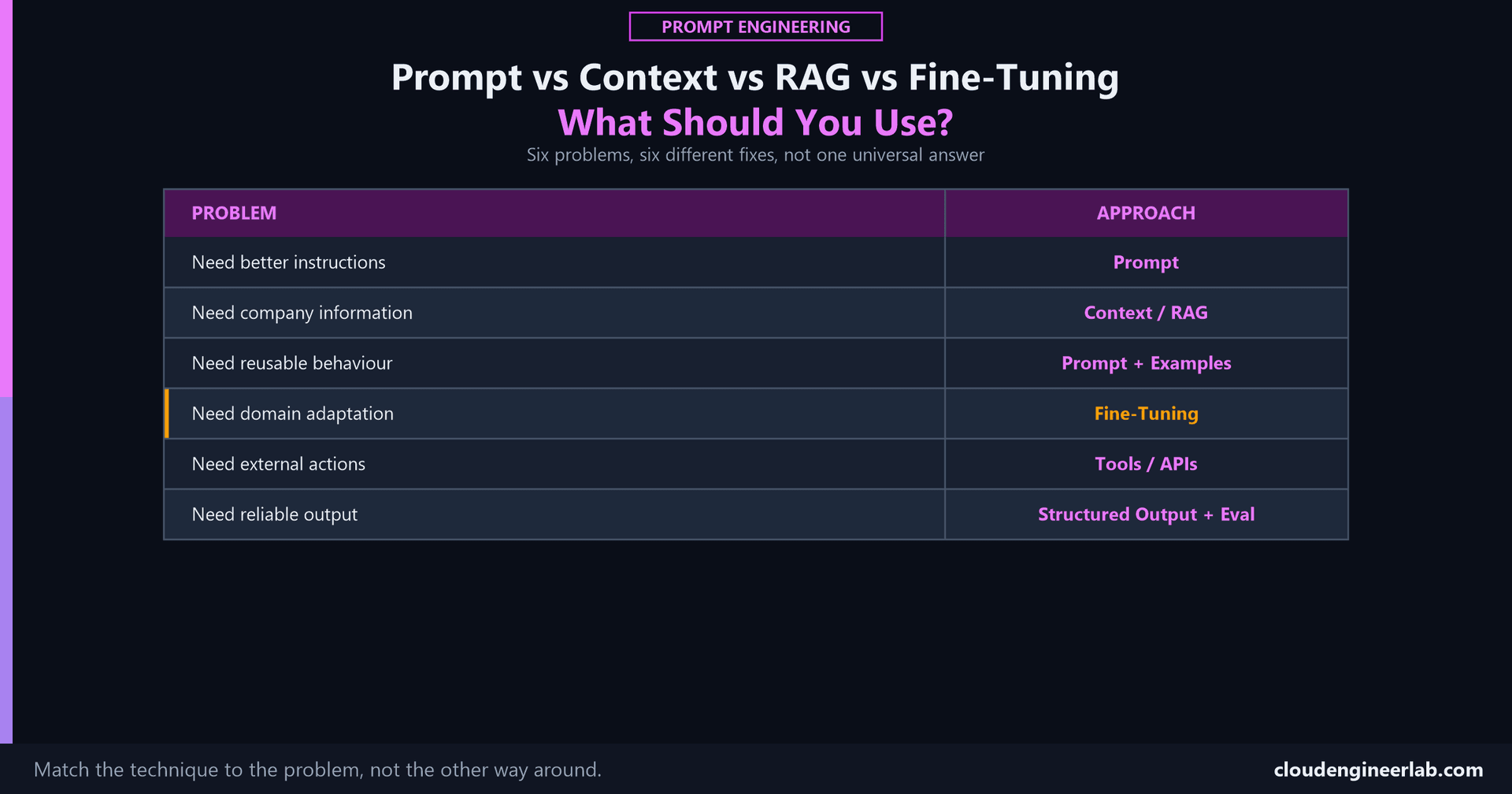
Prompt vs Context vs RAG vs Fine-Tuning: What Should You Use?
Six different problems get mistaken for each other constantly, and each one has a specific, usually cheaper fix than the one people reach for first.
"Should we fine-tune a model for this?" comes up in almost every AI planning conversation eventually, usually aimed at a problem a better prompt or a retrieval layer would have solved for a fraction of the cost. The prompt is not the product mapped the full pipeline a real application needs. This post answers the narrower, more practical question that comes right before that: for the specific problem in front of you, which piece of that pipeline is actually the fix?
The one sentence to remember
Every one of these techniques solves a genuinely different problem. Reaching for the wrong one doesn't just waste effort, it can look like it's working while leaving the actual problem completely unsolved.
The Decision Table
| Problem | Approach | Why |
|---|---|---|
| Need better instructions | Prompt | The model already knows the domain, it just wasn't told clearly what you want |
| Need company information | Context / RAG | The model was never trained on facts specific to you, and those facts change |
| Need reusable behaviour | Prompt + Examples | The same task, done consistently, across many different inputs |
| Need domain adaptation | Fine-tuning | A style, format, or vocabulary prompting can't reliably reproduce, at real volume |
| Need external actions | Tools / APIs | The system needs to do something, not just describe it |
| Need reliable output | Structured output + Evaluation | Downstream automation depends on a consistent, correct result |
Need Better Instructions: Prompt
If the model has the knowledge but the answer keeps missing what you actually wanted, that's not a knowledge gap, it's an instruction gap. The anatomy of a good prompt is the fix, and it's worth exhausting fully before assuming the problem is something bigger. A shocking number of "the AI doesn't understand our use case" complaints are actually "the prompt never told it."
Need Company Information: Context or RAG
Context and RAG are the same idea at two different scales
Context is pasting the specific information a single prompt needs directly into that prompt, covered in full here. RAG is the automated version of the exact same idea at scale, retrieving the right document from a much larger set at request time, built from scratch here and prompted correctly here. Neither one changes the model. Both just make sure it has the actual facts before answering.
The signal that you need one of these instead of a better prompt: the model is confidently wrong about something specific to your environment, your product, or your policies, information it could never have learned during training no matter how the question was phrased.
Need Reusable Behaviour: Prompt + Examples
A one-off answer needs a good prompt. The same task, done the same way, across hundreds of different inputs, needs a template and, where format or tone matters, few-shot examples showing exactly what "done right" looks like. This is still prompting, just prompting built to be reused rather than typed fresh every time.
Need Domain Adaptation: Fine-Tuning
The technique this whole article exists to put in its proper place
Fine-tuning actually changes the model's weights, training it further on examples specific to your task. That's a fundamentally different operation from everything else on this list, none of which touch the model itself, and it comes with real costs: a labeled dataset that has to be built and maintained, retraining every time something meaningful changes, and the loss of RAG's biggest advantage, updating what the model knows just by adding a document instead of running a new training job.
Fine-tuning earns its cost in a narrow set of cases: a very specific output style or format that extensive prompting genuinely can't achieve reliably, domain-specific vocabulary or patterns the base model handles poorly no matter how it's explained, and enough request volume that the upfront training cost pays for itself. It does not fix a knowledge gap, that's what RAG is for, and a knowledge gap is what most people asking about fine-tuning actually have.
The question that settles most of these debates
Would a good example in the prompt fix this? If yes, that's few-shot prompting, not a reason to fine-tune. Would giving the model the missing fact fix this? If yes, that's RAG, not a reason to fine-tune. Fine-tuning is what's left after both of those are honestly ruled out, not the first idea to reach for.
Need External Actions: Tools / APIs
None of the above lets a system actually do anything, only describe what should happen. Tool calling is what turns "this device should be flagged" into the device actually being flagged, and it's a completely separate concern from how well the model reasons about the request in the first place.
Need Reliable Output: Structured Output + Evaluation
This one isn't optional once anything downstream depends on the result
A consistent, parseable output format and a real test dataset proving a specific version actually works apply regardless of which other techniques are in play. A perfectly retrieved document and a perfectly fine-tuned model can still produce an answer nothing downstream can reliably parse or trust.
Ask These Questions in Order
Is the problem unclear instructions?
Fix the prompt first. This is the cheapest possible fix and the most commonly skipped diagnosis.
Does it need facts the model wasn't trained on, and do those facts change?
Context for a single use, RAG once the source material is too large or too current to paste in every time.
Does it need to behave the same way across many different inputs?
A template, with examples if format or tone consistency matters.
Have prompting and retrieval genuinely been exhausted, and does volume justify the cost?
Only now does fine-tuning belong in the conversation.
Does it need to actually do something in the real world?
Tools, regardless of anything else on this list.
Does anything downstream consume this output automatically?
Structured output and evaluation, always, on top of whatever else applies.
A Worked Example: These Aren't Mutually Exclusive
Most real systems use several of these at once
The BitLocker compliance system built up across this series uses nearly every technique on this list simultaneously, not one chosen instead of the others: the anatomy's prompt structure for clear instructions, Context for the specific tenant's environment, RAG if the compliance policy itself lives in a longer internal document, tool calling to actually flag the device, and structured output plus evaluation to make the result something a script can trust. Fine-tuning never enters this picture, because nothing about the task needed the model's own weights to change, every problem in it was solvable with information and structure.
The Bottom Line
These six techniques aren't competing answers to one question. They're specific fixes to six different problems, and the entire practical skill is diagnosing which problem you actually have before reaching for a fix. Most of what gets blamed on "the model isn't good enough" turns out to be an instruction problem, a missing-fact problem, or a missing-structure problem, all of them cheaper and faster to fix than the model itself.
The audit worth running before your next AI feature proposal
Write down the actual problem in one sentence, then match it against the six rows in the table above. If more than one applies, that's normal, most real features need several. If the answer that comes back is "fine-tuning" before anything else has been tried, that's usually the table telling you to check your diagnosis again.
Which of these six have you reached for when a different one was actually the fix, fine-tuning for a knowledge gap, or a longer prompt for something retrieval should have handled? Drop a comment with what the real problem turned out to be.

Written by
Chetan Yamger
Cloud Engineer · AI Automation Architect · Modern Workplace Consultant
Cloud Engineer, AI Automation Architect, and Modern Workplace Consultant based in Amsterdam, Netherlands. Specializing in scalable, secure enterprise solutions with Microsoft Azure, Intune, PowerShell, and AI-driven automation using ChatGPT, Gemini, and modern LLM technologies.
Stay in the loop.
New articles, straight to you.
Deep-dive technical articles on Intune, PowerShell, and AI — no noise, no spam.
Discussion
Share your thoughts — your email stays private
Leave a comment