
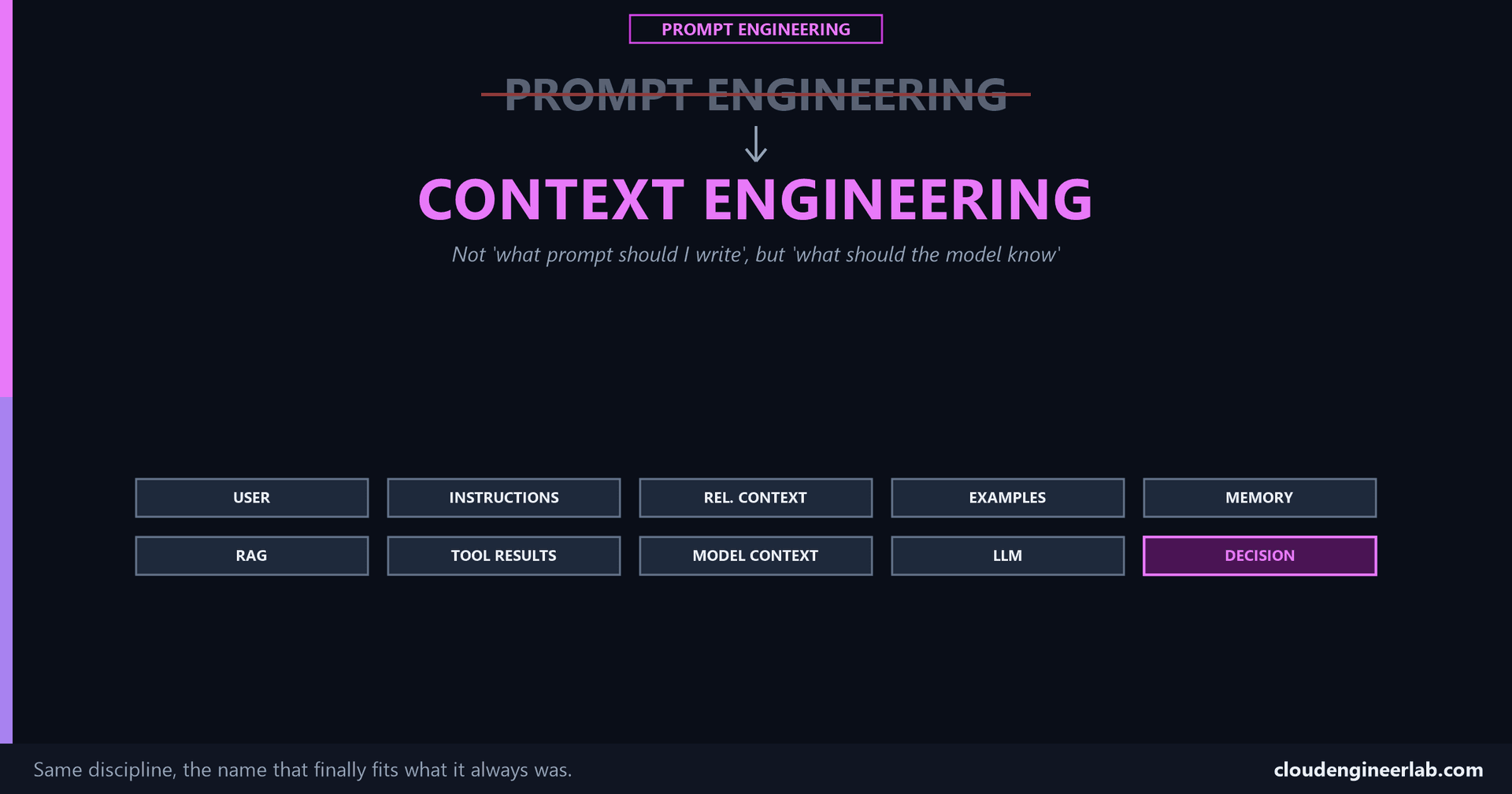
From Prompt Engineering to Context Engineering
The field stopped asking 'what prompt should I write' and started asking 'what should the model know at the moment it decides.' Same eighteen posts, one honest rename.
Eighteen posts into this series, a pattern is obvious in hindsight: almost none of them were actually about finding cleverer words. They were about what information reaches a model, in what shape, from which source, with what guarantee of trust. That's the shift the field itself has been making, and it finally has a name that fits better than "prompt engineering" ever did: context engineering.
The one question that changed
Not "what prompt should I write?" but "what information should the model have at the moment it makes a decision?" Everything in this post, and quietly, everything in the eighteen posts before it, is an answer to the second question wearing the first question's name.
The Architecture
Notice what's doing the work in this diagram
Instructions is one box out of ten. In the old framing, it was the entire diagram, everything else was implicit, assumed, or somebody else's problem. Context engineering just draws the other nine boxes that were always there, doing most of the actual work.
What Actually Changed
Prompt engineering optimized a string. Context engineering optimizes a payload
"Prompt engineering," taken literally, describes tuning the words in one text field until the output looks right. "Context engineering" describes deciding what belongs in the model's context window at all, instructions, facts, examples, history, retrieved documents, tool output, and in what order, before a single word of phrasing is even considered. The second question was always the one that actually determined the outcome. The first one just had a catchier, smaller name.
| Prompt Engineering (the old frame) | Context Engineering (the current one) | |
|---|---|---|
| The question asked | What should I type? | What should the model know right now? |
| The unit of work | A string | An assembled payload from multiple sources |
| Where quality comes from | Clever phrasing | Correct, current, properly scoped information |
| What gets tested | The wording | The whole context, information plus structure |
| What gets versioned | A prompt template | The context-assembly pipeline itself |
Model Context: The Artifact That Actually Matters
This is the piece the old framing never named
Model Context, the assembled combination of instructions, relevant context, examples, memory, RAG results, and tool output that actually reaches the model, is the real deliverable. Not the instruction template alone. Prompt versioning and prompt evaluation are only doing their real job once they're tracking and testing this whole assembled payload, not just the fixed part of it that happened to be typed by a person.
A wrong decision downstream is very often not a wrong instruction. It's a Model Context that was missing a document, stale on a fact, or carrying a tool result that should never have been treated as trustworthy, exactly the failure mode covered here. Debugging "the prompt" when the actual defect is in what got assembled around it is looking in the wrong place entirely.
Decision, Not Just Response
The last box changed on purpose
Older diagrams end at "Response," text coming back to a person. This one ends at Decision, because the same architecture now routes into a tool call, an agent's next step, or a real action just as often as it produces a sentence. Context engineering is the discipline for both, because both are the same problem: get the right information in front of the model before it has to decide anything.
This Was Already the Whole Series, Under Its Old Name
Read back through it with this frame
The anatomy's six ingredients were never really about a prompt's wording, they were the first version of this same architecture: Role and Task as Instructions, Context and Constraints as Relevant Context, Examples as Examples. Why context matters more than clever prompts said this outright, months before this post put a name on it. RAG, tool calling, and the instruction hierarchy are three of this diagram's boxes, each already covered in full. "Prompt engineering" was always the smaller name for a bigger discipline. This is just the field, and this series, catching up to saying so directly.
The Full Series, Now Under Its Actual Name
Every post in this arc, read as context engineering
Why prompts work → the anatomy → zero-shot vs few-shot → why context matters → templates → chaining → output format → does length help → evaluation → versioning → injection → who controls the AI → tool calling → RAG → reliable code → safe PowerShell → the prompt is not the product → which technique to use → this post, the name for what all eighteen of them were actually building toward.
The Bottom Line
Nothing about the underlying skill changed. Structure, examples, grounding, tools, evaluation, safety, all of it is exactly what the last eighteen posts already covered in depth. What changed is the name, and names matter more than they get credit for, because "prompt engineering" pointed everyone toward the one box in this diagram that was never actually the hard part. "Context engineering" points at all ten, which is where the real work, and the real failures, have been living the entire time.
The question to carry forward from here
Next time something an AI system produces is wrong, resist the instinct to ask "what prompt should I change." Ask instead: what did the model actually have in its context at the moment it decided this, and which of the ten boxes in this diagram was missing, stale, or wrong. That question gets to the real cause faster, almost every time.
Has renaming this in your own head, from "the prompt" to "everything the model actually had available," changed where you look first when something goes wrong? Drop a comment with what that shift actually changed about how you debug an AI system.

Written by
Chetan Yamger
Cloud Engineer · AI Automation Architect · Modern Workplace Consultant
Cloud Engineer, AI Automation Architect, and Modern Workplace Consultant based in Amsterdam, Netherlands. Specializing in scalable, secure enterprise solutions with Microsoft Azure, Intune, PowerShell, and AI-driven automation using ChatGPT, Gemini, and modern LLM technologies.
Stay in the loop.
New articles, straight to you.
Deep-dive technical articles on Intune, PowerShell, and AI — no noise, no spam.
Discussion
Share your thoughts — your email stays private
Leave a comment