
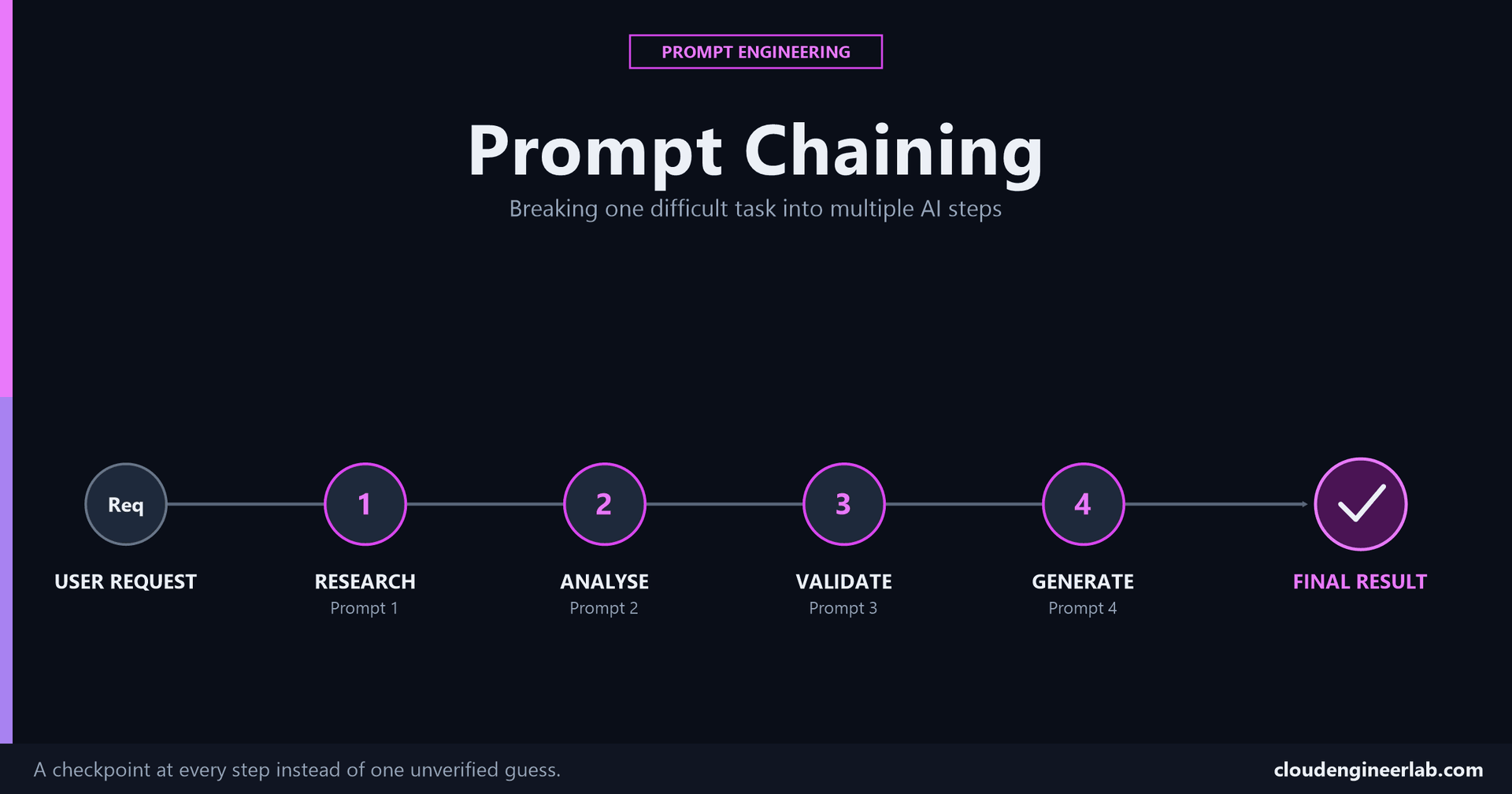
Prompt Chaining: Breaking One Difficult Task Into Multiple AI Steps
One giant prompt asks a model to research, analyse, validate, and generate all at once, with no chance to catch a mistake before it reaches the final answer. Chaining fixes that.
Prompt templates mentioned this in passing: once a task is a template, the output of one can feed the variables of the next. This is that idea in full. A genuinely difficult task rarely survives being crammed into one prompt, not because the model isn't capable, but because one prompt means one shot, with no checkpoint to catch a mistake before it's already baked into the final answer.
User Request
     ↓
Prompt 1
Research
     ↓
Prompt 2
Analyse
     ↓
Prompt 3
Validate
     ↓
Prompt 4
Generate
     ↓
Final Result
Why Split One Task Into Four Prompts
One giant prompt means one giant, unchecked guess
Ask a model to research, analyse, validate, and generate a final document all in a single response, and a mistake in the research step (a fact half-remembered, a detail invented to fill a gap) flows straight through analysis and into the final output, with nothing along the way positioned to catch it. By the time you're reading the result, the error is already indistinguishable from the correct parts.
Splitting into a chain fixes this three ways:
Each step gets its own tailored anatomy
Role, Context, Task, Constraints, and Output Format don't have to be identical across a whole workflow. A Research prompt and a Validate prompt should genuinely have different roles, "thorough researcher" versus "skeptical fact-checker", because they're doing different jobs.
You get a checkpoint between every step
You can actually read the Research output before it becomes the input to Analysis, and catch a problem there instead of three steps later, buried inside a polished final document that reads as confident whether or not it's correct.
Debugging becomes possible
If the final result is wrong, you can tell which specific step produced the bad output, instead of treating one long response as a single black box you either accept or discard entirely.
A Worked Chain: Writing an Incident Postmortem
Task: turn a rough timeline of a three-hour outage into a finished postmortem document.
Prompt 1, Research: extract the facts, nothing else
Role: "a technical writer extracting facts from raw notes." Task: "list every timestamped event from this incident timeline, with no interpretation or analysis." Output: a plain chronological list. This step's only job is accurate extraction, not conclusions.
Prompt 2, Analyse: find the root cause
Role: "a senior site reliability engineer." Context: the Research step's output, fed in directly as this prompt's {context} variable. Task: "identify the root cause and contributing factors from this timeline." This step never sees the original raw notes, only the cleaned facts, which is deliberate, it can't get distracted by noise the Research step already filtered out.
Prompt 3, Validate: try to break the analysis
Role: "a skeptical reviewer whose job is to find unsupported claims." Task: "check this root-cause analysis against the original timeline and flag anything asserted without direct evidence." This step exists specifically to catch the Analysis step's most common failure, a plausible-sounding root cause the actual timeline doesn't fully support.
Prompt 4, Generate: produce the final document
Role: "an IT operations lead writing a postmortem for leadership." Context: the validated analysis. Output: the finished postmortem in the organisation's standard format. Only now, after two checkpoints, does the workflow produce something meant to actually be read and trusted.
This is templates, chained
Each of these four steps is a template on its own, and the output of one becomes the {context} value for the next. Nothing about this requires new tooling to try manually, copy the output of Prompt 1 into Prompt 2's context variable, and so on down the chain.
When to Chain, and When One Prompt Is Actually Enough
| Chain it if | One prompt is fine if |
|---|---|
| The task has genuinely distinct sub-skills (research vs. judgment vs. writing) | The task is one skill applied once |
| A wrong intermediate step would be expensive or hard to catch later | Mistakes are cheap and easy to spot in the final output anyway |
| You want a specific checkpoint before an expensive or risky final action | The task is low-stakes enough that a single best-effort answer is fine |
| Different steps genuinely need different roles or constraints | The same role and constraints apply throughout |
Chaining has a real cost
Every extra step is extra latency and extra token cost. A four-step chain for a task simple enough to get right in one prompt is pure overhead, the same discipline as choosing few-shot only when it earns its cost applies here too.
Where This Becomes an AI Agent
Everything above is a manual chain, a person copying each output into the next prompt. An AI agent is what happens when that exact chaining logic runs itself: the system decides how many steps are needed, loops back to an earlier step if validation fails instead of always moving forward, and calls real tools between steps instead of only passing text.
The Planner, Worker, Reviewer pattern is this exact chain, automated
A multi-agent system built around a Planner, Worker, and Reviewer is structurally the same Research-Analyse-Validate-Generate shape, roles assigned to distinct stages, a validation step with the authority to reject and loop back, just running as an autonomous system instead of a person manually pasting outputs between prompts. The full mechanics of what happens inside that loop are covered here. If manually chaining four prompts for a recurring task starts feeling like something that should just run itself, that instinct is correct, and it's exactly the problem agents exist to solve.
Summary
The one idea worth keeping
A hard task rarely fails because the model isn't capable of any individual step. It fails because one prompt asked it to do every step at once, with no checkpoint in between. Breaking the task into a chain, each link with its own role and its own job, turns one unverifiable guess into a series of checkpoints you can actually inspect, and it's the same structural idea that scales all the way up to a fully autonomous agent.
Have you manually chained prompts for a task before realising, partway through, that you'd basically built an ad hoc agent by hand? That's a very common on-ramp into agentic systems. Drop a comment with the task that got you there.

Written by
Chetan Yamger
Cloud Engineer · AI Automation Architect · Modern Workplace Consultant
Cloud Engineer, AI Automation Architect, and Modern Workplace Consultant based in Amsterdam, Netherlands. Specializing in scalable, secure enterprise solutions with Microsoft Azure, Intune, PowerShell, and AI-driven automation using ChatGPT, Gemini, and modern LLM technologies.
Stay in the loop.
New articles, straight to you.
Deep-dive technical articles on Intune, PowerShell, and AI — no noise, no spam.
Discussion
Share your thoughts — your email stays private
Leave a comment