
From Endpoint Management to Endpoint Engineering: How the Role Is Changing
The routine parts of endpoint admin are being automated away, by Microsoft itself. What's left is a genuinely different job, and most job titles haven't caught up yet.
"I manage devices" used to be a complete job description. It isn't anymore, and the reason isn't that the job got harder in some vague, generic way. It's specific: the parts of that old job that were pure manual labour, clicking through consoles, repackaging the same app for the fifth time, checking one device at a time, are being absorbed by the platform itself. What's left over is a different job, one this entire site has effectively been documenting one post at a time without ever naming it directly. Here's the name: endpoint engineering.
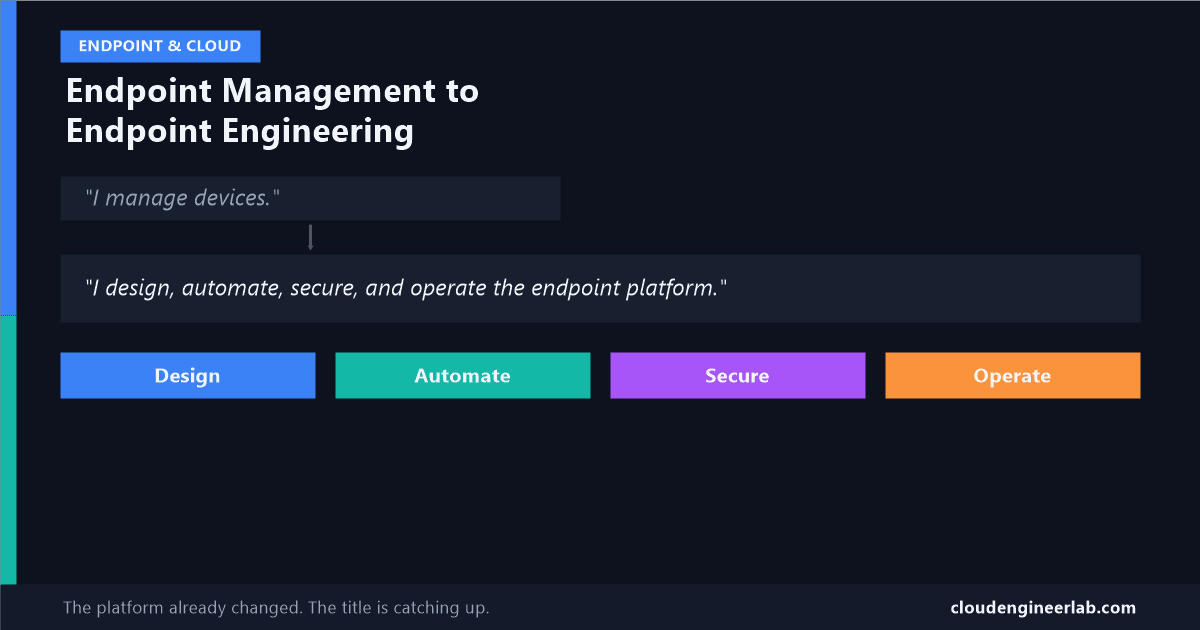
"I manage devices."
        ↓
"I design, automate, secure, and operate the endpoint platform."
Why This Isn't Just a Rebrand
This shift is backed by specific, real changes to the platform itself, not a vague industry mood. Security Copilot's Policy Configuration Agent now drafts entire configuration policies from a plain-language requirement. The Enterprise App Catalog has grown to roughly 600 apps with genuine auto-update, eliminating the manual packaging cycle for anything common enough to be in it. Autopatch now handles update rings and hotpatching with far less manual ring-tuning than it used to need.
None of that is speculation about AI eventually changing the job. It's already shipped, and it specifically targets the repetitive, manual layer of the old job description. It's also worth being precise about what it doesn't remove: the parts of the job requiring judgment are actually getting harder, not easier. Wiring Defender's risk score into an Intune compliance policy is a decision Microsoft still leaves entirely to a human. Knowing that Exchange transport rules still have no Graph coverage at all and choosing the right module for the job anyway is judgment, not automation. What's left isn't less work, it's different work, concentrated in four capabilities the old job never really demanded on their own.
The Four Verbs
Design
The management mindset asks "how do I configure this policy." The engineering mindset asks "where does this policy fit in the whole trust chain, and what does it depend on." That's the actual difference between a working Conditional Access policy and one that quietly assumes a signal it never actually checked for. It's the difference between deploying Intune, Entra ID, and Defender as three separate tools and building the correlated architecture they were designed to form together. Design is the discipline of understanding the whole stack well enough to know which layer actually owns a given problem, laid out fully in the nine-layer journey from a person to their data.
This also means knowing what a design deliberately leaves out. Choosing dependencies over supersedence, or the reverse, is a small example of the same skill a full Zero Trust architecture requires at a much larger scale: picking the right relationship between two things, not just making them both technically work.
Automate
The management mindset treats PowerShell as a fallback for when the portal can't do something. The engineering mindset treats the portal as the fallback, for the one-off task nobody's bothered to script yet, and PowerShell plus Graph as the primary way work actually gets done. This isn't about knowing more cmdlets. It's the difference between a script that works once and one built to run unattended for years, and eventually a whole control plane instead of three separate admin habits.
It also means knowing where automation should actually run, not just that it should exist. A recurring scheduled job, an event that needs an instant reaction, and a workflow that needs a human approval step are three different problems with three different correct answers, and treating them as interchangeable is its own kind of unfinished engineering.
Secure
The management mindset treats a green "Compliant" badge as the finish line. The engineering mindset knows compliance is a checklist, not a security guarantee, and understands specifically where Defender's risk scoring has to be wired into that checklist before it means anything about active threats. This is judgment, not just knowledge: knowing which signal actually answers the question being asked, instead of reaching for the first dashboard that has a colour on it.
It extends to identity too. Knowing that user risk and sign-in risk need separate Conditional Access policies because they call for different remediation isn't a setting you configure once and forget, it's a judgment call that has to hold up as the tenant changes.
Operate
The management mindset reacts to tickets as they arrive. The engineering mindset builds the diagnostic model first, knowing exactly which of nine layers actually owns a given failure before opening a single log, and treats a script that silently stopped running as seriously as one that's actively producing wrong answers. Operating a platform means the platform tells you when it's unhealthy. Managing a device list means you find out when someone complains.
Operating well also means trusting the device over the dashboard. A device that's genuinely fine but shows stale data in the portal, because of a certificate nearing its 40-day cliff or a scheduled task that quietly stopped existing, looks identical to a real failure until you know exactly where to check first.
Four Scenarios, Two Ways
The verbs above are abstract on purpose. Here's what they actually look like on an ordinary Tuesday.
Management way: Create the user in the Entra portal. Switch to the M365 admin centre, assign a licence. Switch to the Intune portal, check group membership synced. Switch to the Exchange admin centre, delegate mailbox access to their manager. Miss the last step because it's a different console with a different mental model. The new hire can't see shared calendars on day one, and IT finds out when they complain.
Engineering way: One onboarding script, creating the user and assigning the licence through Graph, adding group membership through the same call pattern, and delegating mailbox permissions through Exchange Online PowerShell in the same run. Three systems, one script, nothing forgotten because forgetting isn't a step a script does by accident.
What Doesn't Change
None of this replaces the fundamentals, it's built directly on top of them, and skipping straight to architecture without the mechanics underneath it produces exactly the kind of design that looks correct and fails in production. Understanding what actually happens after uploading a .intunewin file, why detection rules report the wrong answer, and what actually keeps a device talking to Intune at all isn't legacy knowledge on its way out. It's the ground truth every automated, correlated, self-monitoring system above it is quietly built on. An engineer who can design a control plane but can't explain why a specific device stopped checking in isn't actually more advanced, they've just skipped a step.
Engineering without mechanics is just architecture theatre
Every automation, every correlated security signal, every self-healing pipeline in this shift is still, underneath, a specific API call against a specific mechanism that can fail in specific, knowable ways. The verbs changed. The requirement to actually understand the platform did not.
A Practical Self-Assessment
| Capability | Management mindset | Engineering mindset |
|---|---|---|
| Configuring a policy | Clicks through the portal, tests on one device | Understands which layer the policy actually belongs to and what it depends on |
| Deploying an app | Repackages it by hand from a vendor installer | Checks the catalog first, builds a pipeline for what's left |
| Reading "Compliant" | Treats it as "this device is safe" | Knows it means "this device passed a checklist," and checks what's actually wired into that checklist |
| A device with a problem | Opens a ticket and starts guessing | Knows which of nine layers to check first, and usually finds the answer by the third |
| A recurring task | Does it again, manually, next month | Has already scripted it, hardened it, and forgotten it's even running |
If most of your own answers land in the left column, that's not a criticism, it's where the entire industry sat until very recently. The right column isn't a different skill set from scratch. It's the same platform knowledge, aimed one level higher.
Making the Shift, One Habit at a Time
Nobody moves down this list in a weekend, and trying to adopt all four verbs at once is a good way to adopt none of them properly. Pick one, and let it pull the others along.
Automate the task that annoys you the most, not the most impressive one
Not the flashiest script, the one you already resent doing manually. That resentment is motivation the impressive projects don't give you, and it's usually a smaller task than it feels like once you actually sit down to script it.
Read the log before you guess
Next time something fails, open IntuneManagementExtension.log or run dsregcmd /status before touching the portal at all. Do this five times and it stops being a deliberate discipline and starts being how you naturally start every investigation.
Audit one Conditional Access policy for a hidden assumption
Pick your most important policy and check whether it's really reading more than one signal, or quietly relying on device compliance alone and calling that a complete strategy.
Take one script past the finish line you usually stop at
If you have a script that works but has no error handling, no logging, and no retry logic, push it through the remaining stages instead of starting a new one. Finishing one properly teaches more than starting five.
None of these require permission from anyone, a new licence, or a project charter. They're things you can start before the end of the week, and each one is a small, direct rehearsal of the verb it belongs to.
The Title Hasn't Caught Up Yet
Most job postings still say "Endpoint Administrator" or "Intune Engineer" without distinguishing which of these two jobs they actually mean. That gap is temporary. The platform itself has already moved, Security Copilot agents drafting policy, catalog apps auto-updating themselves, XDR correlating signals across three products at once, none of that was designed for someone whose job is clicking through a console. It was built for someone designing, automating, securing, and operating a platform. The job title will catch up eventually. The actual work already has.
Where do you feel the pull most strongly in your own role, design, automation, security, or operations? For me it was automation first, everything else followed once scripting stopped being optional. Drop a comment below with where the shift actually started for you.

Written by
Chetan Yamger
Cloud Engineer · AI Automation Architect · Modern Workplace Consultant
Cloud Engineer, AI Automation Architect, and Modern Workplace Consultant based in Amsterdam, Netherlands. Specializing in scalable, secure enterprise solutions with Microsoft Azure, Intune, PowerShell, and AI-driven automation using ChatGPT, Gemini, and modern LLM technologies.
Stay in the loop.
New articles, straight to you.
Deep-dive technical articles on Intune, PowerShell, and AI — no noise, no spam.
Discussion
Share your thoughts — your email stays private
Leave a comment